

Zapout™: Tap Away Puzzle
- Reviews
- 4.8
- Version
- 1.2.3
- Installs
- 1,000,000+

Screenshots
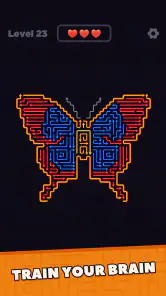
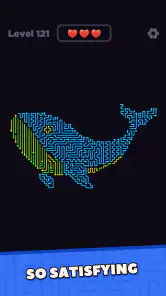
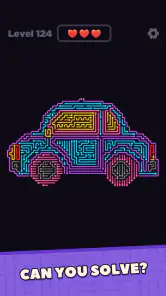
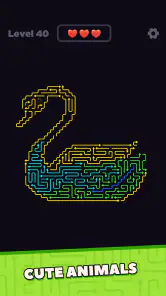
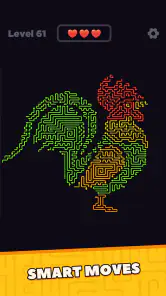
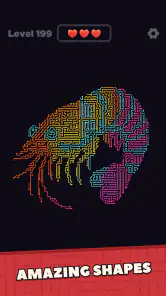
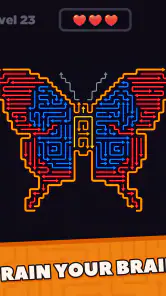
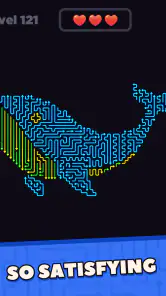
 Analysis by Frivlyz
I went into Zapout™ expecting a small, easygoing puzzle game, and that is exactly where it makes the best first impression. The basic idea is simple: you tap arrows to clear them from a maze, but each move depends on whether the path ahead is open. That gives the game an immediately understandable goal without making the opening feel empty. I could begin thinking about direction, order, and blocked routes almost at once.
It is a free puzzle game from Flyfox Games, rated for Everyone, and it feels designed for short sessions rather than long, demanding campaigns. The store page describes it as a brain-training and relaxing experience, but I think its real appeal is the balance between those two moods. Some boards invite quick decisions, while others make me pause and inspect the arrangement before committing to a tap.
The game has attracted a 4.8 average from around 92 thousand ratings, with more than a million installs. Those figures suggest that its straightforward format has found a broad audience, but they do not mean every puzzle fan will enjoy it equally. If you want a deep logic system with elaborate rules, a story, or a large strategic layer, this may feel too focused. If you want something you can understand in seconds and play whenever you have a spare moment, it is much easier to recommend.
What playing Zapout™ feels like from the first tap
The first thing I noticed is that the game communicates through the board itself. The arrows show the possible direction of movement, and the maze-like arrangement creates the challenge. There is no need to learn a long vocabulary of special pieces before making progress. The puzzle asks a practical question: which arrow can leave safely now, and which one is still trapped by the surrounding layout?
That makes the opening especially friendly for someone who does not usually play puzzle games. I did not need to memorize complicated rules or study a tutorial for a long time. I could look at the screen, identify an arrow with a clear route, and test my understanding through a single action. That first successful removal is important because it turns the game from an abstract board into something I could read.
The experience is also more about sequencing than speed. Tapping the first visible arrow is not always the best choice. A piece may appear ready to go, while removing another one first creates the space needed for several later moves. I found that the most satisfying moments came from recognizing a chain of possibilities rather than simply clearing whatever looked easiest.
For a first-time player, my advice is to resist the urge to tap randomly. Spend a few seconds scanning the edges and the open lanes. Look for arrows whose direction points toward an unobstructed exit, then consider whether removing one piece will expose another. This small habit makes the boards feel less mysterious and helps prevent the impression that success depends on luck.
Gaming Stories You May Enjoy

Dancing Road Turns Short Breaks Into a Test of Rhythm and Timing

Super Stylist Makes Every Outfit a Test of Taste and Patience

Dominoes on Your Terms: Who Should Play and Who Should Pass

Pokémon GO Makes the Familiar World Feel New

Chess.com Turns Rematches Into Rivalries, but Community Has Its Costs

Archery Battle 3D Review: Sharp Aiming, Unclear Feedback
The relaxing side of the game comes from that limited scope. I can start a puzzle without preparing for a long commitment, and the central action remains clear even when the layout becomes more demanding. At the same time, the simplicity can become repetitive if I play for too long without a break. I see Zapout™ as a game that works best in compact visits, where the clean rule set stays fresh.
Getting started without overthinking the setup
Since the game is free and supports Android 7.0 or later, the practical entry barrier is low for many Android users. After installing it, I would begin with the first available puzzle and focus on learning the visual language rather than searching through every option. The important preparation is mental: understand that an arrow is not merely a piece to remove, but a move that changes the space available to everything around it.
I also recommend playing the first few boards with notifications and other distractions set aside if possible. That may sound minor, but the game’s challenge depends on noticing relationships between nearby arrows. A quick interruption can make it easy to forget which route you were evaluating. For a short puzzle, losing that thread can be more annoying than the difficulty itself.
One useful way to approach the opening boards is to divide the maze into small regions. I look at the outer edges first, then the central cluster, and finally the spaces that may open after an early removal. This prevents me from treating the whole screen as one confusing mass. It is not a special mode or hidden tool; it is simply a reading method that makes the board easier to understand.
The current version is 1.2.3, and the game’s presentation stays centered on the tap-away puzzle rather than surrounding it with a complicated setup routine. That suits the audience well. I would not install it expecting a customizable puzzle laboratory or a large collection of separate game systems. Its strength is that it gets me to the main decision quickly.
There is one practical point worth keeping in mind before settling in. In-app purchases are listed at $7.99 per item. The game itself is free to start, but anyone who prefers an entirely purchase-free experience should consider that part of the overall fit. I would approach it as a free casual game first and decide later whether any optional spending feels worthwhile, rather than assuming every player will need to pay to enjoy the core idea.
The first meaningful success is about reading space
My first satisfying success did not come from tapping quickly. It came from identifying an arrow that had a clean route and realizing that its removal would make the next decision easier. That is the moment I think new players should look for. The goal is not just to make one piece disappear; it is to understand why that move improves the board.
When I face a new arrangement, I use a simple three-step check. First, I find arrows pointing toward open space. Second, I ask whether another piece blocks that route farther ahead. Third, I consider what area will become available after the tap. This approach turns a vague visual puzzle into a sequence of manageable questions.
It also helps to separate certainty from possibility. If an arrow has an unmistakably open path, it is a safer first move. If several arrows seem available but one sits in a crowded cluster, I usually leave it alone until the surrounding pieces have shifted. That trade-off is central to the game: a move that looks productive immediately may be less useful than a quiet move that improves the next few choices.
For someone playing during a commute or while waiting for an appointment, this method keeps the game approachable. I can make progress without needing a notebook or a long uninterrupted session. For someone who wants a serious logic workout, however, the compact rules may eventually feel limited. The challenge comes from arrangement and order, not from a broad set of mechanics that continually changes the way the game is played.
A good beginner routine is to pause after every important removal and rescan the entire board. I do not assume that the next move is simply the arrow that has become most visible. The layout may now contain a better opening elsewhere. This habit reduces careless taps and makes the puzzle feel more deliberate, especially when the board’s center becomes less crowded.
Where new players can become confused
The most common confusion is treating every arrow as equally ready to leave. The direction symbol tells me where a piece wants to go, but it does not guarantee that the full route is available. A nearby opening can look promising while another piece still blocks the line. I learned to follow the direction beyond the first gap instead of judging the move from the arrow’s immediate surroundings.
Another source of friction is the temptation to solve the board from one corner outward. That works on some layouts, but not as a universal rule. A move near the edge can be important because it opens the center, while a central move may be better if it clears a route used by several arrows. The correct choice depends on the relationship between pieces, not on a fixed corner-to-center pattern.
I also found that hesitation can be useful, but excessive hesitation is not. Because the rules are simple, it is easy to inspect the same arrangement repeatedly without gaining new information. When I reach that point, I choose the move with the clearest open route and use the result to update my understanding. The game becomes more enjoyable when thought leads to action rather than turning every board into an endless visual test.
Players who are used to match-three games may need to adjust their expectations. Zapout™ is not mainly about creating combinations, collecting objects, or reacting to a timer. Its central satisfaction comes from clearing a route in the right order. Likewise, people coming from traditional crossword or number puzzles may find the visual reasoning more immediate but less language-based. Compared with those alternatives, this game is easier to enter but may offer less variety in the type of thinking it demands.
It is also different from a physics-based puzzle game. I am not experimenting with momentum, timing, or elaborate interactions. The board presents a static problem, and my job is to interpret it. That makes the experience calmer and more predictable, which is a strength when I want a low-pressure break. It can be a weakness when I am looking for surprise, narrative context, or a sense that the environment itself is changing.
Small techniques that make later boards clearer
One technique I recommend is tracing routes mentally before tapping. I follow an arrow’s direction across the visible spaces and stop when I meet another piece or an obstruction. Then I compare that route with neighboring arrows. This takes only a moment, but it prevents the most basic mistake: assuming that a short-looking path is automatically open.
A second technique is to identify “unlocking” moves. These are taps that do more than remove one arrow; they create access to a crowded section or reveal a new safe route. When several moves are possible, I usually prefer the one that changes the board most usefully, even if it does not clear the largest visible piece. This is a more advanced way to judge progress than counting immediate removals.
A third technique is to leave flexible pieces for later. If an arrow can plausibly be cleared through more than one route, I avoid spending it too early when another arrow has only one obvious opportunity. This preserves options and reduces the chance of creating a dead-looking arrangement. It is a small trade-off between immediate progress and future flexibility, and it becomes especially helpful when the maze is dense.
These methods also explain why the game can feel relaxing without being mindless. The actions are gentle and easy to understand, but the order still matters. I can play slowly, revise my plan, and treat mistakes as information rather than as a sign that I need fast reflexes. That makes it suitable for players who want to train visual attention in a light way, although I would not treat it as a replacement for a broad program of cognitive exercises.
For younger players, the Everyone rating makes the game approachable from an age-classification perspective, but I would still judge suitability by the individual child’s patience. A child who enjoys visual sorting and route-finding may connect with it quickly. Someone who needs constant novelty or immediate rewards may lose interest sooner. The same distinction applies to adults: the game is a good quiet diversion, not a universal solution for boredom.
When Zapout™ fits into everyday life—and when it does not
I can easily imagine opening it while waiting for coffee, sitting in a reception area, or taking a short break between tasks. In that situation, the game’s strongest quality is its low commitment. I can focus on one board, put the phone away, and return later without needing to remember a complicated storyline or a long-term strategy. The short-session format makes it more practical than a large puzzle adventure for these moments.
It can also work as a wind-down activity because the core interaction does not demand rapid reactions. I would lower my expectations and play for a few boards rather than trying to force a long session. If a layout starts feeling repetitive, stopping at a natural success is better than continuing until the simple rules become tiring.
I would skip it if my priority is competitive play, rich customization, or a strong narrative. The game’s identity is concentrated in its arrow-and-maze puzzles, so players seeking social battles, character progression, or a constantly expanding rule set should look elsewhere. I would also be cautious about recommending it to someone who dislikes free games with optional purchases, even though the initial download and play experience are free.
Compared with a classic Sudoku app, this is more visual and faster to understand, but it does not offer the same number-based deduction. Compared with a match-three game, it is less reactive and more deliberate, but it lacks the familiar chain-building rhythm. Compared with a large premium puzzle title, it is easier to pick up and less demanding of time, while usually offering a narrower sense of progression. Those differences are not flaws by themselves; they define who will get the most from it.
My recommendation after settling into the puzzle loop
After spending time with it, I see Zapout™ as a focused casual puzzle game that succeeds when I treat each board as a small route-planning problem. Flyfox Games keeps the entry point clear: find a viable direction, make a tap, and learn how the space changes. The best moments come from planning two or three moves ahead without turning the experience into a stressful examination.
The free price makes it easy to try, and the Everyone rating broadens its appeal. Its 4.8 average and large install base show that many players enjoy the formula, but my recommendation still depends on taste. I would suggest it to a friend who wants a calm, visually readable game for spare minutes and who likes the satisfaction of discovering the correct order of simple actions.
I would not present it as an endlessly varied puzzle platform. The central mechanic carries nearly all of the experience, and that focus can become a limitation for players who need new systems or a stronger sense of progression. The listed $7.99 price for each in-app purchase is another reason to decide your spending boundaries before playing regularly.
For a first session, my practical path is simple: install it, begin with the opening board, scan for an arrow with a truly open route, and pause after the first removal to see what changed. Do not chase speed, and do not assume the most visible arrow is the best move. The first real breakthrough is learning to value the move that opens the board, not merely the move that clears one piece.
That is why I would keep it on my phone as a small, dependable option rather than a main game. When I want a quick visual challenge with a relaxed pace, it gives me a clear reason to play. When I want narrative, competition, or a much wider range of mechanics, I would choose another puzzle category instead. For the right player, though, Zapout™ offers an approachable way to turn a few idle minutes into a satisfying exercise in observation and order.
Zapout™: Tap Away Puzzle Pros and Cons
Pros
- Simple tap-to-remove controls are easy to learn.
- Short levels make it suitable for quick gaming sessions.
- 3D block designs provide clear visual feedback.
- Gradual challenges help introduce new puzzle mechanics.
- Works well for players who enjoy relaxing
- casual gameplay.
Cons
- Some puzzles may feel repetitive after extended play.
- Later levels can become difficult without careful planning.
- Ads may interrupt the experience between levels.
- Limited variety may reduce long-term appeal for some players.
- Requires patience when undo options or moves are restricted.
Frequently Asked Questions
What is Zapout™: Tap Away Puzzle?
Zapout™: Tap Away Puzzle is a casual brain game based on the familiar tap-away puzzle concept. You interact with a three-dimensional block formation and tap pieces in the correct direction to remove them from the board. Each level requires observation, planning, and patience because blocks can only move when their path is clear. As the puzzles progress, the layouts become more complex and challenging.
How do you play Zapout™: Tap Away Puzzle?
The main objective is to clear every block from the puzzle. Tap a block to make it move in the direction indicated by its arrow, but it can only leave if no other piece is blocking its route. You may need to rotate or inspect the structure carefully before making a move. Random tapping is usually ineffective, so successful levels depend on identifying the correct sequence and avoiding unnecessary mistakes.
Is Zapout™: Tap Away Puzzle suitable for beginners?
Yes, the game is generally approachable for beginners because its core mechanic is simple to understand and the early puzzles usually provide a gentle introduction. However, later stages require more careful planning and spatial awareness. Players who enjoy short, relaxing challenges should find the basic gameplay easy to pick up, while experienced puzzle fans may appreciate the increasing difficulty and more demanding block arrangements.
Does Zapout™: Tap Away Puzzle require an internet connection?
Whether an internet connection is required can depend on the version of the app, device settings, advertisements, and any online features included by the developer. Basic puzzle gameplay may be available offline, but some functions—such as loading ads, synchronizing progress, receiving updates, or accessing optional rewards—can require connectivity. It is best to check the current store listing and test the game before relying on it without internet access.
Is Zapout™: Tap Away Puzzle free to download, and does it contain ads or purchases?
Zapout™: Tap Away Puzzle may be offered as a free download, but free mobile games commonly support themselves through advertising, optional in-app purchases, or both. Ads may appear between levels or when you choose bonus rewards, while purchases can sometimes provide extra hints, remove advertisements, or unlock convenience features. Before downloading, review the Google Play or App Store listing for the latest pricing, permissions, and purchase details.


