 Article about Pokémon GO
Pokémon GO Makes the Familiar World Feel New
The best moment in Pokémon GO is often the one you did not plan: a Pokémon appears on a familiar street, you step off your usual route to catch it, and a ten-minute errand acquires a second purpose. That small interruption is the game’s real magic. Years after its launch, it remains a distinctive adventure because it does not ask you to leave everyday life behind; it keeps finding ways to make everyday life feel playable.
This is not a conventional open-world game with a handcrafted landscape waiting beyond the screen. Its map is your neighborhood, its landmarks are local meeting points, and its best stories happen between destinations. That premise can be awkward, even inconvenient, but it also gives Pokémon GO a quality most mobile adventures cannot manufacture: the feeling that the next discovery might be just around the corner.
A walk with a reason
The game deserves attention not simply because Pokémon are famous, but because its central idea still works. It attaches a lightweight collection adventure to movement through real places. You can play while exploring a new city, taking a park loop, or walking somewhere you already know by heart. The game gives those routes a second layer without demanding that you settle in for a long, uninterrupted session.
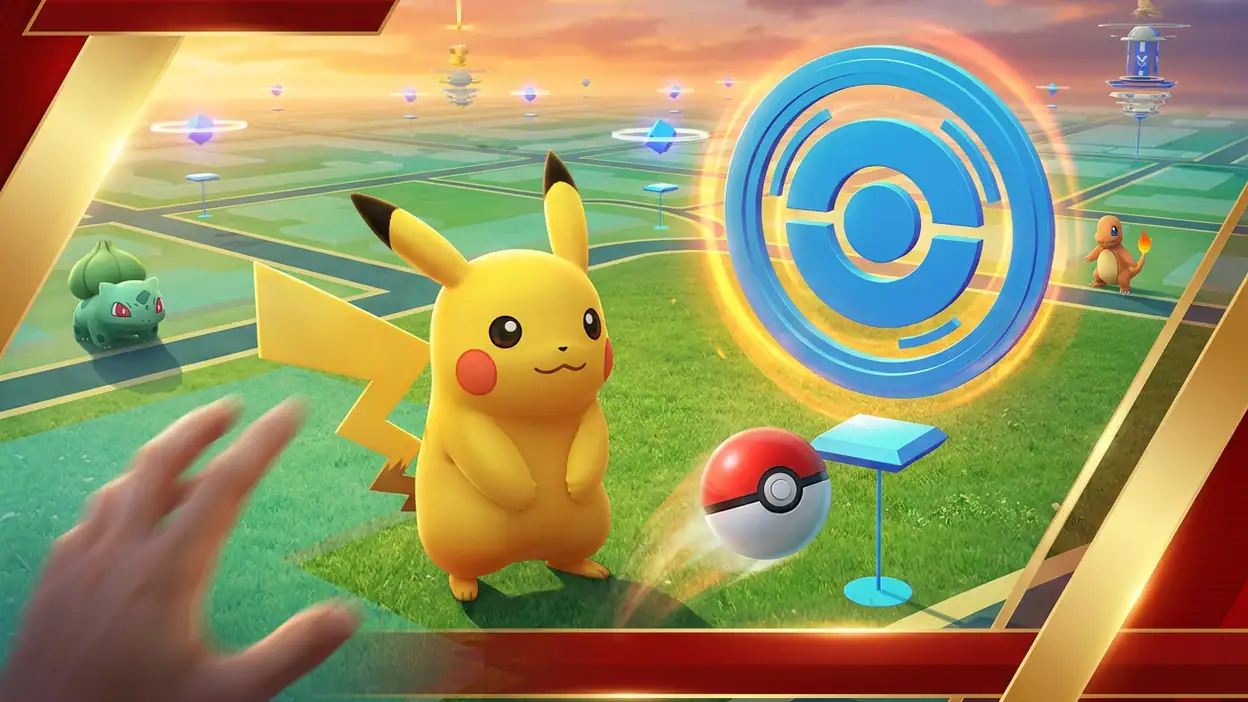
That makes its appeal unusually social and situational. A PokéStop can turn a street corner into a brief objective; a Gym can become a place where strangers share a common task. Even a quiet walk can shift into a hunt when a rare spawn appears nearby. The world outside remains in charge, but Pokémon GO gives you reasons to look at it differently.
There is a practical catch: the experience is strongest when you have places to walk, a reliable connection, and enough time to move around. Dense areas tend to provide more stops and activity than remote routes. The premise is universal, but the map does not serve every player equally.
The opening hook is immediate
The first appeal is wonderfully plain. A Pokémon appears on the map, you tap it, and the view changes to an encounter. A Poké Ball arcs toward the creature; a clean hit, especially one timed inside the shrinking target ring, can feel satisfying even before you understand the deeper systems. The transition from seeing a Pokémon in the world to trying to catch it is fast enough to make curiosity feel like action.
That first catch establishes the game’s rhythm with almost no ceremony. You spot, approach, catch, and add something new to your collection. The animation gives a familiar creature a sense of presence, while the map makes the encounter feel tied to where you are. It is a smart first hour because it explains the fantasy through doing, not a stack of instructions.
There is a gentle thrill in wondering what might appear on the next block. The game does not need a dramatic storyline to create anticipation; a silhouette you cannot identify or a Pokémon you have been hoping to find is enough. The hook is not constant suspense. It is the possibility of a small surprise.
The core loop turns movement into momentum
Once the basics click, the loop widens. You walk to find Pokémon, catch them for Stardust and Candy, spin PokéStops for supplies, and use Gyms and raids to test stronger teams. Eggs hatch as you travel, while research tasks give you small goals to complete along the way. Each action feeds another: catches help strengthen your collection, supplies support more catches, and movement keeps the map changing.
That loop feels best at walking pace. You glance at the map, notice a spawn or nearby stop, make a small detour, then carry on. It is a more relaxed rhythm than the mission-to-mission urgency of many mobile games. The world does not pause for you, and there is no elaborate level corridor to clear. Instead, the pleasure comes from layering a handful of simple decisions onto a real journey.
Pokémon GO also knows how to change gears. A quick solo walk can be a casual collecting session; a raid invites coordination and a more focused battle. Team Rocket encounters add a compact challenge, while event days can turn a familiar park into a busy hunting ground. This range gives the game room for both absent-minded play and planned outings.
Progression has both a long tail and quick payoffs
Collection is the obvious reward, but it is not the only one. Catching Pokémon earns resources, duplicate catches can become Candy, and Stardust helps power up creatures for battle. Research tasks offer specific targets and occasional encounters. Raids can deliver a harder-earned addition, while evolving a favorite provides the pleasure of seeing a collection change shape.
The useful design choice is that progress comes in different sizes. A single catch can feel worthwhile, but so can filling out a research stamp, hatching an Egg, improving a battle team, or finally finding enough Candy for an evolution. Long-term goals give regular play a direction without making every session depend on a rare find.
There is some friction in the systems. Inventory fills, appraisals and combat details take time to learn, and the sheer number of Pokémon can make collection management feel like housekeeping. A player who wants a clean, direct campaign may find that progress is scattered across menus, events, and resource currencies. The reward structure is generous in little moments, but it is not always elegant.
Why a short session becomes a longer one
Pokémon GO is hard to stop for a familiar reason: it keeps placing the next tempting task just beyond the current one. There is one more stop on the route, one more Pokémon in sight, one more task almost complete. A nearby raid can rewrite your plans, and an event bonus can make a familiar activity feel unusually worthwhile. The game is effective at turning a vague “I’ll play for a minute” into a few extra blocks.
Unlike a game built around endless menus or tightly scripted missions, its retention comes from the map changing under your feet. What appears depends on your location, timing, and the current event. That variability creates a mild sense of opportunity rather than pressure. Still, limited-time bonuses and event schedules can make the game feel demanding if you treat every featured activity as something you must complete. It is more enjoyable when you let the event come to you.
There is also a social pull that scales naturally. You can catch alone, compare finds with a friend, or join a group for a raid. The game does not require a fixed party to be enjoyable, but shared objectives give certain moments extra energy. A tough raid win feels different when a handful of local players have helped bring it down.
A bright identity rooted in familiar creatures
The visual style is clean, colorful, and deliberately readable outdoors. Pokémon sit against a simplified map, and encounters place the creatures front and center without burying their character under effects. The game’s art is not trying to imitate a full console adventure. It uses familiar designs and a light augmented-reality premise to make the ordinary world feel like a believable habitat for them.
That restraint helps the fantasy travel. A tiny Pokémon on a sidewalk map can be more charming than a lavish background because the real street supplies the context. You may turn on the camera for an encounter, but the game’s identity does not depend on pretending that every catch is a cinematic augmented-reality spectacle. The important image is simpler: a favorite creature appearing where you did not expect it.
Its strongest identity is therefore not just the Pokémon roster. It is the contrast between a recognizable fictional world and a place you can actually walk through. Roblox offers a broad platform of player-made experiences; School Party Craft leans into a sandbox setting; Super Bear Adventure centers on a more conventional 3D platforming journey. Pokémon GO occupies a different niche. Its map is not merely scenery around the action; it is the reason the action feels personal.
Who should install it, and who may bounce off
This is a natural recommendation for Pokémon fans who enjoy collecting, for walkers who like having a loose objective, and for friends looking for an activity that does not require everyone to sit in one room. It suits players who appreciate gradual progress and do not mind repeating a familiar loop when the hunt is satisfying. If you like the idea of turning a local park or a trip to a new neighborhood into a low-pressure adventure, the game has a clear case.
It is less suitable for someone seeking a deep solo campaign, precise platforming, or constant action. Gym Heros: Fighting Game, for example, puts the appeal closer to direct combat; Pokémon GO spreads its rewards across travel, collecting, and preparation. Players with limited mobility, few nearby stops, or unreliable data may also run into barriers built into the location-based design. And because the game is free to start with optional purchases, it is worth keeping a personal limit on spending rather than treating every convenience as essential.
Other frustrations are mundane but real. GPS drift can place your avatar in an odd spot, loading or network problems can interrupt an encounter, and the game asks for attention at moments when you should be watching your surroundings. It is best played while stopped or walking safely, not while crossing streets with your eyes fixed on the map. The real-world setting is the point, so real-world awareness has to come first.
Why it still earns a place on your phone
The reason to install it now is not that every feature is new or that a perfect team is waiting to be built. It is that the game still gives ordinary movement a light, appealing purpose. A new player can begin with the simple pleasure of catching, while a returning one can find fresh event goals, new collection targets, and familiar routes that look different when the map is active. There is no need to turn it into a daily obligation.
Its staying power comes from a rare balance: the game makes the next action obvious but keeps the outcome uncertain. Walk a little, check what has appeared, make a choice, and see what you bring home. Some days that means a new favorite; some days it is only a few useful items and a pleasant loop around the block. The smallness of the reward is part of its charm.
The real-world walk is the feature, not a backdrop. That idea still separates Pokémon GO from mobile games that keep their adventures entirely on screen. Its rough edges, uneven geography, and occasional management chores are hard to ignore, but so is the pleasure of a familiar place becoming part of a shared game. If you want an adventure that can fit between errands and sometimes make you take the longer route, Pokémon GO is still well worth installing.