

Plague Inc.
- Reviews
- 4.7
- Version
- 1.20.0
- Installs
- 100,000,000+

Screenshots


 Analysis by Frivlyz
I like strategy games best when my choices change the shape of a run rather than simply improve a score. That is the appeal of Plague Inc.: it turns the spread of a fictional disease into a map-wide puzzle about timing, adaptation, and risk. The premise is deliberately dark, but the play is abstract and strategic, not a realistic guide to causing harm. I see it as a thoughtful choice for someone who enjoys planning under pressure and watching a system respond.
Before choosing it, it helps to know what kind of challenge you want. This is a simulation game from Ndemic Creations, built around steering a pathogen while humanity responds. It has been available since October 4, 2012, and its current version is 1.20.0. The game is free to start, with optional in-app purchases priced from $0.99 to $14.99 per item, so I would try the core experience before deciding whether anything extra is worth paying for. It is rated Everyone 10+ and requires Android 5.0 or later on Android devices.
A good fit for deliberate, replayable strategy
The central pleasure is not simply watching infection spread; it is deciding how to manage competing priorities. Early on, I think about how to reach new places, when to develop traits, and whether making the disease more noticeable is worth the advantage it might bring. Moving too aggressively can give humanity time to respond, while waiting too long can leave the pathogen poorly equipped to reach the whole map. Those trade-offs make each run feel like a sequence of decisions rather than a passive simulation.
Our Stories on Plague Inc.
Mastering Viral Strategy: The Art of Disease Customization in Plague Inc.
NewsVehicle Masters: Leading the Pack in Mobile Simulations
NewsColoring & Learn: Revolutionizing Digital Education for Kids
NewsWhy Woodturning Captivates Mobile Gamers
NewsDancing Road Turns Short Breaks Into a Test of Rhythm and Timing
NewsSuper Stylist Makes Every Outfit a Test of Taste and Patience
NewsThat makes the game especially suitable for short sessions with a clear objective. I can start a run while waiting for an appointment, check the map and situation, make a few choices, then come back to see how events have changed. It also suits players who like learning through failed attempts: a loss can point to a specific weakness in a plan, such as slow spread or poor timing, and encourage a different approach next time. If you prefer a calm builder where progress is steady and setbacks are rare, this is less likely to be your kind of game.
How its simulation feels in practice
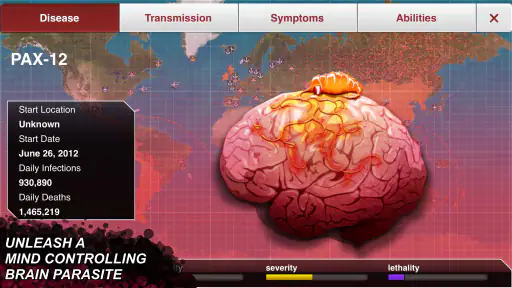
The map and changing world situation are the useful center of the experience. I pay attention not just to where infections appear but to what those changes imply for the rest of the run. A place that is difficult to reach can become a planning problem, and a visible response from humanity can make the order of upgrades matter. One practical habit is to pause before spending points on a tempting new trait and ask whether it solves the current bottleneck. If the disease is not spreading well, adding severity may not fix the real issue.
The game’s feedback is readable, but it does not remove the need to interpret events. I find that part satisfying: the map gives me a broad view, while the challenge is working out why the run is moving too slowly or attracting attention too early. The world can feel unforgiving when several problems arrive together, so it helps to treat each attempt as an experiment rather than assume there is one perfect sequence. That approach also makes losses less frustrating and keeps the strategic decisions interesting.
Where other games may suit you better
Compared with the usual mobile strategy alternatives, this is more focused on managing an evolving crisis than on building a base, collecting units, or competing directly against another player. That focus is a strength if you want a compact solo puzzle with a distinctive theme. It is a weaker match if you want a social game, a long campaign centered on characters, or a relaxed world-building loop. A conventional city or resource-management simulation may be a better choice when you want to create and maintain something rather than try to outpace an escalating response.
Gaming Stories You May Enjoy

Dominoes on Your Terms: Who Should Play and Who Should Pass

Pokémon GO Makes the Familiar World Feel New

Chess.com Turns Rematches Into Rivalries, but Community Has Its Costs

Archery Battle 3D Review: Sharp Aiming, Unclear Feedback

Should You Switch to Geometry Dash Meltdown? A Test of Timing and Patience

Fidget Toys Trading・Pop It 3D: What Happens When the Game Stumbles
The subject matter is also part of the decision. The game frames disease and a global emergency as strategy, which some players will find clever and others may find uncomfortable. I would skip it if that theme is not enjoyable for you, or if you want a medically accurate learning tool. Its simulation makes for engaging play, but I would not treat game outcomes as a substitute for real-world health information. Parents choosing a game for a younger player should also consider the Everyone 10+ age rating and whether the premise feels appropriate for them.
There is a modest switching cost if you are coming from more familiar strategy games: you need to get used to reading the world map and thinking in terms of spread, detection, and response rather than construction or combat. Once that logic clicks, the interface keeps the core decisions in view. I would give it a few attempts before judging the system, since an early failure can be informative rather than evidence that the game is simply unfair. On the other hand, if you mainly want a quick action game with constant movement and immediate input, the deliberate pace may feel slow.
Gameplay That Infects Your Mind
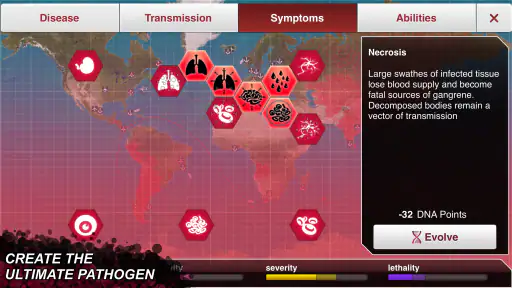
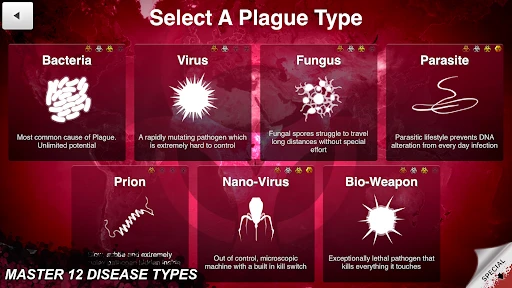
From the moment I launched Plague Inc., I was hooked. The game puts you in the shoes of a devious pathogen, with the ultimate goal of wiping out humanity. It sounds morbid, but trust me, it's insanely addictive. You start by choosing your pathogen type, be it a bacteria, virus, or fungus, each with unique traits and challenges. The real fun begins as you strategically evolve your disease by choosing symptoms, transmission methods, and abilities. You'll find yourself mulling over whether to make your virus airborne or give it antibiotic resistance. It's a strategic dance between spreading your plague and avoiding detection by global health experts.
Realism Meets Strategy
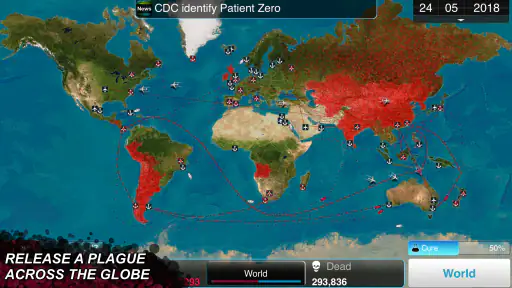
One of the standout features of Plague Inc. is its attention to detail. The game incorporates real-world data and modeling to simulate how diseases spread and how governments might react. As someone who geeks out over epidemiology, I found this aspect incredibly fascinating. The map interface shows the infection's spread across countries, and it’s eerily satisfying to watch the world turn red as your pathogen takes hold. But don't get too cocky—humanity fights back with research and countermeasures, adding layers of complexity to the game.
What makes Plague Inc. even more engaging is the constant need to adapt your strategy. The game’s AI is no slouch, and it will keep you on your toes. Sometimes, you'll need to pause and reconsider your approach as the world starts to close its borders or develop vaccines. It’s a game that challenges your strategic thinking, all while keeping you entertained.
Visuals and Soundtrack
While Plague Inc. doesn't boast flashy graphics, its minimalist design is perfect for the game’s concept. The interface is clean and intuitive, making it easy to track your progress and tweak your strategies. The visuals focus on functionality rather than distraction, which I appreciate immensely. The soundtrack and sound effects add to the experience without overwhelming your senses. The ominous music heightens the tension, ensuring you're fully immersed in your quest for world domination.
Small details that shape a run
A useful way to approach a new attempt is to identify the problem before changing the plan. If the map shows that the outbreak is not reaching enough places, I focus on the spread problem rather than making the disease more severe just because that option looks dramatic. If the response is advancing quickly, I reconsider whether I have made the pathogen too conspicuous too soon. This simple check—spread, visibility, then urgency—helps me make choices with a reason instead of spending resources reactively.
I also avoid treating every run as a race to select the strongest-looking upgrade. An ability that seems valuable in one situation may be a poor use of points when a more basic weakness is holding everything back. The game is more rewarding when I make one or two deliberate adjustments, watch the map, and then decide again. That rhythm is a good fit for mobile play because I can step away between decisions without needing to maintain a constant stream of rapid inputs.
Who should make room for it
For puzzle-minded players, the best part is the gap between what the map shows and what I need to infer from it. The game does not turn every development into a simple instruction; I have to decide whether a setback calls for patience, a change in direction, or a more urgent response. It can also work well for someone who enjoys systems thinking but does not want a sprawling strategy interface. The scope is easy to grasp, yet the consequences of choices give a run enough texture to make another attempt appealing.
It is less convincing as a casual game for someone who wants every session to feel relaxing. The premise and escalating stakes can create tension, and an apparently successful run can still become difficult if the balance of spread and response goes wrong. I would also steer away from it for players looking for a realistic science lesson: the theme borrows the language of disease spread, but the point is to play a strategic simulation, not to teach public-health practice. For that kind of learning, a trusted educational source is the better choice.
What to expect from the free start
The free price makes it easy to see whether the core loop appeals to you before spending anything. I would not treat the in-app purchases as necessary simply because they are available; first find out whether you enjoy planning runs, reading the map, and adjusting to the game’s response. If those choices are the draw, the initial experience gives you a useful basis for deciding whether to continue. If the central premise does not click, optional purchases are unlikely to change the kind of game it is.
With a 4.7 average from around 4 million ratings and over 100 million installs, it is clearly a familiar choice for mobile players, though popularity alone does not make its theme right for everyone. The large audience does suggest that its focused strategy loop has lasting appeal. I would still make the decision based on your taste: choose it for a distinctive, map-led simulation, not because you expect a conventional action game or a gentle management sandbox.
My recommendation
For a realistic everyday session, I would start a run during a quiet break, make a few informed choices, and check back after the map has developed. That works better for me than rushing through upgrades without noticing what the game is telling me. If a run fails, I treat the outcome as a clue about my priorities, not as a reason to repeat the same approach. The most satisfying sessions come from spotting a weakness early enough to try a different plan.
There is also a practical question of commitment: do you need to learn a long list of systems before enjoying it? I do not think so. The core idea is immediately understandable, while the challenge comes from improving your judgment over repeated attempts. That makes it approachable for a strategy newcomer, although someone who dislikes trial and error may find the learning curve irritating. A more guided, story-led game would be a better fit for a player who wants a fixed sequence of events rather than experimentation.
In conclusion, Plague Inc. offers a unique blend of strategy and education. It's a game that makes you think critically while having a blast. Whether you're a fan of strategy games or just looking for something different, I highly recommend giving Plague Inc. a try. Just be warned—it might just become your latest obsession!
Plague Inc. Pros and Cons
Pros
- Highly strategic gameplay experience
- Realistic simulation of diseases
- Multiple difficulty levels available
- Educational value on pandemics
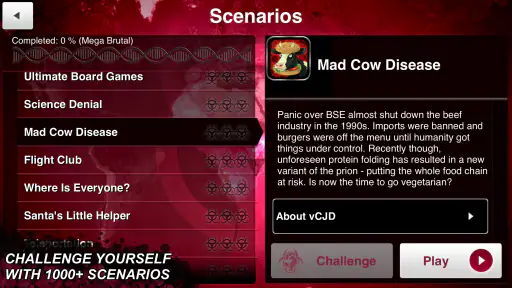
- Varied game modes for replayability
Cons
- Can be difficult for beginners
- In-app purchases can be pricey
- Requires internet connection
- May not suit all ethical views
- Limited free content
This Game in Other Languages
Frequently Asked Questions
What is Plague Inc. and what makes it unique?
Plague Inc. is a strategic simulation game where players aim to evolve a deadly pathogen to wipe out humanity. What sets it apart is its combination of realistic simulation and strategic gameplay. Players must carefully manage pathogen evolution, transmission, and lethality while adapting to human countermeasures, creating a challenging yet engaging experience.
Is Plague Inc. suitable for all age groups?
Plague Inc. is generally rated for teens and older due to its dark theme of global pandemics and potential for mature content. The strategic nature of the game requires critical thinking and understanding of complex systems, making it more suitable for older players who can appreciate its nuanced gameplay and thematic elements.
Can I play Plague Inc. offline, or do I need an internet connection?
Plague Inc. can be played offline, allowing players to enjoy the game without an internet connection. However, certain features, such as updates and global leaderboards, require online access. Offline play is perfect for uninterrupted gameplay, especially when traveling or in areas with limited connectivity.
Are there in-app purchases in Plague Inc., and are they necessary?
Plague Inc. offers in-app purchases, including expansions and additional content that enhance the gaming experience. While these purchases can provide new scenarios and challenges, they are not necessary to enjoy the core game. Players can have a complete experience without spending extra, though purchases can add variety and depth to the gameplay.
How does Plague Inc. handle updates and new content additions?
Plague Inc. regularly receives updates that include bug fixes, gameplay improvements, and new content. The developers are committed to keeping the game fresh and engaging by introducing new scenarios and features. Players can expect ongoing support and enhancements, ensuring the game remains relevant and enjoyable over time.


