

Wordle!
- Reviews
- 4.1
- Version
- 2.0.1
- Installs
- 10,000,000+

Screenshots
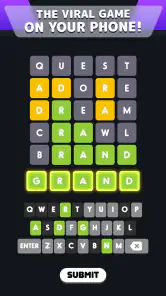
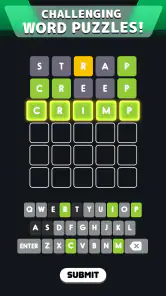


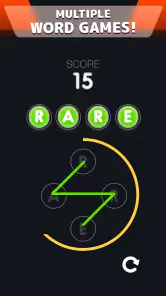
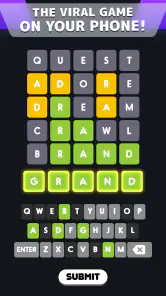
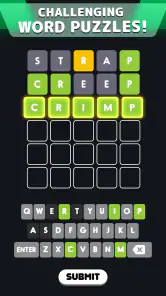
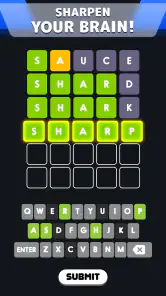
 Analysis by Frivlyz
I came to Wordle! expecting a quick word puzzle, and that is exactly the right way to approach it: a small daily challenge rather than a game to sink an entire evening into. The familiar guessing idea is easy to grasp, but the useful part is how each attempt gives you clues to work with. I found it most enjoyable when I treated those clues as a reason to think carefully, not as a race to tap in the first word that came to mind.
What to expect from the app
This is a free word game from Lion Studios Plus, aimed at Everyone, and its central appeal is a short daily puzzle. The app is listed at version 2.0.1 and requires Android 5.0 or later. It has a 4.1 average from around 165,000 ratings, with over 10 million installs. Those figures suggest broad interest, but the experience itself is deliberately modest: you are here to make guesses, interpret feedback and see whether your vocabulary and deduction can get you to the answer.
That modest scope is a strength if you want a little mental break without committing to a long session. It is also a limit. If you prefer a word game with a long campaign, lots of modes to explore or a steady stream of new challenges at your own pace, this daily format may feel restrictive. I would choose it for a brief pause between tasks, not as my only game for a long commute.
Getting started without overthinking it
On your first visit, the best approach is simply to read the color clues as information rather than as a score. A green tile confirms both a letter and its position; yellow confirms the letter but tells you to move it; gray rules out a letter for that puzzle. Once you understand those three signals, there is no complicated setup to master before you can make a meaningful attempt.
I would begin with a familiar five-letter word that tests several different letters, then use the response to narrow the field. The trick is not to keep reusing letters you have already ruled out. If a guess gives you a yellow letter, try placing it somewhere new; if it gives you green, preserve that position while testing other possibilities. This turns a vague hunch into a small, manageable process, which is especially reassuring if you are new to deduction games.
Making the first win feel earned
My most useful habit is to pause for a moment after each guess and write down, mentally or on paper, what the board has established. It is easy to remember the green letters and forget that a yellow one cannot stay where you put it. Keeping those constraints straight helps prevent a hopeful but uninformative guess from wasting an attempt.
There is a trade-off between testing lots of fresh letters and trying to solve the word immediately. Early on, a guess with several new letters can reveal more of the puzzle; later, once the board has narrowed the options, a word that fits the confirmed pattern is usually more valuable. I would not treat that as a rigid formula, though. If you have a strong candidate, testing it can be more satisfying than playing a purely analytical word just to gather clues.
Gaming Stories You May Enjoy

Dancing Road Turns Short Breaks Into a Test of Rhythm and Timing

Super Stylist Makes Every Outfit a Test of Taste and Patience

Dominoes on Your Terms: Who Should Play and Who Should Pass

Pokémon GO Makes the Familiar World Feel New

Chess.com Turns Rematches Into Rivalries, but Community Has Its Costs

Archery Battle 3D Review: Sharp Aiming, Unclear Feedback
What’s the Buzz About?
Wordle is a simple yet captivating word puzzle game that you can play on both Android and iOS. It’s the kind of game that hooks you with its simplicity but keeps you with its challenge. Every day, you get a new word to guess, and you have six attempts to nail it. Sounds easy, right? Well, it’s trickier than you might think, and that’s what makes it so engaging.
The Gameplay
The rules are straightforward. You start with a blank slate and make guesses to figure out the day’s five-letter word. After each guess, the tiles change color to show how close your guess was to the actual word. Green means you’ve got the right letter in the right spot, yellow means the letter is in the word but in the wrong spot, and gray means the letter isn’t in the word at all. It’s this simple feedback loop that makes you want to keep guessing.
One of the things I love about Wordle is that it’s a game anyone can play. You don’t need to be a wordsmith to enjoy it, although it might help a bit. The game doesn’t rush you; you can take your time and think through your guesses, which is a refreshing change from the fast-paced games that dominate the market these days.
Reading clues carefully
A common source of confusion is what gray means when your guess contains a letter more than once. I make a point of reading the colors against the whole guess rather than assuming the tile sequence works like a simple letter counter. If duplicate letters leave you unsure, avoid spending the next attempt on another word built around the same uncertain pattern. Test a different arrangement or introduce useful letters, then use the new feedback to decide.
Another easy mistake is treating yellow as a general “nearly right” signal. It is more precise than that: the letter belongs somewhere in the answer, but not in that square. When a board starts to look familiar, I still check every yellow position before entering a candidate. That small pause can save a guess, particularly when several possible words share the same visible pattern.
A daily routine that fits real life
I like this format for a realistic in-between moment: open the puzzle while waiting for coffee, make one considered guess, and return to it after a short pause if the answer does not come immediately. Since the game is not asking me to follow a lengthy story or keep up with a timed round, I can enjoy it in a few minutes without turning a break into another obligation. If you play alongside friends or family, comparing the way you reasoned through the clues can be more fun than simply announcing who finished first.
That social angle also calls for a little restraint. It is easy to spoil the answer for someone who has not played yet, so I would share the result or discuss the number of attempts without revealing the word. The puzzle works best when each person gets to make their own deductions. If you would rather keep a word game entirely private, there is no need to make it a competition; the challenge still works on its own.
How it compares with other word games
Compared with a crossword, this is much more focused: you are solving one short word rather than moving through a grid of clues. Compared with a word-search puzzle, it asks you to infer the answer instead of scanning for letters already laid out on the screen. And compared with an open-ended word game that lets you continue through many rounds, the daily structure gives you a clear stopping point. I prefer that limit when I want a compact ritual, but players who want continuous play may be happier with a different style of puzzle.
The familiar concept also means the basic challenge may not feel surprising for long. Its appeal depends on enjoying the small decisions—what to test, which clue to trust, and when a likely answer is worth committing to. If you already play similar guessing games, the experience may feel more like a convenient daily habit than a new kind of word puzzle. I would choose it for a focused five-letter deduction, not for variety or a deep progression system.
Practical trade-offs before you settle in
The game is free to download, with in-app purchases ranging from $0.99 to $99.99 per item. I would check the purchase details before confirming anything and avoid assuming that every optional item is necessary to enjoy the central puzzle. If your priority is a no-cost, low-commitment word challenge, the daily guessing itself is the reason to try it; if you dislike in-app purchase options appearing in games at all, that may be a reason to look elsewhere.
It is also worth matching the game to your vocabulary and mood. A broad vocabulary can make candidate words come to mind faster, but careful reasoning matters more than knowing obscure terms. On a tired day, the limited number of attempts can make an unlucky guess feel frustrating; I find it better to slow down and use each result deliberately than to tap through guesses just to finish. If you want unlimited retries with no pressure, a practice-oriented word game may suit you better.
Why It’s Gaining Popularity
What’s really cool about Wordle is how it brings people together. It’s become a sort of daily ritual for many, with friends and family comparing their scores and strategies. The simplicity of sharing your results with just a few clicks has turned it into a social experience, even though you’re technically playing solo.
There’s no app to download; you just play it in your web browser, which is part of its genius. It’s accessible, no matter what device you’re on, and there’s no clutter or ads to distract you from the experience. Plus, with only one puzzle a day, it doesn’t eat away at your time. It’s a quick, satisfying break from the daily grind.
Who I’d recommend it to
I would recommend the app to someone who enjoys language puzzles but wants an easy entry point, or to friends who like comparing how they arrived at an answer. It can also work well for a family routine because the rules are quick to explain and players can take turns suggesting guesses. For a first session, I would focus on understanding the feedback rather than trying to beat anyone else’s result; getting one clue right is a useful success even if the answer takes more thought.
I would skip it if you need a constant supply of levels, dislike daily limits, or want a game that rewards quick reflexes. It is not a substitute for a full crossword collection or a broad vocabulary app. The strongest reason to keep it installed is that its small puzzle can fit naturally into a day, while its weakest point is that the same compact structure may eventually feel repetitive if you expect a changing set of activities.
My Final Thoughts
In a world where our attention is constantly being pulled in a million directions, Wordle is a breath of fresh air. It’s a reminder that sometimes, less is more. It might not have flashy graphics or a complicated storyline, but that’s precisely why it works. It’s all about the challenge and the satisfaction of cracking the code.
If you’re looking for a game that’s fun, engaging, and a little bit competitive, give Wordle a try. Just be warned—you might find yourself eagerly awaiting each new day’s puzzle!
Wordle! Pros and Cons
Pros
- Enhances vocabulary skills.
- Quick and easy to play.
- Minimalistic and clean design.
- Daily new challenges.
- No ads interruption.
Cons
- Limited to one puzzle a day.
- Can become repetitive.
- Requires internet connection.
- No hints or clues.
- Not ideal for color-blind users.
Frequently Asked Questions
What is Wordle and how does it work?
Wordle is a popular word puzzle game that challenges players to guess a five-letter word within six tries. Each guess must be a valid word, and after each attempt, the letters are color-coded to indicate how close the guess is to the correct word. A green letter is in the correct position, yellow indicates the letter is in the word but in the wrong position, and gray means the letter is not in the word at all.
Is Wordle available on both Android and iOS?
Yes, Wordle is accessible on both Android and iOS platforms. The game can be played directly in a web browser or downloaded as an app from respective app stores. This cross-platform availability ensures players can enjoy the game on their preferred devices without any hassle.
Are there any in-app purchases or ads in Wordle?
Wordle is known for its simplicity and ad-free experience, focusing purely on the puzzle-solving aspect. The game is free to play, and there are no in-app purchases. This allows players to enjoy the game without interruptions or spending money on additional features or hints.
Can I play Wordle offline?
Wordle primarily requires an internet connection to function, especially when played in a web browser. However, if downloaded as an app, some versions may offer limited offline play. It's best to check the app's specifications or settings to determine its offline capabilities before downloading.
What makes Wordle different from other word games?
Wordle stands out due to its daily puzzle challenge, where all players attempt to solve the same word each day. This creates a sense of community and competition as players share their results and strategies. Unlike many word games, Wordle's minimalist design and lack of distractions allow for a focused and engaging experience.


