

Triple Harvest™: 3D Match Game
- Reviews
- 4.9
- Version
- 1.1.0
- Installs
- 1,000,000+

Screenshots
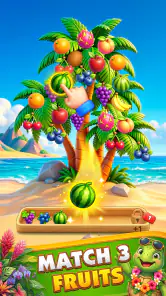
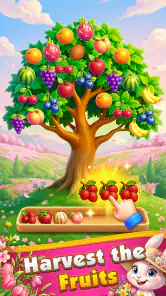
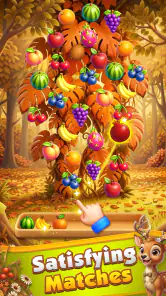


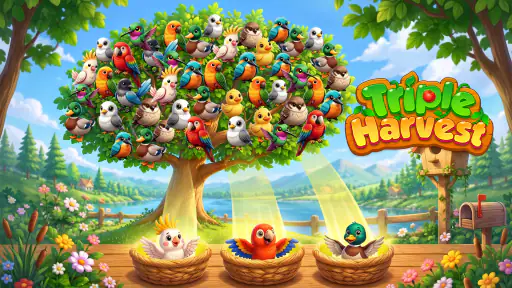
 Analysis by Frivlyz
I usually reach for a puzzle game when I want something calm enough for a short break but engaging enough to keep my attention. Triple Harvest™ fits that mood with a simple 3D matching idea: I look for three identical items, remove them, and keep clearing the play area before the available spaces become a problem. It is easy to understand within moments, yet the three-dimensional presentation gives the familiar match format a little more to think about.
Flyfox Games presents it as a free puzzle game for everyone, and my overall impression is that it works best as a relaxed, visual sorting challenge rather than a high-pressure test of reflexes. The average rating is 4.9 from around 32 thousand ratings, while the game has passed one million installs. Those figures suggest that the basic concept is connecting with a broad audience, but they do not remove the need to look at how the game actually feels during ordinary play.
How Triple Harvest™ feels in its current state
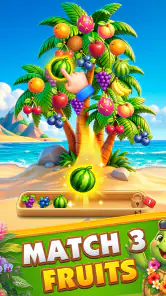
The central loop is immediately approachable. Objects are arranged in a 3D scene, and I tap matching pieces to place them into a selection area. Completing groups of three clears them and opens room for more choices. That sounds straightforward, but the perspective matters: an item that looks available may be partly hidden by another object, while a seemingly harmless tap can use one of the limited spaces needed for a later match.
That combination makes the game more thoughtful than a flat tile-matching app. I am not only identifying identical pictures; I am also judging visibility, order, and the risk of filling the tray with unrelated pieces. The most satisfying moments come when I uncover an item that completes a group I had been quietly preparing several moves earlier.
The harvest theme gives the puzzles a warmer personality than a purely abstract matching board. It also makes the game feel suitable for casual use: I can play while waiting for an appointment, during a quiet commute, or for a few minutes before bed. The Everyone content rating reinforces that broad accessibility. A child, a casual adult player, or someone who rarely plays games can understand the objective without studying a long tutorial.
That accessibility is one of the strongest parts of the design, but it also defines the game’s limits. Players who want a deep story, competitive rankings, fast action, or complex character progression should not expect those things from this experience. Its appeal comes from arranging visual information and making careful selections, not from building a large long-term system around a character or world.
The small decisions that make each board interesting
The most useful habit I developed was to avoid tapping the first obvious match immediately. I first scan the whole visible area and identify pairs, isolated pieces, and objects that appear to be covering something important. If I remove a match too quickly, I may expose a new item but leave the selection area crowded with pieces that do not connect. Waiting a moment to understand the board often produces a cleaner sequence.
Gaming Stories You May Enjoy

Dancing Road Turns Short Breaks Into a Test of Rhythm and Timing

Super Stylist Makes Every Outfit a Test of Taste and Patience

Dominoes on Your Terms: Who Should Play and Who Should Pass

Pokémon GO Makes the Familiar World Feel New

Chess.com Turns Rematches Into Rivalries, but Community Has Its Costs

Archery Battle 3D Review: Sharp Aiming, Unclear Feedback
Another practical approach is to treat the selection area as a budget rather than a temporary shelf. Every unmatched item occupies room, and several speculative taps can turn a manageable puzzle into a forced restart or a dependence on assistance. I found it better to create one nearly complete group, then look for the third item, than to collect a random assortment of attractive objects.
Three-dimensional presentation also changes how I use the camera and my attention. I look from more than one angle before deciding that an item is unavailable. A piece can be visually easy to miss when it sits behind a larger object or blends into a busy arrangement. This is a small but important difference from ordinary two-dimensional match-three games, where the entire board is usually readable at once.
For that reason, the game rewards patience more than speed. I do not feel that tapping rapidly is the point. The better rhythm is scan, plan, clear, and rescan. That makes it a good fit for players who enjoy organizing clutter or spotting patterns, but a weaker choice for anyone who wants a quick reflex challenge with constant movement.
What the early version tells us about the direction
The current version is 1.1.0, and the game was released on June 17, 2026. That places the experience in an early stage of its product life, so I would judge it primarily by the clarity of its main loop rather than by expecting years of accumulated systems. The important positive sign is that the basic interaction is understandable and pleasant without needing a large amount of explanation.
I also see a clear opportunity for Flyfox Games to refine the experience as it evolves. A puzzle game built around 3D visibility benefits greatly from careful level pacing, readable object placement, and a fair balance between challenge and recovery. Small adjustments in those areas can make a bigger difference than adding unrelated features. If later updates preserve the calm matching identity while improving variety and clarity, the foundation should remain appealing.
Existing users should therefore think of version 1.1.0 as a snapshot of a focused casual game, not as a promise of a large content roadmap. The current appeal is already understandable: short sessions, familiar rules, and enough spatial planning to prevent the activity from becoming completely automatic. Whether it remains interesting over a long period will depend on how much fresh puzzle variety arrives and how well the difficulty continues to respect the player’s learning curve.
That distinction matters when deciding whether to install it. If I want a game I can understand quickly and revisit in brief sessions, the current version makes sense. If I am choosing one main puzzle game for months of increasingly complex play, I would want to see how its later stages and future updates develop before making it my primary choice.
Who will get the most from the matching format
I would recommend it first to people who like sorting, visual recognition, and gentle planning. It is especially suitable for players who find traditional match-three games too repetitive but still want rules that remain simple. The 3D board adds a layer of discovery because clearing one group can change what is visible and alter the best next move.
It can also work well as a shared, low-pressure game. Someone who does not normally play mobile games can understand the goal by watching a single round, then take over without learning complicated controls. That makes it more approachable than many puzzle games built around timers, elaborate menus, or several resource systems.
On the other hand, I would skip it if I dislike games where a mistake comes from selecting the wrong item rather than failing a difficult maneuver. I would also look elsewhere if I need a strong narrative reason to continue, a competitive multiplayer component, or a puzzle system with a clearly defined expert ceiling. The relaxed presentation is a strength for some players and a weakness for others.
It is also not the ideal option for people who become frustrated by visual clutter. Because the board is three-dimensional, careful observation is part of the challenge. Players with smaller screens or difficulty distinguishing similar-looking objects may need to play more slowly. The game’s accessibility comes from its rules, but the visual format can still demand concentration.
How it compares with familiar puzzle alternatives
Compared with a standard match-three game, this title feels less dependent on chain reactions and more dependent on deliberate selection. In a typical grid, I can often read the board in one glance and search for a move that creates several automatic combinations. Here, I spend more time deciding which object is safe to remove and which one should remain available as an anchor for a future group.
Compared with hidden-object games, it has a clearer repeatable action. I am not searching for unrelated clues or following a scene-specific story; I am grouping identical items under spatial constraints. That makes the experience easier to pick up repeatedly, although it may feel less varied to someone who wants every level to introduce a new kind of investigation.
Compared with block or number puzzles, the appeal is more visual and tactile. There is no need to calculate a long sequence or build a complicated structure before seeing progress. I receive a satisfying result whenever a trio disappears. The trade-off is that the challenge may feel lighter to players who prefer abstract reasoning over object recognition and board management.
For me, its best position is between a traditional casual matching game and a three-dimensional sorting exercise. It offers more spatial awareness than a flat board but less strategic depth than a serious logic puzzle. That middle ground is exactly why I can imagine using it often in short sessions, while still understanding why a dedicated puzzle enthusiast might eventually want something more demanding.
The practical cost of a free game
The game is free to download, which lowers the barrier to trying it. It includes in-app purchases ranging from $0.99 to $49.99 per item. I would keep that range in mind before treating the game as a completely cost-free hobby. A free entry point is useful, but optional purchases can change how comfortable the experience feels for players who want to progress without spending.
My advice is to decide in advance whether I am willing to buy anything at all. If the answer is no, I should approach the game as a casual diversion and avoid allowing a difficult board to pressure me into a purchase. If I am comfortable spending occasionally, I would still judge each purchase by whether it solves a temporary obstacle or adds lasting value to the way I play.
This is one area where the game’s calm style can create a subtle trade-off. A relaxed puzzle feels ideal for unwinding, but any interruption connected to progression or assistance can make the session feel less relaxing. I would rather see the core challenge remain understandable and fair, with purchases treated as convenience rather than something I feel required to use.
The minimum operating system is Android 7.0, so the compatibility range is relatively broad for Android users with older devices. That makes it easier to try on a phone that is not new, although the 3D presentation means the personal experience can still depend on screen size, responsiveness, and how comfortably the objects can be distinguished.
What I would watch in future updates
The first thing I would watch is puzzle variety. A matching loop can remain enjoyable for a long time when layouts, object combinations, and decision patterns continue to surprise me. If boards begin to feel like the same scan-and-clear routine with only cosmetic changes, the initial charm will fade for players who finish several sessions in one sitting.
I would also watch how difficulty is introduced. The best progression should teach me to plan further ahead without turning hidden objects into guesswork. When a puzzle is hard because I missed a relationship, I feel motivated to improve. When it is hard because the scene is difficult to read or the correct item is obscured without a fair clue, the challenge feels less satisfying.
Another important point is the relationship between the free experience and the purchase system. Since individual in-app purchases can reach $49.99, I would want the ordinary play loop to remain worthwhile for someone who never buys anything. That does not mean every convenience must be free, but the difference between optional help and uncomfortable pressure should stay clear.
Finally, I would look for improvements that make the 3D format easier to read without removing its purpose. Better visual separation, thoughtful camera behavior, or clearer feedback could help new players understand why a move succeeded or failed. Those changes would support the game’s strongest idea rather than turning it into a different kind of puzzle.
My recommendation after spending time with it
Triple Harvest™ is a pleasant choice when I want a free puzzle game that combines familiar matching with a more spatial, three-dimensional board. Its strongest quality is not complexity; it is the way a simple rule becomes a small planning exercise once the selection area and hidden objects matter. I can start a round quickly, play with care, and stop without needing to remember a complicated story or progression system.
The limitations are just as clear. The experience may not satisfy players looking for competition, narrative, rapid action, or deep logic. Its long-term value will also depend on how Flyfox Games develops the puzzle variety and keeps the balance fair between free play and optional purchases. At this stage, I see a focused foundation rather than a complete replacement for every other puzzle style.
For a friend who wants something relaxing to play in short bursts, I would recommend giving it a try, especially if they enjoy sorting objects and planning a few moves ahead. I would suggest approaching the three-dimensional boards slowly, keeping the selection area organized, and resisting random taps. The best way to enjoy this game is to treat each trio as part of a larger plan, not as an isolated match.
Triple Harvest™: 3D Match Game Pros and Cons
Pros
- Relaxing match-3 gameplay that is easy to learn and play casually.
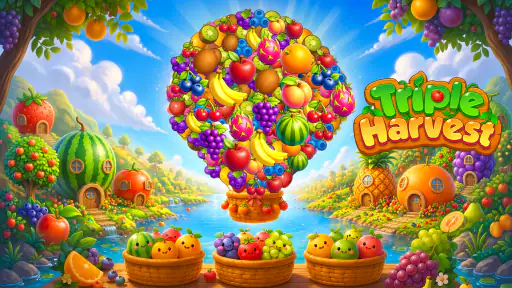
- Bright 3D visuals make the fruit and puzzle pieces easy to recognize.
- Short levels fit well into quick breaks or daily play sessions.
- Increasing challenges keep the game engaging beyond the opening levels.
- Suitable for players who enjoy simple
- non-competitive puzzle experiences.
Cons
- Some levels may feel repetitive after extended play sessions.
- Later stages can become difficult without careful planning or boosters.
- Frequent rewards and prompts may interrupt the flow of gameplay.
- Progression may feel slow for players who avoid optional purchases.
- The 3D presentation can be demanding on older phones or tablets.
Frequently Asked Questions
What is Triple Harvest™: 3D Match Game?
Triple Harvest™: 3D Match Game is a casual puzzle game focused on finding and matching three identical 3D objects. You explore a colorful play area, tap items to place them in matching slots, and clear the board before the available spaces become full. Its simple controls make it approachable, while increasingly complex layouts and limited moves can provide a more demanding challenge.
How do you play Triple Harvest™: 3D Match Game?
To play, look across the 3D objects on the board and select three matching items. Each selected object is moved into the collection area, and completing a trio removes it from play. You need to plan your taps carefully because the tray has limited capacity. Clearing all objects completes the level, while filling the tray without making a match may end the attempt.
Is Triple Harvest™: 3D Match Game free to download and play?
Triple Harvest™: 3D Match Game can generally be downloaded and played without an upfront purchase, although the exact availability may depend on your Android or iOS region. Like many free puzzle games, it may include optional advertisements, rewards, boosters, or in-app purchases. Check the store listing and your device’s purchase settings before downloading, especially if children use the device.
Does Triple Harvest™: 3D Match Game require an internet connection?
Some parts of Triple Harvest™: 3D Match Game may work without a constant internet connection, particularly the basic puzzle gameplay. However, online access can be needed for advertisements, cloud-related features, events, reward claims, updates, or purchases. Offline behavior may also vary after an update, so players should not assume every feature will remain available without a connection.
Is Triple Harvest™: 3D Match Game suitable for children and casual players?
The game is suitable for casual players who enjoy relaxed object-matching puzzles, colorful visuals, and short levels. The controls are easy to understand, but later stages may require concentration and forward planning rather than simple tapping. Parents should review the current age rating, advertising content, privacy information, and in-app purchase options before allowing younger children to play.


