

Toy Match 3D: Triple Match
- Reviews
- 4.8
- Version
- 3.44.0
- Installs
- 500,000+

Screenshots


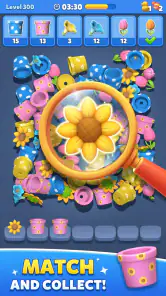
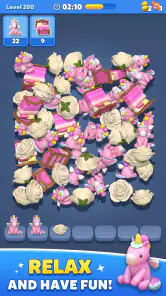
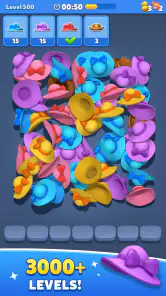
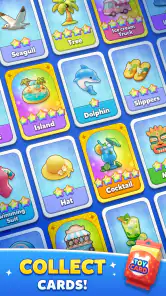

 Analysis by Frivlyz
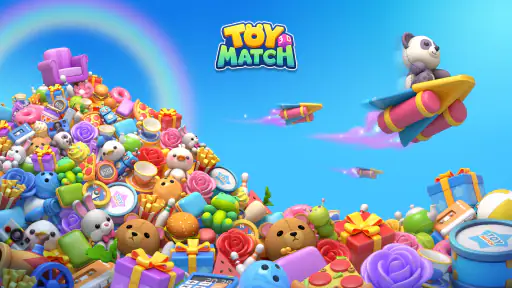
I spent time with Toy Match 3D: Triple Match as a casual puzzle game, and its appeal became clear within the first few rounds: it turns the familiar matching idea into a small three-dimensional sorting task. Instead of scanning a flat board, I had to look through a cluttered arrangement of objects, identify three matching pieces, and decide what to remove before the available space became awkward. That extra visual layer gives the game a more tactile feel than a standard match-three title.
It is a free puzzle game from PLAYNEXX, aimed at Everyone and available for devices running Android 7.0 or later. The store presents it as a relaxing 3D matching experience, but I would describe it more precisely as a gentle game that alternates between easy recognition and moments of careful planning. It works well when I want something uncomplicated for a few minutes, although players looking for deep strategy or a long-form story will probably find it too light.
How the matching loop builds its early goals
The first goal is refreshingly direct: find three identical objects and clear them. That simplicity makes the opening easy to understand without a tutorial-heavy start. I could begin by looking for obvious groups, then gradually pay more attention to objects partly hidden by the pile. The three-dimensional presentation is not just decoration; it changes how I read the board and makes each move feel like a small act of visual organization.
Early rounds are strongest when treated as observation exercises rather than speed tests. I found it useful to scan the entire arrangement before tapping anything. Removing the first visible trio can expose another object, but it can also leave unrelated pieces occupying the spaces I need. That creates a modest but meaningful decision: take the easy match now, or prepare the board for a cleaner sequence later.
This is where the game establishes its main rhythm. I am not solving a complicated mathematical puzzle, yet I am constantly choosing between immediate progress and better positioning. The early objectives are therefore accessible to children and casual players, while still giving adults a reason to pause instead of tapping randomly.
The object-based design also makes the game easy to understand at a glance. A player does not need to memorize complicated symbols or learn a large rule set. The challenge comes from recognizing shapes, tracking partially covered items, and keeping enough room available for future matches. That is a good fit for short sessions because the mental effort is clear and contained.
What progress feels like during ordinary play
The most noticeable progress signal is the board itself. Every successful trio reduces clutter and reveals more of the arrangement. I liked that visual feedback because it gives each tap a visible purpose. Even when a round is not especially difficult, watching the pile become more organized provides a small sense of completion.
Gaming Stories You May Enjoy

Dancing Road Turns Short Breaks Into a Test of Rhythm and Timing

Super Stylist Makes Every Outfit a Test of Taste and Patience

Dominoes on Your Terms: Who Should Play and Who Should Pass

Pokémon GO Makes the Familiar World Feel New

Chess.com Turns Rematches Into Rivalries, but Community Has Its Costs

Archery Battle 3D Review: Sharp Aiming, Unclear Feedback
There is also a satisfying change in confidence as I learn to read the three-dimensional layout. At first, I tended to grab whatever matching object was easiest to see. After a few rounds, I started checking which pieces were supporting or hiding others and thinking one match ahead. The game does not need elaborate explanations to communicate that improvement; the player feels it through fewer careless selections.
For me, the best progress is not simply clearing a level. It is becoming better at preserving options. A careless move can fill the temporary selection area with unrelated objects, while a thoughtful move keeps several possible trios available. That makes the game more interesting than a purely reflex-based matching activity, even though the controls remain simple.
The current version is 3.44.0, and the game has built a sizeable audience, with over 500 thousand installs and an average rating of 4.8 from around 12 thousand ratings. Those figures suggest that its straightforward format has broad appeal, but they should not be mistaken for evidence that it suits every puzzle fan. The experience is deliberately casual, and its strengths are tied to that limited scope.
Why the three-dimensional board matters
A conventional flat match-three game usually asks me to plan swaps across a visible grid. This game asks a different question: which objects are available, which are concealed, and which removal will make the next part of the board easier to read? That distinction makes it closer to visual sorting than to a classic jewel-swapping puzzle.
I found the difference especially useful when I wanted a break from games that demand constant calculation. The objects are easier to interpret than abstract tile combinations, and the board feels more like a messy tabletop that I am gradually tidying. At the same time, the extra depth can make the screen busier. Players with limited patience for visual clutter may prefer a clean two-dimensional board where every possible move is immediately visible.
Another practical point is that the game rewards a slower scan. It is tempting to tap rapidly because the rules are so familiar, but speed does not automatically produce better decisions. I had more reliable rounds when I paused after every match to reassess what had been uncovered. That small habit is one of the most useful ways to improve without needing a guide.
Difficulty, pacing, and the pressure to keep playing
The difficulty curve works best when it gives familiar actions a little more consequence. Matching three objects never becomes hard to understand, but the arrangement can make the same rule more demanding. A board with several visible trios feels forgiving; a board with overlapping or less obvious pieces asks for memory and restraint.
I would not call the challenge intense. The game is better suited to players who enjoy mild tension than to people seeking punishing puzzle design. Its difficulty comes from making a wrong choice inconvenient rather than from requiring a rare skill. That balance supports the relaxing tone, but it also means experienced puzzle players may reach the limits of the system sooner than newcomers.
The pacing is appropriate for everyday interruptions. I can imagine playing while waiting for an appointment, during a commute break, or at the end of the day when I want something more interactive than scrolling. The rounds do not require a large uninterrupted block of attention, and the basic objective is easy to resume after looking away.
A realistic use case is a short evening session after work. I might play a few rounds while listening to a podcast, using the first moments to settle into the visual sorting and then stopping when the boards begin to feel repetitive. That is where the game succeeds: it offers a small, self-contained activity without demanding that I commit to a campaign or remember a complicated plot.
However, the same short-session design can limit its staying power. If I play for too long in one sitting, the act of locating triples begins to feel familiar. The game has enough variation in object placement to keep the basic loop active, but players who need constantly changing mechanics may find the pacing too even.
Where challenge becomes friction
The main friction is the possibility of making a poor selection before I have fully understood the board. In a flat puzzle, an error may be immediately obvious because the grid is fixed. In a three-dimensional pile, the consequences can appear later, after several objects have been removed. That delayed realization can be satisfying when I recover, but irritating when a round becomes difficult because of one impulsive tap.
My advice is to treat the selection area as a limited planning space, not merely a place where matched objects disappear. Before taking a pair or a single item, I look for the third piece and consider whether another visible object is likely to become accessible. This approach reduces dead ends and makes the challenge feel more deliberate.
That trade-off also explains who may not enjoy the game. If you prefer instant feedback, rapid combos, or direct control over every outcome, the hidden-object arrangement may feel slower than a traditional match-three board. If you enjoy tidying visual chaos and making low-pressure decisions, the same feature is likely to be the reason you return.
Unlocks, goals, and the reason to continue
The game’s strongest continuing motivation comes from the immediate goal of clearing the current arrangement and seeing whether the next challenge asks for more careful reading. I found that enough for short bursts, especially because each completed board confirms that my choices were working.
Its retention is less convincing for players who need a strong long-term structure. I would not approach this as a narrative adventure or a competitive strategy game. The attraction is the repeatable matching routine, the gradual sharpening of visual judgment, and the satisfaction of finishing another compact puzzle. That can be genuinely relaxing, but it depends heavily on whether you enjoy the core action itself.
The free entry point makes it easy to test that question without committing money at the start. Optional in-app purchases range from $0.99 to $99.99 per item, so I would recommend checking the purchase prompts carefully and deciding in advance whether you want to spend anything. For my play style, the sensible approach is to treat purchases as optional convenience rather than part of the reason to install the game.
This is also where the game’s retention pressure deserves a balanced look. A player who becomes invested in clearing difficult boards may feel tempted by paid options when progress slows or a mistake becomes costly. I prefer to play patiently and use the board-reading approach first. If the game starts feeling like it is pushing me to pay rather than improve, that is a good point to end the session.
How it compares with familiar puzzle alternatives
Compared with a classic match-three game built around swapping gems or tiles, this title is less about creating chains and more about managing visibility. There is no need to study a fixed grid for the highest-scoring move; instead, I focus on grouping physical-looking objects and avoiding a crowded selection area. That makes it calmer and more approachable, but potentially less exciting for players who love cascading effects.
Compared with a hidden-object game, the purpose is clearer and more structured. I am not searching for unrelated items from a long list; I am repeatedly building groups of three. The result feels more active than simple observation, while still being gentler than a timed action puzzle.
Compared with minimalist sorting games, the three-dimensional presentation gives the board more depth and makes discovery part of the challenge. The cost is visual busyness. Someone who wants maximum clarity and instant access to every piece may be happier with a simple flat sorter. Someone who likes uncovering the next useful object will probably appreciate this design more.
For younger players, the Everyone rating and recognizable matching rule make the premise approachable. I would still encourage an adult to keep an eye on purchase prompts, especially if the device is shared. For older players, the game can work as a light concentration activity, but it should not be mistaken for a demanding brain-training program. Its value is in accessible attention and organization, not in proving a complex puzzle skill.
My practical verdict on the progression
After reviewing the way goals, progress signals, challenge, and pacing fit together, I see a game with a clear purpose rather than an ambitious one. It gives me a simple task, lets the board show my progress, and adds enough uncertainty through object placement to prevent every round from feeling automatic. That is a solid formula for relaxed play.
The best way to enjoy it is to slow down just enough to inspect the whole arrangement, prioritize matches that reveal useful space, and avoid filling the selection area with pieces whose partners are hard to locate. This turns the game from random tapping into a small planning exercise. It is a subtle improvement, but it makes the experience more rewarding and reduces frustration.
I would recommend it to anyone who likes casual 3D matching puzzles, visual sorting, and short sessions with a clear finish. It is particularly suitable for breaks, quiet evenings, and players who want familiar rules with a little more depth than a flat matching board. The free price makes trying it straightforward, while the broad audience and strong average rating show why the format has connected with many users.
I would skip it if I wanted a story, competitive rankings, elaborate character progression, or a constantly changing set of mechanics. I would also choose a more traditional match-three game if chain reactions and fast combinations were the main reason I played puzzles. For everyone else, the real strength is its small decision-making layer: every match clears space, reveals information, and changes what I should consider next.
Overall, PLAYNEXX has made a focused puzzle game that understands the value of an uncomplicated loop. It does not need a complicated premise to provide a useful few minutes of concentration. Its progression is modest, its pressure can become noticeable for some players, and its visual clutter will not suit every taste. Still, when I want a free, approachable way to organize a busy screen one trio at a time, I find it easy to recommend.
Toy Match 3D: Triple Match Pros and Cons
Pros
- Simple triple-matching mechanics are easy to learn and play.
- Bright 3D objects make the board visually appealing.
- Short levels work well for quick gaming sessions.
- New items and layouts help keep the puzzles feeling fresh.
- Offline play is useful when you have no internet connection.
Cons
- Later levels can feel difficult without boosters or extra moves.
- Frequent ads may interrupt the gameplay experience.
- Some boosters and bonuses require in-app purchases.
- The matching formula can become repetitive over long sessions.
- Performance may vary on older phones with limited memory.
This Game in Other Languages
Frequently Asked Questions
What is Toy Match 3D: Triple Match?
Toy Match 3D: Triple Match is a casual puzzle game based on the classic triple-matching formula. You search through a colorful 3D collection of objects and place three identical items together to clear them from the board. The game is easy to understand, but later levels add more clutter, limited space, time pressure, and special objectives that require careful planning rather than random tapping.
How do you play Toy Match 3D: Triple Match?
The main objective is to find three matching 3D toys or objects and combine them. Tap an item to move it into the selection area, then continue searching for identical pieces. You need to manage the available slots because filling them with unrelated objects can end the level. As you progress, rotating the scene, checking behind objects, and deciding which items to remove first become important parts of the strategy.
Is Toy Match 3D: Triple Match free to download and play?
Toy Match 3D: Triple Match can generally be downloaded and played without an upfront purchase, making it accessible for casual players. However, free-to-play games commonly include advertisements and optional in-app purchases, such as extra boosters, additional attempts, or other conveniences. The game can be enjoyed without spending money, although progressing through difficult stages may require patience when lives, moves, or helpful tools are limited.
Does Toy Match 3D: Triple Match work offline?
Some of the core matching gameplay may remain available without a continuous internet connection, which is useful when traveling or playing in areas with weak service. Nevertheless, online access may be required for advertisements, cloud synchronization, events, updates, rewards, or purchases. Offline behavior can also vary between Android and iOS versions, so it is best to test the game after installation rather than assuming every feature will work without internet.
Is Toy Match 3D: Triple Match suitable for children?
The game uses simple controls, bright toy-like graphics, and straightforward matching mechanics, so it can be approachable for many children and families. However, parents should review the app’s advertising and in-app purchase settings before allowing unsupervised play. Difficulty, timed challenges, and repeated attempts may also encourage longer sessions. Since content and monetization can change through updates, parental controls are recommended for younger players.


