

Thief Puzzle: to pass a level
- Reviews
- 4.6
- Version
- 1.17.1
- Installs
- 100,000,000+

Screenshots
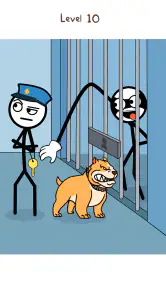
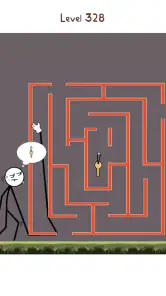
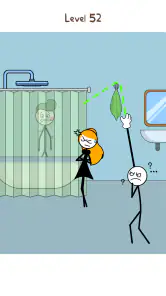
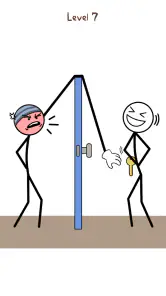
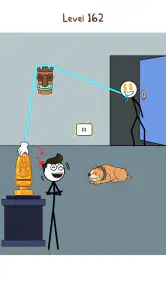
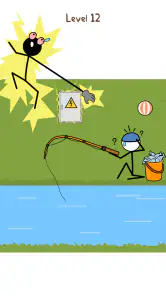
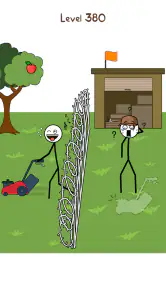
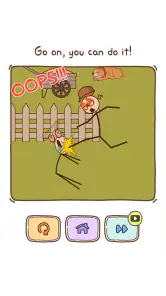
 Analysis by Frivlyz
I tend to enjoy puzzle games that give me one clear problem to solve at a time, and Thief Puzzle: to pass a level fits that mood. It is a light, mischievous game built around guiding a stickman thief through awkward situations, with each level asking me to work out how to reach the prize. I can pick it up for a quick break, but the funny outcomes also make it easy to play a few puzzles longer than I planned.
Getting a feel for the basic puzzle loop
From the moment I launched Thief Puzzle: to pass a level, I was hooked. The game presents a series of puzzles that require you to think like a thief. Your objective is simple: solve each puzzle to pass the level and steal the treasure. But don’t be fooled by its simplicity – each level challenges you to think outside the box and use your creativity to find the solution.
That straightforward loop is a real strength on a phone. I do not need to learn a long list of rules before attempting a level; I can look at the scene, identify the prize and try to figure out a route for the thief’s reaching arm. The challenge is less about memorising instructions and more about reading the arrangement carefully. I get the best results when I pause for a moment and trace a possible path in my head before making a move.
Our Stories on Thief Puzzle: to pass a level
Mastering the Art of Strategy in Thief Puzzle
NewsToon Blast: The Puzzle Game That Keeps You Hooked
NewsDancing Road Turns Short Breaks Into a Test of Rhythm and Timing
NewsSuper Stylist Makes Every Outfit a Test of Taste and Patience
NewsDominoes on Your Terms: Who Should Play and Who Should Pass
NewsPokémon GO Makes the Familiar World Feel New
NewsWhen a first attempt fails, I treat it as information rather than a reason to swipe randomly. The obstacle that stops the thief often points to what I overlooked: a guard’s position, a barrier, or the angle of the route. Trying one deliberate adjustment at a time makes the puzzle easier to understand and gives each retry a purpose. That habit also keeps the cartoon mishaps funny instead of turning the game into a string of frustrating guesses.
Creative levels, visual clues and comic failures
Every level in the game is unique, offering a fresh challenge that requires different strategies. One moment you're figuring out how to swipe a diamond from a heavily guarded museum, and the next, you're trying to sneak past a laser security system. The variety keeps the gameplay exciting and ensures that you never get bored. It's like a mental gym where each puzzle helps sharpen your cognitive skills.
The scenes reward close observation more than speed. Before I move, I look for the line the arm will follow and notice what sits between the thief and the object. A route that seems direct may be blocked, while a longer curve can make more sense. I also avoid assuming that a familiar-looking setup has the same answer as an earlier one; small changes in the picture can change the whole solution.
The graphics are simple yet effective, allowing you to focus on the task at hand. The animations add a layer of humor that makes the game all the more enjoyable. I found myself chuckling at the antics of our little stick figure thief as he bumbled his way through each scenario.
Gaming Stories You May Enjoy

Chess.com Turns Rematches Into Rivalries, but Community Has Its Costs

Archery Battle 3D Review: Sharp Aiming, Unclear Feedback

Should You Switch to Geometry Dash Meltdown? A Test of Timing and Patience

Fidget Toys Trading・Pop It 3D: What Happens When the Game Stumbles

NBA LIVE Mobile Makes the Season the Main Event

Sonic Forces: PvP Battle Race - Speed and Strategy Combined
That comic feedback is useful as well as entertaining. A failed move shows the consequence immediately, so I can connect my choice with the result and adjust on the next try. The visual simplicity helps here: the screen is not crowded with detail, and the main puzzle remains easy to read on a small display. The trade-off is that players looking for elaborate worlds, story scenes or a strong sense of progression may find the presentation intentionally modest.
Playing comfortably, improving your approach and knowing the limits
I find that the most comfortable way to play is to treat each level as a small observation task, not a test of swipe speed. In this section, I’ll look at how sound, grip and a deliberate retry routine can make attempts feel clearer, then consider where that approach helps—and where the game’s compact puzzles may not be enough.
Settings and habits worth checking
The game’s user interface is intuitive, making it easy to navigate through the different levels. The controls are straightforward, which means you spend less time figuring out how to play and more time enjoying the game itself. Plus, the hint system is a lifesaver when you’re stuck, offering helpful nudges in the right direction without completely giving the game away.
I would check the device’s sound and notification settings before settling in for a longer session, especially if I am playing in a quiet waiting room or during a commute. Those are ordinary phone controls rather than special game tricks, but they make a quick puzzle session less disruptive. I also prefer to play with the screen clean and the phone held steadily: because the action depends on a swipe, a smudge or an awkward grip can make a simple movement feel less precise than it should.
Hints work best when I use them after I have made a genuine attempt and can describe what is confusing me. If I tap for help immediately, I lose the small satisfaction of spotting the route myself. If I am still stuck after studying the layout and trying a careful alternative, a nudge can get me moving again without making every level feel solved for me. This is a useful middle ground for younger players too: they can ask for help when they need it, while still doing the thinking that makes the puzzle enjoyable.
I would not assume there is a hidden shortcut or a special setting that bypasses the thinking. The reliable way to improve is to keep the movement controlled, study the scene, and learn from what the animation shows. That repeatable approach is more helpful than swiping faster, particularly when a level looks simple enough to tempt a careless first attempt.
Who will enjoy it, and when another puzzle is a better fit
One of the things I love about Thief Puzzle: to pass a level is its universal appeal. It’s a game that can be enjoyed by both kids and adults alike. The puzzles are challenging enough to keep seasoned puzzle enthusiasts engaged, yet not so difficult that younger players can't join in the fun. It’s the perfect game to play with family or friends, stimulating conversation and teamwork as you brainstorm solutions together.
In practice, it suits people who like visual challenges, playful slapstick and short attempts more than players who want lengthy logic grids or a serious narrative. I can imagine handing the phone to a friend while waiting for food: one person studies the scene, another suggests a route, and then we see whether the thief makes it. It also works for a brief break between tasks because I can focus on one problem without needing to remember a complicated plot or a long sequence of controls.
Compared with the usual mobile puzzle alternatives, this is more about interpreting a scene and tracing a swipe than solving word clues, arranging tiles, or planning a long chain of moves. That makes it accessible, but it also means the challenge is deliberately compact. If I want deep strategy that builds over a long session, a more complex puzzle game is a better choice. If I want a quick visual problem with a silly payoff, this one is a better match.
It is also worth keeping expectations realistic about difficulty. Some levels may feel obvious once I notice the intended route, while others invite a few attempts before the trick becomes clear. Anyone who dislikes trial and error may find that rhythm irritating, and anyone seeking a calm, no-failure experience may prefer a gentler game. For me, the quick reset and humorous outcomes make the occasional wrong move easy to shrug off.
Practical details and a balanced recommendation
TapNation’s puzzle game is free to download, with in-app purchases ranging from $0.99 to $10.99 per item. It is rated Everyone, so it is suitable for a broad audience, and its simple controls make it easy for a new player to understand. The game has a 4.6 average from around 684,000 ratings and has been installed over 100 million times, which gives a useful sense of its broad reach without telling me whether its particular style will suit me.
It first arrived on January 24, 2021, and the current version is 1.17.1. The listed minimum operating system is Android 7.0. Those details are handy to check before installing, especially if I am using an older Android phone. The game is also available on iOS, so the same basic appeal is not limited to one mobile platform.
The main friction for me is not complicated controls but the possibility that a run of similar-feeling attempts can wear thin. When I am in the mood for careful observation, that repetition is part of the appeal: each failure helps narrow down the route. When I want a puzzle that rewards planning across several stages or lets me explore a larger environment, I would choose something else. I also keep in mind that free-to-play games may present optional purchases; anyone trying to control spending can review purchase settings on their device before handing it to a child.
The audience rating makes it a reasonable family option, but I still find it more fun when people take turns explaining their ideas rather than one person rushing through the levels. That small change turns a solitary swipe puzzle into a shared guessing game. For solo play, I use the same principle by stating the intended route to myself before moving; if I cannot explain why the arm should go that way, I probably have not read the scene closely enough.
My verdict on mastering the thief’s route
In conclusion, Thief Puzzle: to pass a level is a delightful addition to the world of mobile puzzle games. It's engaging, challenging, and just plain fun. Whether you're commuting, waiting for an appointment, or just kicking back at home, this game is a perfect companion. It’s a great way to pass the time while keeping your brain active. So, if you’re looking for a game that will make you think, laugh, and maybe even cry out in frustration (in a good way), give Thief Puzzle a try. Trust me, it’s worth it!
My practical recommendation is to play it in short bursts, resist random swipes, and save hints for the moment you have genuinely run out of ideas. That routine gives the puzzles room to be satisfying without making a quick break feel like homework. I would recommend it to anyone who enjoys visual, humorous challenges and wants something easy to pick up; I would skip it if I needed deep strategy, a substantial story, or a consistently demanding puzzle curve. For the right mood, its mix of simple interaction and comic consequences makes it an easy game to return to.
Thief Puzzle: to pass a level Pros and Cons
Pros
- Engaging puzzles that challenge the mind.
- Simple controls suitable for all ages.
- Unique levels keep gameplay fresh.
- Visually appealing graphics and design.
- Free to play with optional in-game purchases.
Cons
- Contains ads that can interrupt gameplay.
- Some levels may feel repetitive.
- In-app purchases can be expensive.
- Requires internet connection to play.
- Occasional bugs in certain levels.
This Game in Other Languages
Frequently Asked Questions
What is Thief Puzzle: to pass a level about?
Thief Puzzle: to pass a level is an engaging puzzle game that challenges players to solve various puzzles by strategically removing objects to help a thief complete their mission. The game combines elements of strategy and critical thinking, requiring players to use logic and creativity to progress through increasingly complex levels. It offers a fun and mentally stimulating experience for puzzle enthusiasts.
Is Thief Puzzle: to pass a level free to play?
Yes, Thief Puzzle: to pass a level is free to download and play. However, like many free mobile games, it features in-app purchases and ads. Players can choose to buy in-game items or remove ads for a smoother gaming experience. It's important to manage in-app purchases, especially if children are playing the game.
What age group is Thief Puzzle: to pass a level suitable for?
Thief Puzzle: to pass a level is suitable for players aged 12 and above. The game involves strategic thinking and problem-solving skills, which might be challenging for younger children. Additionally, the presence of in-app purchases and occasional mild content means parental guidance is recommended for younger players.
Does Thief Puzzle: to pass a level require an internet connection?
Thief Puzzle: to pass a level can be played offline, making it accessible for users who may not have a constant internet connection. However, some features, such as in-app purchases and ad removal, may require an internet connection. Always ensure you have a stable connection for these features to work properly.
How often are updates released for Thief Puzzle: to pass a level?
The developers of Thief Puzzle: to pass a level regularly release updates to improve gameplay, fix bugs, and add new levels or features. Players can expect updates every few months. It is recommended to keep the app updated to enjoy the latest content and improvements, ensuring the best possible gaming experience.


