

Take Off Bolts: Screw Puzzle
- Reviews
- 4.1
- Version
- 1.23.0
- Installs
- 10,000,000+

Screenshots
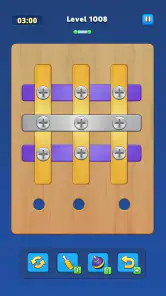
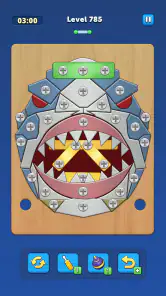
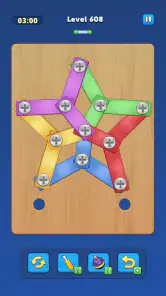
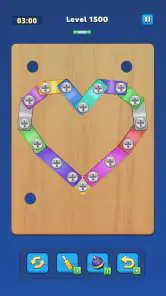
 Analysis by Frivlyz
Take Off Bolts: Screw Puzzle is the kind of mobile game I open when I want a focused break rather than a long session. It is a free puzzle game from Playful Bytes built around removing bolts in the right order, clearing pieces, and working out how the board can be dismantled without blocking the next move. The idea is easy to understand, but the better levels ask for more than quick tapping. They make me pause, inspect the layout, and decide which screw is safe to release first.
After spending time with Take Off Bolts: Screw Puzzle, my impression is that its strongest quality is the simple relationship between action and consequence. A bolt may look harmless to remove, yet it can leave another piece trapped or close off the route I need later. That gives the game a pleasant logic-puzzle rhythm: observe, predict, make a move, and adjust when the plan was not as good as expected.
It is currently available as a free game for Everyone, with optional in-app purchases ranging from $1.49 to $49.99 per item. The game has reached over ten million installs, and its average rating sits at 4.1 from around fifty-one thousand ratings. Those figures suggest that the format has found a broad audience, although the rating also tells me not to treat it as a perfect fit for every puzzle player.
How the bolt puzzles feel in everyday play
I find the everyday appeal of these bolt puzzles comes from turning a quick glance into a small plan: the board may look simple, but the order of actions matters. A useful habit is to pause before the first tap and identify which piece seems most likely to become trapped, rather than focusing only on the easiest bolt to reach. That gives each attempt a clearer purpose and sets up the next question: how to recover when the layout is less obvious.
Quick starts, but not always quick decisions
The opening appeal is immediate. I do not need to learn a complicated control scheme or remember a large set of rules. The central interaction is based on taking off bolts, and the visual arrangement does most of the explaining. That makes it comfortable for short sessions: I can start a level while waiting for an appointment, play a few moves during a commute, or use it as a mental reset between more demanding tasks.
The speed of the experience depends less on the device than on the puzzle in front of me. Easy boards move quickly because the correct sequence becomes visible after a short inspection. More involved layouts slow me down in a useful way. I find myself tracing which panel will fall, which opening will become available, and whether removing one fastener will create a dead end. The game therefore feels responsive as a mental activity even when I am not completing levels rapidly.
One practical tip is to avoid touching the most obvious bolt immediately. I first scan the entire board and look for pieces that are supported by only one or two fasteners. Removing a central bolt can be tempting, but the safer move is often the one that creates space without disturbing a useful support. This habit makes the puzzles feel less like trial and error and more like compact mechanical problems.
Gaming Stories You May Enjoy

Dancing Road Turns Short Breaks Into a Test of Rhythm and Timing

Super Stylist Makes Every Outfit a Test of Taste and Patience

Dominoes on Your Terms: Who Should Play and Who Should Pass

Pokémon GO Makes the Familiar World Feel New

Chess.com Turns Rematches Into Rivalries, but Community Has Its Costs

Archery Battle 3D Review: Sharp Aiming, Unclear Feedback
What happens during longer sessions
For casual use, the basic loop is easy to return to. I can play one puzzle and stop without feeling that I have abandoned a complicated story or lost track of a large objective. That is a genuine advantage over puzzle games that depend on long chains of upgrades, daily routines, or extensive menus. Here, the board itself remains the main thing demanding attention.
During a longer session, however, the simplicity can become a limitation. The same broad action—removing bolts in sequence—remains at the center of the experience. Players who enjoy spatial reasoning and gradual improvement may appreciate that consistency, while anyone looking for changing genres, narrative chapters, or several distinct puzzle modes may find the loop narrow. I would describe it as a game to dip into repeatedly, not necessarily one I would play continuously for an entire evening.
Heavy use also changes how I judge mistakes. When I am fresh, I am willing to restart mentally and examine the board again. After many similar puzzles, I am more likely to make a fast move simply because it looks familiar. My best approach is to treat each board as a new object instead of assuming that a pattern from the previous level applies. That small discipline prevents careless moves and makes the challenge feel fairer.
A realistic use case for busy days
Imagine having ten minutes before a meeting. A game like this works well because it does not require a large time commitment to feel complete. I can attempt a board, stop after solving it, and return later without needing to remember character names or a complicated mission. It also suits a quiet evening when I want something interactive but do not want the pressure of a competitive match.
On the other hand, I would not choose it when I need a completely passive distraction. The puzzles require visual attention, and rushing while distracted is likely to produce poor decisions. It is also not my first choice for a group setting. The experience is mainly personal and methodical, so it works better with headphones off and a few uninterrupted minutes than as a party game or shared activity.
Reliability and the value of a careful rhythm
Playful Bytes is the developer behind the game, which has been available since January 25, 2024. The current version is 1.23.0. In practical terms, the important point for me is that this is an established release rather than a newly appearing experiment. Its large install base also makes it easier to see the game as a regular puzzle title rather than a one-off novelty.
I judge reliability here by how consistently the core interaction supports a session. The concept is self-contained: the board presents a problem, and my task is to reason through it. That reduces the number of moving parts that can get in the way. I am not depending on a complex multiplayer exchange or a large online world to make a short session worthwhile.
Still, a reliable puzzle experience is not only about whether it opens. It is also about whether mistakes feel understandable. The best moments come when I can identify why my sequence failed and try again with a better plan. If I remove a bolt without considering the resulting structure, the setback feels connected to my choice. That clarity is important because it encourages learning instead of making the game feel random.
My advice is to slow down whenever a board contains several overlapping pieces. Before committing to a move, I mentally ask three questions: what will move, what space will open, and which bolt might become inaccessible afterward? This takes only a few seconds, but it is more useful than repeatedly tapping through guesses. It is also the main way I get more value from the game than the store summary alone suggests.
Where the experience may create friction
The free entry point is convenient, but the presence of optional purchases means players should decide early how they feel about spending inside a puzzle game. The listed purchase range extends from $1.49 to $49.99 per item. I would approach those options cautiously and treat them as optional conveniences rather than part of the basic reason to install the game.
That matters especially for players who prefer a pure logic challenge. If you want every solution to come from your own planning, avoid turning assistance into a habit. A hint can be useful when I have genuinely exhausted the board’s possibilities, but using help immediately can remove the satisfying part of discovering the sequence. My preferred rule is to inspect the board twice before considering any aid.
Another possible friction point is repetition. The bolt-and-panel idea is clear and approachable, but its appeal depends on how much enjoyment I get from variations within that framework. People who need a strong story, expressive characters, or a constantly changing set of mechanics should probably choose a broader puzzle adventure instead. This game is more focused and more mechanical in spirit.
Device constraints and sensible expectations
The game requires Android 8.0 or later, so compatibility is not aimed at the oldest Android devices. That requirement is worth checking before installing, particularly if you keep an older phone for casual gaming. For supported devices, the puzzle format should be less demanding than graphically intensive action games because the emphasis is on a compact board and deliberate interaction rather than a large animated world.
I would still avoid promising identical behavior on every phone or tablet. Screen size can affect comfort even when it does not affect the puzzle itself. On a smaller display, fine visual relationships between bolts and panels may deserve more attention, while a larger screen can make the board easier to inspect at a glance. If I were choosing a device specifically for this game, I would prioritize a clear screen and comfortable touch response over raw gaming power.
Resource demands are also best considered in context. This is a puzzle game designed around short, contained boards, not a title that advertises itself through expansive environments. That makes it a reasonable candidate for casual play on a supported Android device, but I would not infer that every phone will deliver exactly the same loading speed or battery behavior. The sensible expectation is modest gameplay rather than a high-end visual showcase.
For iOS users, the important decision is simply whether the version available on their device matches their expectations and preferred platform. I would not switch platforms solely for this game unless I already enjoy bolt-removal puzzles. Its appeal comes from the style of thinking it encourages, not from a platform-exclusive feature that changes the entire experience.
Recovery after a bad move
Recovery is central to this type of puzzle. A poor early decision can make the remaining arrangement awkward, so I try not to force a board once I know the sequence has become unworkable. Restarting with a new plan is often faster than attempting to rescue a position that no longer has a clean route.
The useful lesson is to distinguish a genuine mistake from a move that merely looks uncomfortable. Sometimes a piece shifts into an unfamiliar position but creates the opening needed for the next step. I give the board a moment to settle mentally before deciding that I have failed. This prevents unnecessary restarts and helps me understand the structure rather than chasing the most visually obvious result.
When I do restart, I change one assumption at a time. I might begin with an outer bolt instead of a central one, or clear a supported panel before touching the piece that initially attracted my attention. That method turns repetition into analysis. Randomly repeating the same sequence is much less effective and can make a fair puzzle feel frustrating.
How it compares with familiar puzzle alternatives
Compared with match-three games, this title is less about creating chains and more about planning a complete sequence. There is no need to wait for a lucky arrangement to appear; the board asks me to read the relationships already present. That makes it a better fit for players who want a small logic exercise and a weaker fit for anyone who prefers constant visual rewards and rapid cascades.
Compared with classic sudoku or word puzzles, the challenge is more spatial and tactile. I am not filling a grid or searching for vocabulary. I am reasoning about physical-looking objects and the consequences of removing supports. Players who enjoy visual problem solving may find that more intuitive than numbers, while those who prefer abstract deduction may need a little time to adjust.
Compared with physics-based puzzle games, the appeal is more controlled. The board suggests mechanical movement, but my enjoyment comes from choosing the order of actions rather than experimenting with elaborate tools. If you like puzzles where one small interaction can produce a surprising chain reaction, this approach should feel approachable. If you want open-ended experimentation, it may feel too directed.
That comparison also clarifies who should skip it. I would skip this game if my priority were competitive rankings, a deep narrative, or a large collection of unrelated mini-games. I would also be cautious if I dislike restarting after a sequence goes wrong. For a player who enjoys methodical boards, short sessions, and the satisfaction of finding the correct order, it is a much more natural recommendation.
My performance verdict after using it
My overall performance impression is positive but measured. The focused puzzle design should make it approachable on supported Android devices, and the game does not need the visual scale of a demanding action title to deliver its main appeal. The perceived speed comes from how quickly I can read each board, while longer sessions are governed more by repetition and concentration than by spectacle.
The strongest practical benefit is its low commitment. I can pick it up for a short mental workout, use a careful inspection routine, and put it away without feeling that I need to maintain a complicated progression. The main weaknesses are equally clear: the central mechanic may become repetitive, and optional purchases deserve attention from anyone who wants to keep the experience strictly free.
At no cost to start, with an Everyone age rating and a current version of 1.23.0, it is an easy game to try if bolt puzzles sound appealing. I would recommend it to casual players who enjoy visual logic, especially those who like finding a safe sequence rather than reacting quickly. I would point more demanding puzzle fans toward it as a compact side game, not necessarily as their only long-term challenge.
My final advice is to play slowly at first, inspect the whole structure, and treat every bolt as part of a larger chain rather than an isolated tap. If that style of thinking feels satisfying, Take Off Bolts: Screw Puzzle can turn a few spare minutes into a surprisingly absorbing exercise. If you need constant novelty or a larger sense of progression, another puzzle category will probably serve you better.
Take Off Bolts: Screw Puzzle Pros and Cons
Pros
- Simple controls make it easy to start playing immediately.
- Short levels are convenient for quick sessions during spare time.
- Gradual difficulty keeps the puzzle experience approachable at first.
- Satisfying bolt-removal animations make successful moves feel rewarding.
- Works well for players who enjoy spatial reasoning and planning.
Cons
- Later levels can feel repetitive once the core mechanics become familiar.
- Some puzzles may rely more on trial and error than clear deduction.
- Mistakes can be frustrating when one move blocks the remaining solution.
- Progress may feel slow for players seeking faster-paced gameplay.
- Frequent advertising may interrupt the flow between completed levels.
Frequently Asked Questions
What is Take Off Bolts: Screw Puzzle?
Take Off Bolts: Screw Puzzle is a casual physics and logic game built around removing bolts, screws, pins, and other fasteners in the correct order. Each level presents a mechanical-style arrangement that must be dismantled carefully. The main challenge is planning your moves, opening space, and avoiding situations where a piece becomes trapped or impossible to remove.
How do you play Take Off Bolts: Screw Puzzle?
The gameplay is based on tapping or selecting bolts and moving them into available holes or positions while gradually taking apart the structure. Before making a move, you need to examine the board and consider which fastener should be removed first. Later stages generally introduce tighter layouts, more obstacles, and arrangements that require several steps of forward planning rather than random tapping.
Is Take Off Bolts: Screw Puzzle free to download and play?
The game can generally be downloaded without an upfront purchase, allowing players to try its core puzzle levels at no initial cost. However, free mobile games may include advertisements, optional purchases, extra hints, or other paid features. Availability and pricing can vary between Android and iOS, so it is worth checking the store listing and in-app purchase information before downloading.
Does Take Off Bolts: Screw Puzzle require an internet connection?
Many levels in this type of puzzle game can usually be played offline after the application has been installed, which makes it suitable for short sessions while travelling or when mobile data is unavailable. Nevertheless, advertisements, cloud synchronization, rewards, updates, and some special content may require an internet connection. The exact offline functionality can also change with future updates.
Is Take Off Bolts: Screw Puzzle suitable for children and casual players?
Take Off Bolts: Screw Puzzle is easy to understand because its controls are simple and the objective is clearly presented. It can suit casual players who enjoy short logic challenges, although some levels may become surprisingly difficult and require patience. Parents should still review the age rating, advertising, and optional purchase settings, particularly if children will be playing on a shared device.


