

Solitaire Tripeaks - Farm Trip
- Reviews
- 4.8
- Version
- 2.31.7.20260629
- Installs
- 5,000,000+

Screenshots

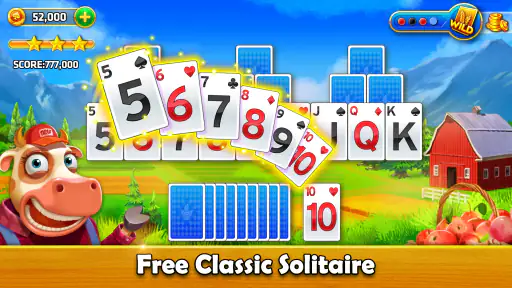
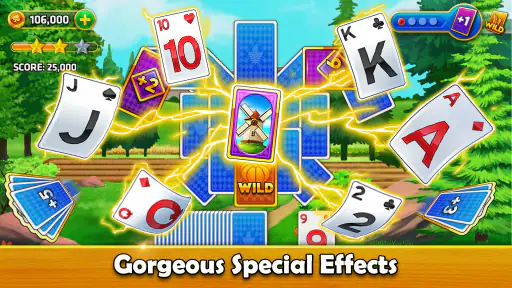
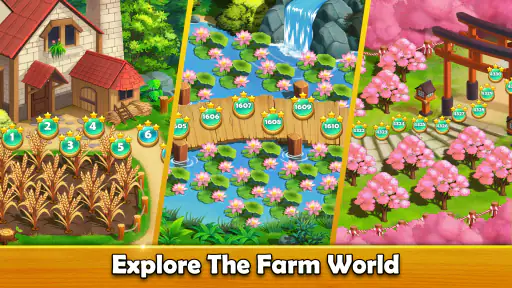
 Analysis by Frivlyz
I spent time with Solitaire Tripeaks - Farm Trip as a light card game built around a familiar patience format and a simple farming theme. The basic idea is easy to understand: clear cards from a TriPeaks layout, make sensible choices, and gradually connect that play with a farm-building setting. It is the kind of game I can open without preparing myself for a long session, which is a big part of its appeal.
What makes it worth considering is not a complicated ruleset, but the way it combines a recognizable Solitaire Tripeaks loop with a calmer visual goal. I found it more suitable for short breaks than for intense, uninterrupted play. At the same time, anyone deciding whether to install it should look beyond the relaxing presentation and think about progress pressure, optional spending, and how much variety they expect from a card game.
How the card loop fits the farm setting
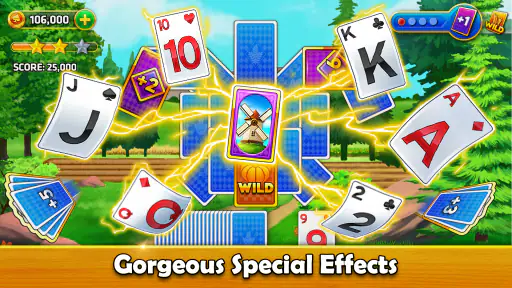
The main attraction is the card puzzle itself. In Tripeaks solitaire, I am usually watching for cards that can be removed in sequence while trying not to waste useful moves too early. That creates a small but meaningful balance between immediate opportunities and preserving flexibility for later. The rules are approachable enough for someone who already knows solitaire, while the layout gives each hand a little more direction than a completely open arrangement.
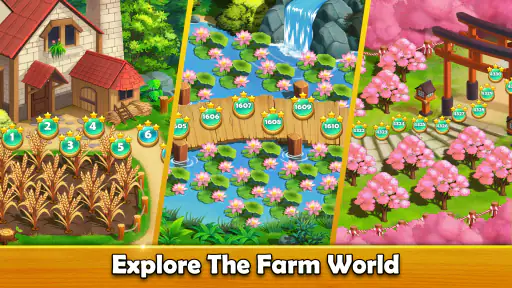
The farm theme gives the activity a longer-term feeling. Instead of treating every deal as an isolated puzzle, the game frames progress as part of building and developing a farm. That framing matters because it gives a reason to continue after a single successful round. I personally prefer this kind of gentle structure when I want a casual game, although players who only want pure card play may find the decoration and progression layer less important.
Fruit Puzzle Games is the developer behind the game, and the title sits clearly in the card-game category rather than trying to be a full farming simulation. That distinction is useful. I would not install it expecting detailed crop management, deep resource planning, or the broad systems of a dedicated farm game. The farm element works best as a backdrop and motivation for returning to solitaire.
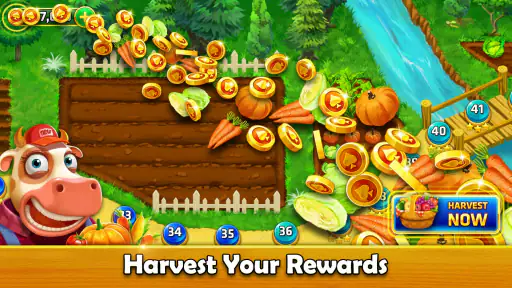
The store summary presents it as a relaxing way to plant, harvest, and build around Tripeaks solitaire. In my experience, that promise is most convincing when I use the game in small portions. The card decisions give my attention something to do, while the farm theme keeps the experience from feeling like a plain deck of cards. It is a modest combination, but a sensible one for casual mobile play.
What a normal session feels like
A realistic use case is a short wait before an appointment or a quiet few minutes after dinner. I can start a round, focus on the available card sequence, and stop when the moment is over without needing to remember a complicated story or control scheme. That makes it more convenient than many action games, which often punish interruptions or require a longer commitment before a session feels worthwhile.
Gaming Stories You May Enjoy

Dancing Road Turns Short Breaks Into a Test of Rhythm and Timing

Super Stylist Makes Every Outfit a Test of Taste and Patience

Dominoes on Your Terms: Who Should Play and Who Should Pass

Pokémon GO Makes the Familiar World Feel New

Chess.com Turns Rematches Into Rivalries, but Community Has Its Costs

Archery Battle 3D Review: Sharp Aiming, Unclear Feedback
The same simplicity can become a limitation. If I am looking for a deep strategy game with several distinct modes, a strong narrative, or a large collection of mechanics, this is not the right destination. Its strength is the repeatable card puzzle, not a wide range of activities. The farm theme adds context, but it does not change the game into a management simulator.
One useful habit is to treat each deal as a planning exercise rather than tapping the first available card automatically. I get more value from looking at the visible options, considering whether a short chain can be extended, and avoiding moves that remove my only useful continuation. This is a small tip, but it changes the experience from random tapping into a more deliberate puzzle.
Free access and the spending question
The game is free to download, which makes it easy to try without committing money at the start. It includes in-app purchases ranging from $0.99 to $99.99 per item. That is the key spending context I would keep in mind before playing regularly: the entry point is free, but the purchase range reaches from a small optional transaction to a much larger one.
I would approach those purchases carefully and decide in advance whether I am comfortable spending anything. A good personal rule is to play several sessions first, learn whether the card loop genuinely holds my attention, and only then consider an optional purchase. There is no reason to spend simply because a later round feels inconvenient or because progress appears slower than expected.
The purchase range tells me that spending can be meaningful for different kinds of players, but it does not by itself explain what every item does or how strongly purchases affect progression. I therefore would not assume that buying is necessary, nor would I assume that it has no effect. The sensible approach is to inspect each offer in the game before confirming it and to use device purchase controls if children may access the app.
For a relaxed player, the most important question is not whether the game has purchases, but whether the free experience remains enjoyable without turning every session into a shopping decision. I would judge that personally over time. If the card puzzles are enough to keep me interested, I can treat the farm progression as a bonus rather than something I need to accelerate.
Progress, repetition, and the feeling of pressure
The farm structure gives repeated solitaire rounds a visible purpose, but it can also create a subtle pressure to continue. When a game links cards to building or harvesting, I may feel that stopping means leaving progress unfinished. That feeling is not automatically negative; it can make a short puzzle more satisfying. Still, I find it healthier to set my own stopping point instead of chasing the next reward whenever a session starts to feel repetitive.
This is particularly relevant for players who enjoy completion. The card format naturally asks me to try again after an unsuccessful deal, and the farm context can make that retry feel more important. I recommend treating a failed round as part of the puzzle rather than as a reason to spend immediately. Waiting, changing my approach, or simply returning later keeps the game closer to its relaxing purpose.
Another practical tip is to separate enjoyment from progress. If I am having fun analyzing the layout, the round is already doing its job even when the farm does not advance as quickly as I wanted. That mindset reduces the temptation to measure every session only by what I unlocked. It also makes the game more suitable for casual players who do not want a second job disguised as a card game.
Players who need constant novelty should think carefully before installing. Tripeaks solitaire depends on a familiar pattern, so its appeal comes from decisions within that pattern rather than dramatic mechanical change. I can enjoy that repetition when I want something steady, but I would choose a broader card collection or a more competitive title if I wanted frequent surprises and sharper escalation.
Is the experience fair for competitive players?
This is primarily a personal puzzle and progression game, not something I would choose as a serious competitive benchmark. That matters when judging fairness. If I am comparing my performance with friends or trying to prove skill through tightly balanced matches, a dedicated competitive card game would likely serve me better. The farm framing points more toward individual progress and relaxation than toward a formal contest.
For me, fairness here means having a clear relationship between my decisions and the outcome. I want to feel that planning card chains matters, rather than believing that spending is the only reliable way forward. The available purchase information confirms that optional items exist and can cost between $0.99 and $99.99 each, but it does not establish a complete competitive system or prove that purchases determine success. I would therefore avoid presenting it as an esports-style test of equal conditions.
If I were playing alongside a child, I would explain that free access does not mean every item inside the game is free. The Everyone age rating makes the game broadly accessible, but age suitability and spending suitability are separate questions. A family can enjoy the card puzzles while still keeping purchases protected and discussing when an in-game offer is worth ignoring.
My own fairness test would be simple: can I open the game for a short break, play the cards, and leave without feeling pushed into a transaction? If the answer remains yes, the purchase system is easier for me to live with. If the experience starts making progress feel like a payment decision, I would stop spending and reconsider whether this particular style of casual game suits me.
Device reach and practical expectations
The game was released on April 10, 2020, and its current version is 2.31.7.20260629. It requires Android 7.0 or later, so anyone using an older Android device should check compatibility before planning around it. That requirement is not especially demanding for many users, but it is still worth checking if the game is intended for an older phone or tablet.
Its broad reach is reflected in more than five million installs, with an average rating of 4.8 from around ninety-nine thousand ratings. Those figures suggest that the combination of solitaire and farming has found a substantial casual audience. I would treat that as a useful signal of popularity, not as proof that every player will enjoy the same pace or progression style.
The game is rated Everyone, which fits its accessible card format and non-specialist presentation. I would still distinguish between content suitability and play habits. A game can be appropriate for a wide age range while still encouraging frequent returns or presenting optional purchases, so families should make their own rules about screen time and spending.
One unknown I would keep in mind is how the long-term balance feels for a particular player. Store information can establish the purchase range, version, compatibility, and audience response, but it cannot replace several personal sessions. I would use the free entry point to test whether the card layouts remain enjoyable after the first impression, especially if I normally tire quickly of repeated solitaire formats.
Who should play it, and who should skip it?
I would recommend it to someone who already likes solitaire and wants a softer setting around it. It is also a good match for players who enjoy short, interruptible sessions and like having a visual sense of building toward something. The farm theme can make ordinary card clearing feel more purposeful without demanding that I learn a complex strategy system.
I would be more cautious about recommending it to someone who dislikes repetition, expects a fully featured farming game, or wants direct competition with carefully defined rankings. Those players may be happier with a dedicated farm simulator, a multiplayer card game, or a solitaire collection offering several rule variations. Choosing one of those alternatives would not mean this game is poor; it would simply reflect a different reason for playing.
I would also skip it if I know I am vulnerable to chasing progress through purchases. The free price is inviting, but the presence of items from $0.99 to $99.99 means I should enter with a clear budget. For me, this is a game to enjoy on its own terms, not a project that deserves increasingly large spending just because I have already invested time in it.
My trust verdict after weighing the trade-offs
My final view is positive but measured. Solitaire Tripeaks - Farm Trip succeeds when I want a familiar card puzzle with a pleasant farm-oriented reason to keep playing. It is easy to approach, suitable for brief everyday sessions, and supported by a large audience. The 4.8 average and roughly ninety-nine thousand ratings reinforce that it has connected with many players, although my recommendation still depends on whether the Tripeaks loop itself is enjoyable to you.
I trust it most as a free game I can sample without pressure, then evaluate based on how I feel after repeated rounds. I would not promise that it offers deep farming strategy or endless variety, because that is not where its appeal lies. I would also keep purchases under deliberate control, particularly because the listed per-item range extends from small amounts to $99.99.
The best way to approach this game is to enjoy the cards first and treat the farm progress as an extra layer, not a bill to be paid. If that sounds like the kind of calm, repeatable mobile activity you want, it is worth trying. If you need competitive fairness, complex simulation, or constant mechanical change, another card or farming game will probably be a better fit.
Solitaire Tripeaks - Farm Trip Pros and Cons
Pros
- Relaxing solitaire gameplay suitable for short sessions.
- Farm-themed visuals give the classic card game a cheerful style.
- Simple controls make it accessible for casual players.
- Level progression provides a clear sense of ongoing achievement.
- Offline play may be convenient when an internet connection is unavailable.
Cons
- Some later levels can feel heavily dependent on card luck.
- Energy or life limits may interrupt longer play sessions.
- Frequent rewards and events can make the interface feel busy.
- Optional purchases may appeal to players seeking faster progress.
- The core gameplay may become repetitive after extended play.
Frequently Asked Questions
What is Solitaire TriPeaks - Farm Trip?
Solitaire TriPeaks - Farm Trip is a casual card game that combines classic TriPeaks solitaire with a colorful farm-themed setting. The main objective is to clear cards from the tableau by selecting cards that are one value higher or lower than the card in the discard pile. As you progress, you complete levels, earn rewards, and unlock new farm areas and visual content.
How do you play Solitaire TriPeaks - Farm Trip?
Each level presents a layout of face-up and face-down cards arranged in TriPeaks formations. You remove available cards by matching them with a card that is one rank above or below the current discard card. Aces may generally connect with kings or twos, depending on the game’s rules. When no suitable move is available, you draw from the stock and try to continue the sequence.
Is Solitaire TriPeaks - Farm Trip free to download and play?
The game can generally be downloaded and played without an upfront purchase, allowing users to begin with a selection of levels and features at no cost. However, optional in-app purchases may be available for coins, boosters, extra lives, or other advantages. Advertising can also appear during play, so check the store listing and purchase settings before downloading.
Can Solitaire TriPeaks - Farm Trip be played offline?
Some solitaire levels may remain playable without a continuous internet connection, which is useful when traveling or playing in areas with limited reception. Nevertheless, online access may be required for advertisements, cloud synchronization, updates, special events, leaderboards, or in-app purchases. Offline availability can vary by device and version, so test the game after installation.
Is Solitaire TriPeaks - Farm Trip suitable for all ages?
The basic card mechanics are simple to understand and the farm theme makes the game approachable for casual players, including many younger users. However, the app may include advertisements, optional purchases, social features, or age-related store restrictions. Parents should review the game’s content rating, privacy information, and device purchase controls before allowing children to play.


