

Smashy Road: Wanted 2
- Reviews
- 4.0
- Version
- 1.52
- Installs
- 10,000,000+

Screenshots
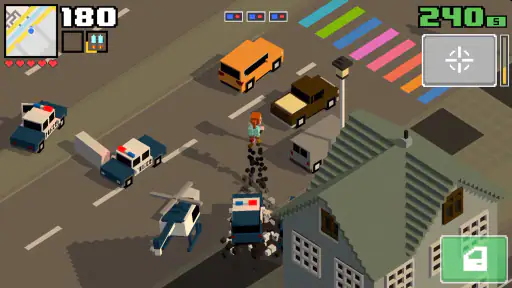
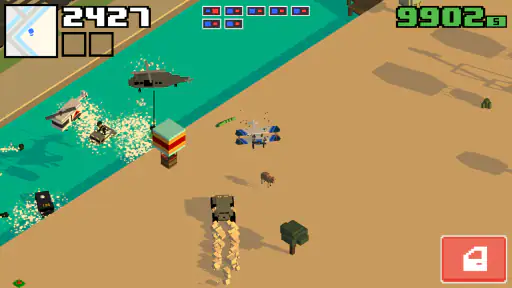
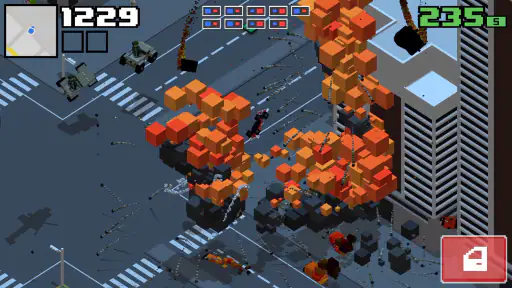
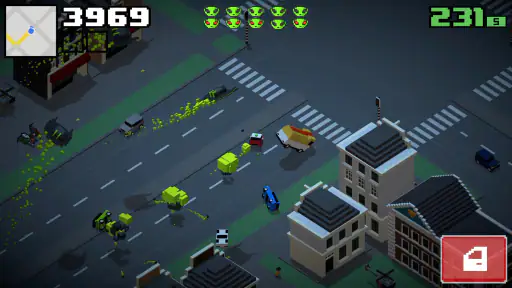
 Analysis by Frivlyz
I first understood the appeal of Smashy Road: Wanted 2 during a short break when I wanted something immediate rather than a long campaign. The idea is simple: I am being chased, I need to keep moving, and every second on the road creates another chance to escape or make a spectacular mistake. That direct pressure makes it a natural choice for quick sessions on a phone, especially when a device is shared around the house and nobody wants to commit to a complicated setup.
This is an action game from Bearbit Studios B.V., available free of charge, with optional purchases priced from $0.99 to $18.99 per item. Its store summary asks how long you can stay on the run, and that is a fair description of the central challenge. I would not approach it expecting a realistic driving simulator or a slow, story-heavy adventure. I see it as a fast arcade chase built around improvisation, traffic, obstacles, and the satisfying tension of trying to survive a little longer than last time.
How it works when a household shares the device
The biggest strength for shared use is that the game explains itself through play. A person can pick it up, move through the opening moments, and quickly understand the basic rhythm without needing a long tutorial session from someone else. That matters when one phone or tablet moves between family members, because the next player can usually start from the main game flow instead of asking for a detailed lesson.
I also like the fact that the short-session design fits ordinary household interruptions. If dinner is ready, a younger player needs the device, or I simply have only a few minutes before leaving, I can play a run without treating it like a major appointment. The chase structure gives each attempt a clear beginning and end, which feels more practical than handing over a game that expects everyone to remember a large map, a complicated inventory, or a long chain of objectives.
That convenience has a trade-off. The same immediate design can make the game feel repetitive if the player expects a large narrative or a carefully paced progression system. The fun comes from reacting to what happens during a run, not from discovering a deep plot. I would recommend it to someone who enjoys trying again after a poor escape, but I would steer a story-focused player toward a more traditional adventure game.
For a shared device, I would establish a simple routine: one person plays a short run, then hands the phone over rather than continuing indefinitely. This is not a special feature of the game; it is just a sensible way to keep the experience friendly. Because the action is easy to understand but difficult to master, watching another person play can be entertaining too. A child may learn a useful route or reaction by observing an older player, while the older player may discover that a younger family member is better at making quick turns.
The right expectations before anyone starts
The game is rated Everyone 10+, so I would treat it as a better fit for older children, teenagers, and adults than for very young players. The rating is not a substitute for a parent’s judgement, particularly because the game revolves around pursuit and crashes. In my view, the presentation is more cartoon-like arcade action than realistic driving, but families should still decide whether that kind of chase theme suits the person using the device.
Gaming Stories You May Enjoy

Dancing Road Turns Short Breaks Into a Test of Rhythm and Timing

Super Stylist Makes Every Outfit a Test of Taste and Patience

Dominoes on Your Terms: Who Should Play and Who Should Pass

Pokémon GO Makes the Familiar World Feel New

Chess.com Turns Rematches Into Rivalries, but Community Has Its Costs

Archery Battle 3D Review: Sharp Aiming, Unclear Feedback
The game has passed ten million installs and holds an average rating of 4.0 from around one hundred five thousand ratings, with roughly four thousand one hundred written reviews. Those figures suggest a broad audience and a substantial amount of player feedback, but they do not tell me whether it will match a particular household. I pay more attention to the play style: quick reactions, repeated attempts, and a willingness to accept failure are more important than popularity here.
The minimum operating-system requirement is Android 6.0. On a compatible device, I would still leave some attention for practical matters such as available storage, battery use, and who is allowed to make purchases. Those are not gameplay problems, but they become important when a phone belongs to more than one person. A free download can still create questions if optional items are available, so I would agree on the household rule before handing the device to a child.
Keeping play and ownership separate
Shared-device gaming works best when everyone knows what belongs to the device and what belongs to the individual player. I would not assume that a run, unlock, or purchase should be treated as a personal achievement unless the household has agreed on that. If several people take turns, the simplest approach is to regard the game as a common activity and avoid arguments over who “owns” progress made during another person’s turn.
This is especially useful because the game encourages repeated attempts. One player may want to chase a personal best, while another may simply want to cause a dramatic escape and pass the phone along. Those are different goals, and neither is wrong. The household can make the experience smoother by deciding whether the priority is competition, cooperation, or casual rotation.
I would also keep purchase responsibility with the device owner. The optional items range from $0.99 to $18.99, so the difference between a harmless curiosity and an unwanted charge can be significant. I would explain clearly that tapping a purchase is not part of the basic requirement for playing. The game is free to start, but “free” should not be confused with “nothing needs to be discussed” on a shared device.
One practical tip is to let each player describe what they want from a session before beginning. If someone wants a calm turn, the chase may not deliver that. If someone wants to experiment, another player should not immediately take over after a failed attempt. This tiny bit of coordination prevents the game’s fast pace from turning into household frustration.
Why the chase feels good, and where it becomes demanding
What keeps me playing is the balance between control and unpredictability. I can make a plan, but the road keeps asking me to adjust it. A route that looked safe can become awkward when traffic or an obstacle changes the available space. That makes the game more interesting than simply holding one direction and waiting for a result. The best moments come when I recover from a mistake rather than when everything goes perfectly.
That recovery-based design is also why the game suits short breaks. I do not need a quiet hour to appreciate it. A single attempt can provide a complete little story: a confident start, a risky shortcut, a near miss, and an ending that makes me think I could have survived if I had reacted earlier. The next attempt then feels purposeful without requiring a large commitment.
My main limitation is that the same loop can lose its freshness for players who need constant novelty. If you dislike repeating a challenge after failure, the chase may feel more irritating than exciting. It is also not the best choice for someone who wants precise simulation controls. The appeal is arcade responsiveness and pressure, not careful recreation of real-world driving.
Another trade-off is attention. Although a run may be brief, the action does not leave much room for distraction. On a shared family device, I would avoid playing while walking, crossing a street, or doing anything that requires awareness elsewhere. At home, the game is easy to fit between tasks, but it still rewards a player who gives it a focused few minutes rather than constantly looking away.
How I would coordinate turns and expectations
For two or more people, I would use a simple rotation rather than letting the strongest player dominate the device. Each person gets one attempt, then the phone moves on. This works particularly well because failure is part of the game, so a short turn does not feel pointless. It also gives less experienced players room to improve without being compared with someone who has already learned the roads and reactions.
A friendly household competition can work, but I would measure more than survival time. The player who lasts longest is not automatically the most entertaining to watch, and a risky escape may be more memorable than a cautious run. I would encourage players to share one useful observation after each turn, such as which mistake ended the attempt or where a sudden decision was needed. That turns the game into a small coordination activity rather than silent score chasing.
There is also a good use case for siblings or friends sitting together. One person can hold the device while another gives route suggestions, although the driver should have the final say. Too many instructions can make a fast game harder, so I would keep the advice short: point out a danger, suggest a direction, and then let the player react. This makes spectators feel involved without pretending that the game is cooperative multiplayer.
For adults sharing a device with children, I would separate game advice from purchase advice. Helping with a difficult escape is harmless guidance; approving a purchase is a separate responsibility. The game’s free entry makes it easy to try, but the presence of optional items means the household should not rely on assumptions. A clear rule before play is more comfortable than sorting out a surprise afterward.
Age, trust, and the kind of player who will enjoy it
For a child who likes cars, quick reactions, and playful chaos, this can be an approachable action game. I would still watch the first few sessions, not because the controls are mysterious, but because the player may need help understanding that losing is normal and that purchases are optional. The most useful adult role is setting boundaries around time and spending, then allowing the child to experiment with the driving itself.
For teenagers, the game can work well as a quick break between other activities. It does not demand the same emotional investment as a large competitive title, and it is easy to show a friend a funny escape or a bad mistake. Adults who enjoy arcade games may appreciate the clean focus, particularly if they remember older chase games but do not want to install something demanding or complicated.
I would skip it for someone who wants a relaxing driving experience. The constant feeling of being pursued means the game is built around urgency. I would also choose another option for a player who needs a strong story, extensive character development, or a clearly structured campaign. This game’s identity is its chase loop, and asking it to behave like a narrative adventure will only create disappointment.
The age rating also deserves a little context in a shared household. “Everyone 10+” gives a useful starting point, but children differ in how they respond to crash-focused action and repeated failure. Some will laugh and immediately try again; others may find the pressure tiring. I would let the player’s reaction guide the amount of play rather than assuming that an age label answers every family question.
Where it stands beside other action games
Compared with a realistic racing game, this is much easier to pick up and much less concerned with authentic driving technique. I do not need to approach it as a test of braking points, racing lines, or vehicle setup. Compared with a story-led action game, it offers less narrative direction but reaches the fun faster. Compared with a slow puzzle game, it asks for quicker decisions and gives me less time to consider every move.
That position makes it useful as a secondary game rather than a single all-purpose choice. I can keep it for moments when I want immediate action, while using a racing simulator for careful competition or a narrative game for a longer evening. The comparison is important because the game is not trying to win every category. Its strongest argument is that it turns a few spare minutes into a tense arcade challenge without a long preamble.
The developer, Bearbit Studios B.V., has given the game a clear identity instead of burying the chase under unnecessary complexity. I appreciate that focus, but focus can also expose repetition. If I play for too long in one sitting, I notice the core loop more clearly. My advice is to stop while the last attempt still feels like something I want to improve. That keeps the game refreshing when I return later.
The current version is 1.52, and the game was released on August 5, 2020. For someone choosing an app today, those details place it as an established title rather than a brand-new experiment. I would approach it with the expectation of a known arcade format: easy to sample, quick to understand, and best enjoyed in bursts rather than as a substitute for a huge modern action production.
My household verdict after weighing the trade-offs
I recommend Smashy Road: Wanted 2 for households that want a free, quick-to-start action game that several people can understand without a lengthy explanation. It is particularly good when the device changes hands often, because each attempt is self-contained and spectators can follow the action. The strongest shared-use habit is simple rotation: agree on turns, keep purchase decisions with the owner, and treat progress as a common activity unless separate boundaries have been arranged.
I would be more cautious if the main player is very young, easily frustrated by repeated failure, or likely to tap optional purchases without asking. The Everyone 10+ rating is a useful guide, not a replacement for supervision. I would also avoid recommending it to anyone searching for realistic driving, deep storytelling, or a calm experience. Those players will probably be happier with a different type of game.
For me, the deciding quality is how quickly a routine moment becomes a little challenge. Waiting for someone, taking a break from work, or sharing a phone after dinner can all become an excuse for one more escape. The game does not need to pretend to be larger than it is. It offers arcade pursuit, quick decisions, and the satisfaction of surviving a messy situation for a little longer.
My final view is positive but specific: this is a strong choice for short, energetic sessions and casual household rotation, not a universal driving recommendation. If everyone understands that the fun comes from repeating the chase, learning from mistakes, and managing optional spending responsibly, the free download is easy to justify. Its best feature is not complexity but immediacy: anyone can start, yet staying in control remains a real challenge.
Smashy Road: Wanted 2 Pros and Cons
Pros
- Fast-paced driving feels exciting from the first session.
- Large open areas encourage exploration and creative escapes.
- Many unlockable vehicles provide useful variety between runs.
- Simple controls make the game easy to learn on mobile.
- Short sessions work well for quick breaks or casual play.
Cons
- Random events can sometimes make failures feel unfair.
- Progress may require considerable time to unlock preferred vehicles.
- Visual effects can become distracting during crowded police chases.
- Some challenges feel repetitive after extended play sessions.
- Ads and optional purchases may interrupt the overall experience.
Frequently Asked Questions
What is Smashy Road: Wanted 2?
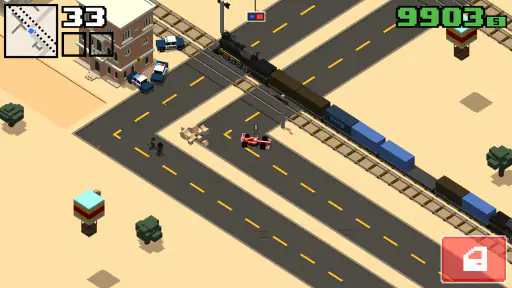
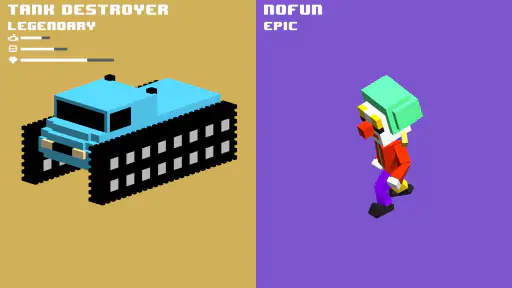
Smashy Road: Wanted 2 is an arcade driving and police-escape game for Android and iOS. You drive through an open, blocky world while avoiding police, military vehicles, and other hazards. The controls are intentionally simple, making it easy to start playing, while the escalating pursuit system keeps each run challenging. The main goal is to survive as long as possible, collect rewards, unlock vehicles, and discover different characters and locations.
Is Smashy Road: Wanted 2 free to download and play?
Yes, Smashy Road: Wanted 2 can generally be downloaded for free, but the game may include optional in-app purchases and advertising. You can progress without paying, although some purchases may help unlock content or provide additional convenience. Because gameplay involves repeated runs and rewards, players who prefer a completely uninterrupted experience should review the current store listing and in-game purchase settings before downloading.
Does Smashy Road: Wanted 2 require an internet connection?
The game is primarily designed as a casual mobile experience and many driving sessions can usually be played offline. However, certain features may depend on an internet connection, including advertisements, cloud-related services, store content, updates, or optional online functionality. Availability can also vary by device and game version, so it is best to launch the game once while connected before relying on it during travel or in areas without reliable mobile data.
What are the main features and gameplay mechanics?
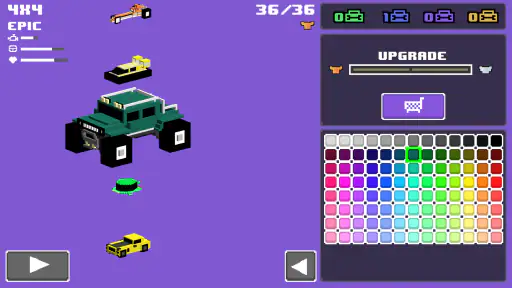
Smashy Road: Wanted 2 focuses on fast arcade chases rather than realistic driving simulation. You steer through an open environment, escape increasingly aggressive pursuers, use the surroundings to your advantage, and try to maintain control during chaotic collisions. The game includes a variety of vehicles and unlockable characters, along with missions, collectibles, and randomly developing situations that help make each attempt feel different. Its short sessions work well for quick breaks.
Is Smashy Road: Wanted 2 suitable for children and low-end devices?
The game uses colorful, pixel-inspired visuals and cartoon-style action, so it is generally more approachable than realistic crime or combat games. Nevertheless, parents should remember that it portrays police chases, crashes, and chaotic driving, and may contain advertising or optional purchases. Performance is usually suitable for many modern phones, but older or low-end devices may experience reduced performance. Check the required operating-system version and store compatibility before installing.


