

Rising Super Chef - Cook Fast
- Reviews
- 4.7
- Version
- 10.8.0
- Installs
- 10,000,000+

Screenshots





 Analysis by Frivlyz
I went into Rising Super Chef - Cook Fast expecting a simple time-management game, but its appeal is more specific than that. It turns the familiar pressure of serving food into a compact routine built around quick decisions, visual order, and the satisfaction of keeping a kitchen moving. You prepare dishes, respond to customer demands, and try to avoid the small mistakes that can turn a smooth shift into a scramble. It is easy to understand, but staying consistent becomes the real challenge.
This is a free simulation game from Mini Stone Games - Chef & Restaurant Cooking Games, aimed at Everyone and available for devices running Android 7.0 or later. The game has built a substantial audience, with over 10 million installs, a 4.7 average from around 237 thousand ratings, and roughly 13 thousand written reviews. Those figures do not make it automatically perfect, but they do suggest that its fast kitchen format has remained appealing to a wide range of players.
My overall impression is that it works best as a short-session game. I can play for a few minutes while waiting for an appointment, complete a handful of tasks, and stop without feeling that I have abandoned a complicated strategy plan. At the same time, it is not really a relaxing cooking experience. The food theme is friendly, but the play depends on speed, memory, and recovering quickly when several orders arrive together.
How the current kitchen experience feels
I find the current kitchen experience easiest to judge by how well its simple order-and-serve rhythm holds up once several requests compete for attention. What matters most is not tapping faster, but learning to read the counter and choose a useful next action; that practical rhythm also gives a helpful lens for considering how the game has changed over time.
A clear loop that becomes demanding quickly
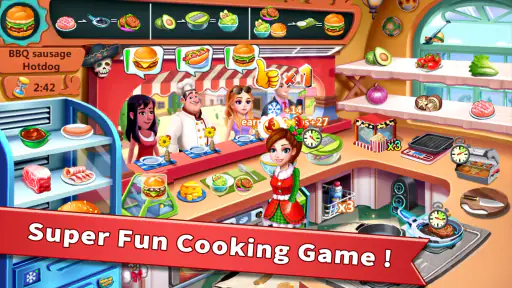
The central loop is straightforward: customers ask for food, I assemble or prepare what they want, and I try to serve it before the pressure becomes too much. Burgers, pizza, coffee, and bakery-style items give the kitchen a varied identity without making the controls difficult to learn. The first few moments are approachable, while later sessions test whether I can prioritize correctly instead of simply tapping as fast as possible.
That distinction matters. Fast fingers help, but they are not enough. I have to notice which order is closest to completion, remember which item needs attention next, and avoid wasting time on a dish that is not immediately useful. A player who treats every customer equally can easily create a backlog. A player who scans the whole counter before acting usually has a better chance of keeping the queue under control.
The visual presentation supports that style of play. Food orders are easier to understand when the ingredients and finished items are presented clearly, and the kitchen theme gives each short session a recognizable purpose. I never felt that I needed a long tutorial to know what the game wanted from me. That accessibility is one of its strongest qualities, especially for people who do not usually play management games.
Gaming Stories You May Enjoy

Dancing Road Turns Short Breaks Into a Test of Rhythm and Timing

Super Stylist Makes Every Outfit a Test of Taste and Patience

Dominoes on Your Terms: Who Should Play and Who Should Pass

Pokémon GO Makes the Familiar World Feel New

Chess.com Turns Rematches Into Rivalries, but Community Has Its Costs

Archery Battle 3D Review: Sharp Aiming, Unclear Feedback
Why the food theme works better than a generic timer
Many time-management games could replace their setting without changing much of the experience. Here, the cooking theme gives the actions a natural rhythm. A burger, a coffee, or a baked item feels like a small task with a visible beginning and end. That makes the pressure easier to read than an abstract list of buttons or numbers.
I also like that the game creates tension through combinations of ordinary actions rather than complicated rules. One order might be easy on its own, but two or three different food requests arriving close together force me to divide attention. The enjoyment comes from finding a workable sequence: start one task, serve another, return to the first, and prepare the next item before the kitchen becomes crowded.
This makes the game a good fit for players who enjoy light strategy but do not want a large management spreadsheet. It is less about designing a restaurant from the ground up and more about performing well inside a busy service. If you want deep decoration, staff scheduling, or detailed economic planning, this is not the same type of experience. Its focus is the immediate flow of cooking and serving.
Playing in an everyday situation
A realistic use case is a short break during a commute or a quiet moment before dinner. I can open the game, play a few rounds, and put it away when I need to return to something else. There is no need to reserve a long evening for it, and the basic controls are simple enough to use when I want entertainment without learning a new system.
That convenience has a trade-off. Because the sessions are built around momentum, interruptions can be more annoying than they would be in a turn-based puzzle game. If I leave in the middle of a busy kitchen sequence, I lose the rhythm that helps me remember which order deserves attention. For someone who regularly plays while multitasking, a slower simulation or a traditional puzzle game may be a better match.
What the current version says about its evolution
The version history matters less to me as a promise of constant reinvention than as context for a game that has kept its quick-service identity. For a new player, the useful question is whether that established format still feels approachable and engaging today, rather than whether it resembles a more elaborate restaurant simulator. That distinction leads directly to the limits I would weigh before installing it.
A long-running format rather than a brand-new experiment
The game was released on May 4, 2017, and the current version is 10.8.0. That combination tells me I am looking at an established title rather than a newly launched cooking concept. The important point is not simply the version number; it is that the game has continued to exist as a recognizable product while retaining its quick-service identity.
For an existing player, a current version can matter because it is the version that defines the present experience, not the one remembered from an earlier installation. Menus, balancing, progression pacing, and the feel of repeated sessions can change over time even when the basic idea remains familiar. I would therefore judge the game by how well its current kitchen loop holds up, rather than assuming that an old memory of it tells the whole story.
The evolution is most visible in the way the product presents itself as a complete cooking game instead of a single novelty mechanic. The combination of burger preparation, pizza work, coffee service, and bakery tasks gives the title a broader food-service identity. It still has a focused core, but the setting is not limited to one repetitive recipe.
What that means for someone installing it today
A new player does not need to know the earlier versions to understand the game. The basic appeal is immediate: serve food, manage the rush, and improve your handling of the kitchen. That makes it relatively easy to approach even if you have never played a restaurant simulation before.
However, the long-running nature of the title also means that players should not expect every part of it to feel modern or experimental. The strongest design choice is still the quick service loop. If that loop appeals to you, the age of the release is not a serious obstacle. If you are looking for a constantly surprising structure, a story-heavy restaurant adventure, or a highly detailed business simulator, the established format may feel limited.
The developer name, Mini Stone Games - Chef & Restaurant Cooking Games, makes the intended audience clear: this is built around casual cooking and restaurant play rather than a serious culinary simulation. That is useful context when deciding whether to install it. I would recommend approaching it as an accessible arcade-style management game with a food theme, not as a realistic lesson in running a restaurant.
The effect on returning players
Returning players are likely to notice the comfort of a familiar loop first. If you already enjoy the timing of preparing orders and keeping customers moving, the current version gives you a known structure to return to. Familiarity can be a strength here because it lets you focus on improving your decisions instead of relearning the entire interface.
The downside is that familiarity can also expose repetition. Once I understand the best order in which to handle common tasks, some sessions become more about execution than discovery. That is not a flaw for everyone; many casual players specifically want a dependable game they can pick up without effort. But players who need constant novelty may eventually prefer a title with deeper construction, more elaborate progression, or stronger narrative goals.
My practical advice for returning users is to treat each session as a performance exercise rather than expecting a completely new game every time. Try to reduce unnecessary movement, prepare the next likely item before the queue becomes urgent, and pay attention to where mistakes happen. The game becomes more satisfying when I use it to sharpen a routine instead of tapping randomly through each rush.
Where it still falls short
The pressure that makes a busy service satisfying can also be the reason some players put the game down: a short session may still demand focused attention, and repetition can become more noticeable once the routine is familiar. I would weigh that against the appeal of quick, food-themed challenges and consider whether a slower or deeper simulation better fits the way I want to play.
Speed can become pressure instead of fun
The main limitation is built into the concept. The game asks me to act quickly, and that can feel exciting when the kitchen is manageable. When several demands overlap, the same pressure can become tiring. A player who prefers calm cooking, creative decoration, or open-ended experimentation may find the constant urgency stressful rather than entertaining.
This is also why it is not the best choice for very young children who want to explore food freely, even though the content rating is Everyone. The age rating makes it broadly accessible, but accessibility does not mean that every child will enjoy the timing demands. Some players will appreciate the simple goals, while others may need a slower game with fewer simultaneous tasks.
Free access does not mean every part is cost-free
The game is free to download, but it includes in-app purchases ranging from $0.99 to $24.99 per item. That does not prevent me from trying the core experience, yet it is something I would keep in mind before handing the device to a child or allowing unrestricted purchases. The safest approach is to decide in advance whether I want to play without spending and to use the platform's purchase protections where appropriate.
This payment structure can change how some players experience progression. Someone who enjoys earning progress through repeated play may be perfectly comfortable ignoring optional purchases. Someone who dislikes any temptation to accelerate a game may prefer a paid title with a simpler pricing model. The better choice depends less on the food theme and more on how strongly you want to avoid in-game spending.
It is not a substitute for a deep restaurant simulator
Compared with a detailed restaurant-management alternative, this game puts much more weight on immediate service. I do not come to it for long-term financial planning, staff rosters, menu engineering, or a realistic supply chain. Its strength is the moment-to-moment challenge of fulfilling orders, not the broader business of operating a restaurant.
That comparison helps clarify who should skip it. If your ideal game lets you design every room, set prices, study customer behavior, and make slow strategic decisions, another simulation will probably serve you better. If you want a responsive cooking game that fits into short breaks and rewards quick organization, this one is more suitable.
Small habits make a noticeable difference
One non-obvious lesson is that speed should not be the first priority in every situation. I get better results by looking at the whole order flow before committing to an action. Starting the most visible task can be a mistake if another customer is already waiting for a nearly finished item. A quick scan of the kitchen often saves more time than frantic tapping.
A second useful habit is to protect the items that create bottlenecks. If a particular preparation step takes attention or delays several orders, I try to deal with it before the queue becomes crowded. This is more reliable than waiting until every customer is already demanding something. The game rewards anticipation, even though it presents itself as a fast-action title.
A third trade-off concerns perfection. Chasing an ideal sequence can make me hesitate, and hesitation is often worse than a slightly untidy but completed order. I have found that consistent service is more valuable than trying to perform a flawless routine every time. That is a practical approach for players who become frustrated by mistakes: focus first on keeping the kitchen moving, then refine the sequence.
Who should install it and what to watch next
I would recommend it to anyone who enjoys casual simulation games, food-service themes, and short challenges that reward attention. It is especially well suited to players who like seeing immediate results from better timing. The game is also a reasonable starting point for someone curious about restaurant games but unwilling to learn a complex management system.
I would be more cautious about recommending it to players who dislike timers, repeated service routines, or in-app purchase systems. It is also a weak fit for someone searching for a peaceful cooking sandbox. The fact that it is free makes trying it easy, but the right question is whether you enjoy managing pressure, not whether you like the idea of cooking in general.
When considering future updates, I would watch for changes that improve variety without weakening the clear service loop. New food situations are useful only if they create meaningful decisions rather than adding visual clutter. I would also pay attention to how the game balances returning players who already know the routine with newcomers who need a gentle learning curve. Those are the areas most likely to affect whether the long-running format continues to feel rewarding.
For now, version 10.8.0 presents a focused and approachable cooking simulation with enough urgency to make ordinary orders feel engaging. Its 4.7 average and large install base reflect broad appeal, but my recommendation is still conditional: choose it for quick kitchen action, not for a full restaurant-management career. If you want a friendly game that turns a spare few minutes into a small test of planning and reflexes, this is a worthwhile free download.
My final view is positive because the game understands its own scale. It does not need to pretend to be a realistic culinary simulator to be enjoyable. It offers a readable kitchen, familiar food tasks, and a satisfying challenge when I learn to prepare rather than simply react. The pressure, repetition, and purchase options will not suit everyone, but for the right player, Rising Super Chef - Cook Fast remains an easy game to start and a surprisingly demanding one to master.
Rising Super Chef - Cook Fast Pros and Cons
Pros
- Simple controls make cooking tasks easy to learn.
- Fast-paced levels provide a satisfying challenge.
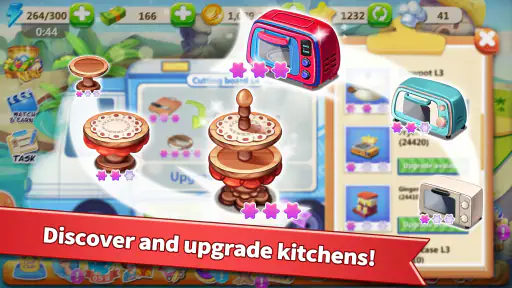
- Many recipes and kitchens add variety to the gameplay.
- Short rounds work well for quick mobile gaming sessions.
- Bright cartoon visuals create a cheerful
- family-friendly atmosphere.
Cons
- Later levels can feel difficult without careful timing and upgrades.
- Energy or waiting systems may limit extended play sessions.
- Frequent objectives can make gameplay feel repetitive over time.
- Some upgrades may require substantial in-game currency.
- The small screen can make rapid ingredient taps less comfortable.
This Game in Other Languages
Frequently Asked Questions
What is Rising Super Chef - Cook Fast about?
Rising Super Chef - Cook Fast is a time-management cooking game in which you prepare meals, serve hungry customers, and expand your culinary business. You move through different locations, unlock recipes and ingredients, and try to complete orders quickly and accurately. The main challenge is balancing speed, organization, and upgrades while keeping customers satisfied and earning enough rewards to progress.
Is Rising Super Chef - Cook Fast free to download and play?
The game can generally be downloaded and played for free, allowing you to experience its main cooking levels without an initial purchase. However, like many mobile management games, it may include optional in-app purchases for coins, boosters, extra resources, or faster progress. You can usually play without paying, although advancing more comfortably may require patience or occasional interaction with advertisements.
Does the game require an internet connection?
An internet connection may be needed for certain features, such as displaying advertisements, synchronizing progress, processing purchases, or accessing promotional content. Some cooking levels may work when you are offline, but availability can depend on the version installed and the device being used. For the most reliable experience, it is best to launch the game online and keep it updated.
Is Rising Super Chef - Cook Fast suitable for children?
The game is generally easy to understand because it uses colorful graphics, simple touch controls, and straightforward cooking objectives. It can be suitable for younger players, but parents should review the store age rating and device settings before installation. Since the game may contain advertisements and optional purchases, parental controls are recommended if children will be playing without supervision.
What devices can run Rising Super Chef - Cook Fast?
Rising Super Chef - Cook Fast is designed for mobile devices running compatible versions of Android or iOS. Performance can vary depending on the phone or tablet, available storage, operating-system version, and background apps. Before downloading, check the official store listing for the current requirements. Keeping sufficient free space and updating your device can help prevent crashes or slow loading.


