

Railroad Empire: Train Game
- Reviews
- 4.2
- Version
- 6.3.4
- Installs
- 5,000,000+

Screenshots
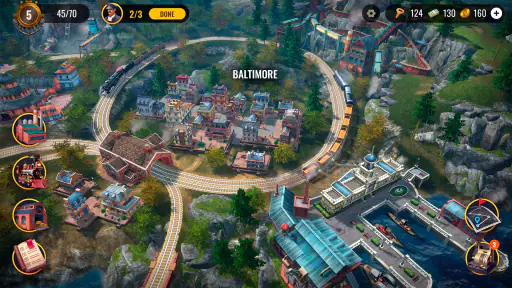
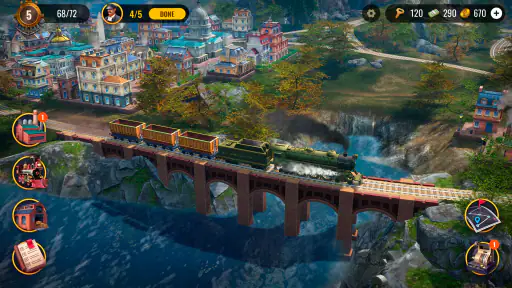
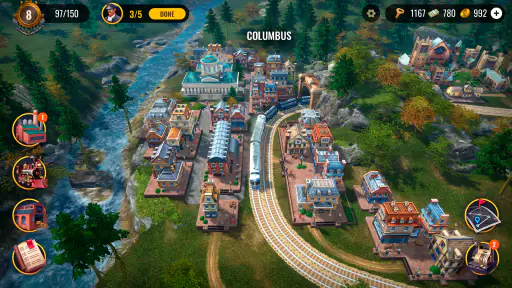
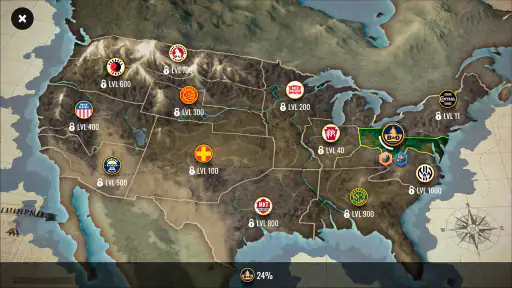
 Analysis by Frivlyz
I approached Railroad Empire: Train Game expecting a relaxed train-building experience, but I quickly found that its appeal comes from balancing several jobs at once. You are not simply placing tracks and watching locomotives move. You are trying to improve trains, connect cities, expand a railway network, and make sensible business decisions without turning the whole map into an expensive tangle. That combination makes it a good fit for players who enjoy simulation games with visible progress and a steady stream of small decisions.
The game is free to start and is listed for Everyone, which makes it easy to try without committing money first. It comes from Azur Interactive Games Limited and sits in the simulation category, although it also borrows ideas from management and strategy games. The store summary describes its central idea clearly, but the real question is whether the railway-building loop remains interesting after the first few upgrades. In my experience, it does, provided you enjoy planning routes more than chasing fast action.
How the current version feels to play
The current version is 6.3.4, and that detail matters because this is the sort of game where small adjustments to progression can change how comfortable the whole experience feels. My impression is that the game is designed around gradual development rather than a single long challenge. You begin with practical goals, then work toward a more capable network as your trains and connections improve.
The basic rhythm is easy to understand. I look for useful connections, decide where an upgrade will make the biggest difference, and then wait for the network to produce enough progress for the next decision. That structure makes it suitable for short sessions. I can check in during a break, make a few improvements, and leave without needing to remember a complicated sequence of controls.
At the same time, the game is more engaging when I treat every upgrade as part of a plan. Spending resources immediately on the first available improvement can feel satisfying, but it may leave an important route underdeveloped. I found that it helps to pause before upgrading and ask whether the purchase improves the whole network or only one attractive-looking train.
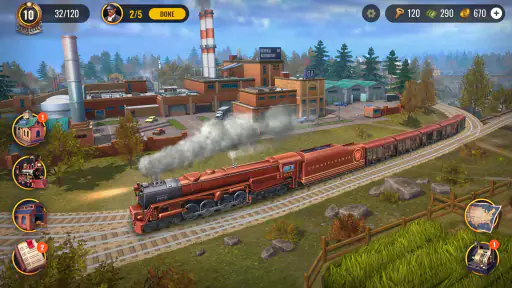
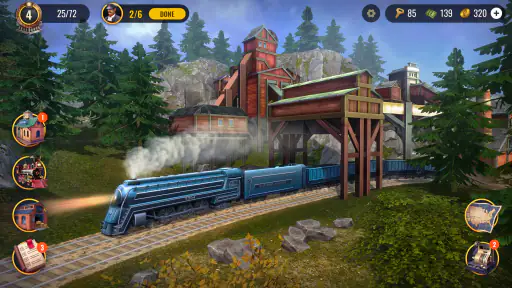
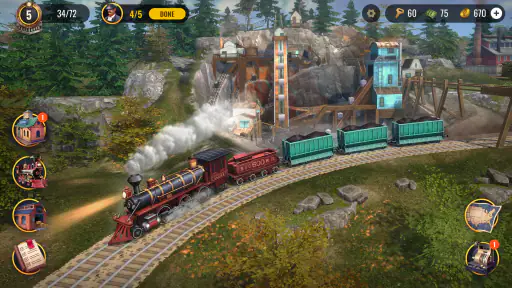
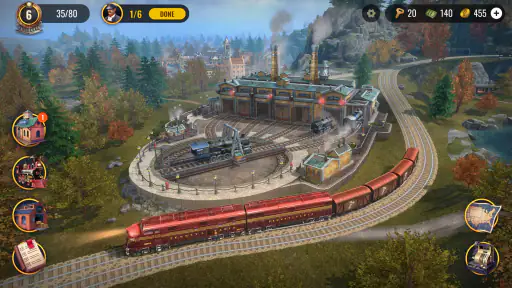
The presentation supports that approach. Moving trains and expanding routes give the map a sense of activity, while the management layer keeps the experience from becoming a passive screensaver. I especially like the feeling of seeing a connection become useful after several modest improvements. The reward is not only a larger railway; it is the sense that earlier choices are beginning to work together.
A simple routine that makes progress easier
My most useful routine was to separate expansion decisions from maintenance decisions. When I had enough resources for one meaningful change, I first considered whether an existing connection was limiting the rest of the network. If so, improving that bottleneck usually felt better than adding another route simply because it was available.
Gaming Stories You May Enjoy

Dancing Road Turns Short Breaks Into a Test of Rhythm and Timing

Super Stylist Makes Every Outfit a Test of Taste and Patience

Dominoes on Your Terms: Who Should Play and Who Should Pass

Pokémon GO Makes the Familiar World Feel New

Chess.com Turns Rematches Into Rivalries, but Community Has Its Costs

Archery Battle 3D Review: Sharp Aiming, Unclear Feedback
This is a small distinction, but it prevents a common mistake in business simulations: expanding the map faster than the underlying operation can support. In Railroad Empire, a compact network with sensible upgrades can feel more rewarding than a scattered collection of routes that looks impressive but develops slowly.
I also recommend checking the purpose of a train before treating every upgrade as equally valuable. A faster or stronger train can be useful, but its value depends on where it operates. An improvement placed on a quiet connection may produce less practical benefit than a cheaper change on a busy link. That makes the game more thoughtful than its simple controls initially suggest.
What the train upgrades actually add
Train upgrades provide the clearest sense of personal ownership. Instead of viewing the railway as one large abstract system, I can focus on individual machines and decide which ones deserve attention first. That gives the progression a satisfying physical quality: the network grows, but the trains within it also become part of the story.
The trade-off is that improvement menus can encourage a narrow focus. It is tempting to keep upgrading the same favorite train because the result is easy to notice. I had better results when I compared that choice with the needs of the wider railway. An upgrade is most useful when it solves a real operational problem, not merely when it produces a larger number on one screen.
For new players, I would avoid spending everything as soon as a button lights up. Keep enough flexibility for the next connection or requirement. The game is more enjoyable when you retain room to react, especially if your first plan turns out to be less efficient than expected.
Building connections without losing control
Connecting cities is the part that gives the game its strongest sense of direction. A new link is not just another decoration; it changes what the railway can do and opens a new reason to improve trains. I enjoy this because each expansion feels like a decision about the shape of the business, rather than a simple increase in a progress bar.
However, expansion can also create friction. If you chase every possible connection, the network may become harder to manage mentally. I found it more comfortable to choose a clear next objective and finish enough of it to understand its value before branching out again. This approach is particularly helpful on a smaller phone, where the map and management information compete for attention.
One practical use case is a short evening session after work. I can open the game, inspect the railway, identify one underperforming connection, and make a focused improvement. That is more satisfying than opening a large action game when I only have a few minutes, because the progress does not depend on quick reflexes or uninterrupted concentration.
How the game has evolved and what that means
The game was released on June 17, 2022, and its current version shows that it has continued moving beyond its original launch state. I would not treat a newer version number as proof that every personal complaint has been solved, but it does suggest an actively maintained product rather than a forgotten one. For an ongoing simulation, that is important because long-term enjoyment depends on the experience remaining usable as players spend more time with it.
The available version information does not by itself explain every individual change, so I prefer to judge the evolution through the current experience rather than inventing a detailed patch history. What is clear is that the game now presents itself as an established railway-management title with a substantial audience. It has an average rating of 4.2 from around 72 thousand ratings, with about 1.7 thousand written reviews. Those figures indicate broad interest, but they should be read alongside the game’s particular style: a slow, upgrade-focused simulator will naturally suit some players much better than others.
Its reach is also considerable, with over 5 million installs. That does not guarantee that it will fit your habits, but it does make the game easier to approach as a known mobile simulation rather than an obscure experiment. I would still recommend judging it by the actual loop. Popularity can tell you that the concept connects with many players; it cannot tell you whether you personally enjoy waiting, planning, and gradually optimizing routes.
For existing users, version 6.3.4 is best viewed as the current baseline. If you already played earlier versions, the main practical question is whether the present balance keeps your old strategy useful. My advice is to return with a flexible mindset. Recheck which train or connection is providing the most value instead of assuming that an old upgrade order remains ideal forever. That habit is useful in any evolving management game, especially when the temptation is to repeat a familiar routine.
Where the free model affects the experience
The game is free, but it includes in-app purchases ranging from $0.99 to $124.99 per item. That wide range is worth considering before you become invested in the progression. I can enjoy the core railway idea without paying immediately, yet the presence of optional purchases means players should decide early how they want to approach advancement.
My preferred approach is to treat purchases as a boundary rather than a solution. If a particular stage feels slow, I would first check whether a better route choice or a more carefully selected upgrade solves the problem. Paying can be convenient, but it can also weaken the satisfaction that comes from finding an efficient plan. Players who dislike any pressure around optional spending may find the free-to-play structure distracting, even if they enjoy the trains themselves.
On the other hand, someone who wants a casual game and is comfortable ignoring purchase prompts may find the model manageable. The important point is to avoid confusing convenience with strategy. A paid shortcut may reduce waiting or effort, but it does not necessarily teach you which connections deserve priority. The most rewarding part of the game remains the planning.
Who will enjoy it, and who should skip it
I would recommend Railroad Empire to players who like watching a system grow from modest beginnings. It suits people who enjoy route planning, incremental upgrades, and the quiet satisfaction of making a network more coherent. It is also a good choice for anyone who wants a simulation that can be played in short bursts rather than requiring a long uninterrupted campaign.
It is less suitable for someone looking for a highly detailed railway simulator with deep technical control over every aspect of train operation. The appeal here is the broader business-and-network view, not an attempt to reproduce every real-world engineering task. Likewise, players who need constant action may find the pace too patient. The game rewards returning to a plan, not reacting to enemies or mastering fast controls.
I would also hesitate to recommend it to anyone who strongly dislikes free-to-play progression. Even though the entry price is free, the purchase range means the commercial structure is part of the experience. If you prefer a single upfront payment with no temptation to accelerate progress, a premium simulation may be a better match.
How it compares with other mobile simulation choices
Compared with a pure city-building game, this title gives the railway a clearer purpose. Roads, buildings, or decorative expansion may be enjoyable elsewhere, but here the train network is the main character. Every connection has a practical relationship with the vehicles and the wider business, which gives upgrades more context.
Compared with a more technical train simulator, it is much easier to pick up. You do not need to spend your first session learning a complex control scheme or studying railway procedures. The compromise is depth: players seeking realistic driving, detailed signaling, or a cockpit-focused experience may prefer a specialized simulator instead.
Compared with idle business games, Railroad Empire asks more of me than simply collecting rewards and tapping upgrades. I have to think about where improvement matters and how expansion affects the network. Still, it remains more approachable than a demanding strategy game because the theme and objectives are easy to understand. That middle position is its strongest competitive advantage.
Remaining friction and practical expectations
The biggest limitation is the possibility of repetition. Once the basic pattern of upgrading, connecting, and improving becomes familiar, the experience depends heavily on whether you enjoy optimizing small choices. Players who need dramatic new mechanics every few minutes may feel that the loop settles into a predictable rhythm.
There is also a mental cost to expansion. A larger railway sounds automatically better, but more activity can make it harder to see which decision matters next. I found that the game is more enjoyable when I resist the urge to expand simply for visual growth. Keeping a short priority list makes the map feel like a project rather than a pile of unfinished intentions.
Another limitation is the difference between visible progress and meaningful progress. A new train or connection can look exciting, yet not every improvement changes the way the network functions. Before committing resources, I suggest checking whether the upgrade helps a busy route, unlocks a useful connection, or removes a clear bottleneck. If it does none of those things, saving for a more consequential choice may be wiser.
Device compatibility is straightforward for many users because the game requires Android 8.0 or later. That makes it accessible on a broad range of Android phones, although the experience will still depend on the device’s screen size and general performance. On a smaller display, I would expect map inspection and menu navigation to feel less comfortable than on a larger phone or tablet, so the game is worth testing on the device you actually plan to use.
What I would watch during future updates
For future development, I would pay attention to whether new versions keep the early game welcoming without making later progress feel unnecessarily slow. A good update should give returning players meaningful reasons to rethink their network while preserving the clarity that makes the game approachable in the first place.
I would also watch how the balance between train upgrades and railway expansion develops. If one path becomes obviously stronger, the strategic part of the game could narrow. The best version of Railroad Empire is the one that lets different players succeed through different priorities: a careful route planner should feel rewarded, but so should someone who enjoys improving a small group of trains.
Existing players can prepare by keeping notes about which connections consistently help their network and which upgrades were mostly cosmetic or marginal. That may sound excessive for a mobile game, but even a brief mental record prevents you from repeating weak spending choices after a long break. New players should simply focus on learning the relationship between a train, its route, and the next expansion target.
After spending time with the game, I see it as a friendly, accessible railway-management experience rather than a fully realistic railroad simulator. Its best moments come from making a modest network more efficient and then watching that decision support the next stage of growth. Its weaker moments come when progression feels repetitive or when the free-to-play structure becomes more noticeable than the planning.
My recommendation is positive for patient simulation fans, especially those who want a game that works well in short sessions and still offers decisions beyond simple tapping. I would skip it if you need constant action, technical train driving, or a completely purchase-free premium structure. For everyone else, the free entry makes it easy to test the central loop, and the current 6.3.4 release gives the game a mature starting point for building a railway you can improve at your own pace.
Railroad Empire: Train Game Pros and Cons
Pros
- Large railway network encourages long-term planning and expansion.
- Multiple train types add variety to routes and business strategies.
- Clear objectives help new players understand the core mechanics.
- Progression provides a steady sense of growth and achievement.
- Works well for players who enjoy management and simulation games.
Cons
- Some upgrades and expansions can require considerable time to unlock.
- The interface may feel crowded on smaller smartphone screens.
- Later scenarios can become repetitive without major gameplay changes.
- Resource management may feel restrictive during the early stages.
- Performance can vary on older devices with larger railway networks.
Frequently Asked Questions
What is Railroad Empire: Train Game about?
Railroad Empire: Train Game is a strategy and management game focused on building a successful railway company. You connect cities, organize train routes, transport passengers or goods, and expand your network over time. The game combines planning, resource management, and gradual progression, so it is better suited to players who enjoy making long-term decisions rather than simply controlling trains directly.
Is Railroad Empire: Train Game free to download and play?
The game can generally be downloaded for free, but availability and pricing may vary depending on whether you use Android or iOS. Like many mobile strategy games, it may include optional in-app purchases for currency, upgrades, boosts, or other convenience items. You should review the store listing carefully before installing, especially if the device is used by children or if you prefer games without additional spending.
Does Railroad Empire: Train Game require an internet connection?
Some features may require an active internet connection, particularly advertisements, cloud-related services, account functions, events, or in-app purchases. Depending on the version installed, basic gameplay may work offline for a limited time, but you should not assume that every mode will be available without connectivity. Testing the game in airplane mode is recommended if offline access is important to you.
Is Railroad Empire: Train Game suitable for beginners?
The game is relatively approachable for newcomers because its early stages usually introduce railway construction, route management, and upgrades gradually. However, the number of trains, resources, destinations, and expansion choices can become more demanding as your company grows. New players should pay attention to tutorials and avoid spending premium resources too quickly, since careful planning becomes increasingly important in later progression.
Are there advertisements or in-app purchases in Railroad Empire: Train Game?
Railroad Empire: Train Game may contain advertisements and optional in-app purchases, depending on the platform and current version. Advertisements can sometimes provide rewards or speed up progress, while purchases may offer premium currency, upgrades, or other advantages. Before downloading, check the official Google Play or App Store page for the latest details, pricing, age rating, and purchase information available in your region.


