

Pyramid Solitaire Saga
- Reviews
- 4.5
- Version
- 1.168.0.0
- Installs
- 10,000,000+

Screenshots



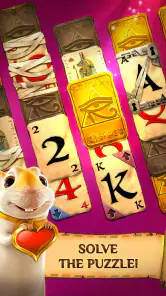
 Analysis by Frivlyz
When I want a card game that gives a short break a little shape and purpose, I’m drawn to a simple rule with enough room for thought. Pyramid Solitaire Saga builds its play around clearing a pyramid of cards, turning familiar solitaire into a small planning puzzle. I find that focus more appealing than a game that asks me to learn a large set of rules before I can enjoy a round.
The key question is not just whether I can remove a pair, but whether I should remove it now. Each choice can expose cards that change what is possible next, so a move that looks useful on its own may leave the remaining layout awkward. That push and pull gives the game its identity: it is a casual card game, but one that rewards looking beyond the next match.
Why the pyramid changes the usual solitaire rhythm
In many familiar solitaire games, I’m arranging cards into sequences or suits, often with a long chain of moves to manage. Here, the pyramid makes the board itself the main puzzle. I’m looking for pairs that total thirteen, and the order in which I uncover and clear cards matters. That makes each layout feel more like a compact problem to solve than a routine sorting exercise.
I also like that the central rule is easy to explain to someone else. You can understand the goal quickly, then gradually get better at spotting which available pair is worth taking. For me, that is a good fit for casual play: the first few decisions are approachable, while later planning can still make me pause and reconsider.
The adventure framing gives those card puzzles a reason to sit together as a longer journey. King has made a game that connects individual levels with a broader sense of progress, rather than presenting only an endless stack of unrelated deals. That context can make it easier to return after a break, because I have a clear next step instead of needing to invent a goal for myself.
How I approach a tricky board
My most useful habit is to check what a move will uncover before I take it. If removing one pair opens a card that can combine with another exposed card, that route may be stronger than clearing a different pair immediately. I try to scan the visible choices, identify which cards are blocking the most useful possibilities, and avoid treating every available match as equally valuable.
This is also where patience matters. A quick tap can feel satisfying, but rushing through the board makes it easier to miss a better sequence. When I’m stuck, I slow down and look for the cards that are still covered, then work backward: which exposed card would help me reach them, and what would need to be cleared first? That small change in approach makes the puzzle feel more deliberate without turning a casual session into homework.
Gaming Stories You May Enjoy

Dancing Road Turns Short Breaks Into a Test of Rhythm and Timing

Super Stylist Makes Every Outfit a Test of Taste and Patience

Dominoes on Your Terms: Who Should Play and Who Should Pass

Pokémon GO Makes the Familiar World Feel New

Chess.com Turns Rematches Into Rivalries, but Community Has Its Costs

Archery Battle 3D Review: Sharp Aiming, Unclear Feedback
The other practical point is to treat boosters as a limited rescue rather than the default answer. A special assist can help when a board has narrowed to awkward options, but using it the moment I hesitate can take away the chance to learn the layout. I prefer to make a careful pass first, then use help only when I understand what problem it is solving. That keeps the decision in my hands and makes a successful clear feel earned.
A good fit for short, low-pressure breaks
A realistic time to play is while waiting for a ride, winding down after dinner, or taking a quiet pause between tasks. The basic matching rule lets me get into a level without a long warm-up, and the individual-board format suits moments when I don’t want to commit to a complicated multiplayer match or a lengthy story-heavy game. I can focus on the cards in front of me and stop when I’ve had enough.
That convenience does depend on what I want from a card game. If I’m after the pure, unadorned feel of classic solitaire, a standard solitaire app is a cleaner choice: it puts the card layout first and usually avoids an adventure wrapper. If I want a deeper competitive card game, this is not the same kind of experience either. Pyramid Solitaire Saga is best when I want a self-contained matching puzzle with a steady sense of forward motion, not a replacement for every other kind of card game.
It may also be a poor fit if I dislike progression systems, themed presentation, or the possibility of hitting a difficult level and needing another attempt. The card rule is simple, but the puzzle can still ask for patience. I would choose a more open-ended solitaire game if I wanted to play at my own pace without feeling nudged toward the next milestone.
What to expect from the free game
The game is free to install, and it includes optional in-app purchases, with listed items ranging from $0.99 to $69.99. I’d approach those purchases as optional convenience rather than part of the basic appeal: the reason to play is the card puzzle, and it is worth seeing whether the natural pace suits you before spending. If you tend to buy extra help in mobile games, setting a personal limit beforehand is a sensible way to keep a casual pastime casual.
King’s game is rated Everyone, and its long-running presence is reflected in an average rating of 4.5 from around 1.1 million ratings, with over 10 million installs. It first arrived on June 30, 2014; the current version is 1.168.0.0, and Android requires version 6.0 or later. Those details make it easy to judge basic suitability, but the better test is whether the pyramid-clearing rule feels satisfying to you after a few boards.
Who gets the most from its central idea
I’d recommend it to people who enjoy card puzzles, want a clear objective in each session, and like improving through better decisions rather than learning a complicated rulebook. It can also work for someone who already knows traditional solitaire and wants a different way to think about a familiar deck. The main pleasure is the small strategic question repeated across a changing pyramid: which match helps most right now?
I’d steer away from it if I wanted a completely frictionless game with no progression, or if I preferred head-to-head play and direct competition as the main event. Its strength is focused solo decision-making. A useful way to decide is to play for the rule, not just for the theme: if you enjoy scanning the pyramid and planning a few moves ahead, the adventure gives that habit a pleasant place to live.
A card puzzle with a clear point of view
Ever found yourself in need of a little "me time" to unwind and relax? Well, grab your phone because I’ve discovered a gem that’s perfect for those cozy evenings or quick breaks during the day. Enter Pyramid Solitaire Saga, a delightful spin on the classic solitaire game, with a twist that’ll keep you coming back for more.
Journey into the Mystical World
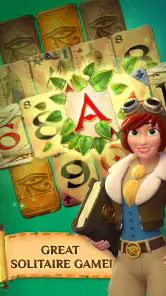
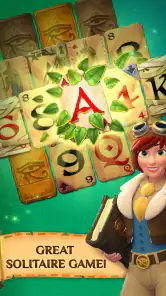
From the moment I opened Pyramid Solitaire Saga, I was swept away into an enchanting adventure. The game takes you on a quest alongside Helena the treasure hunter and her pal, Kingsley the gerbil. Together, you explore ancient lands to uncover hidden treasures and secrets. The narrative isn’t just a backdrop; it’s a driving force that makes each level feel like a new chapter in a gripping story.
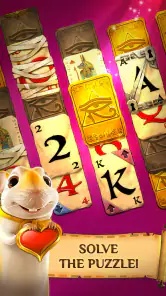
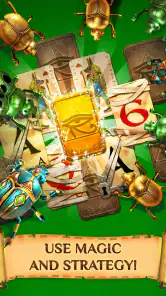
The graphics are nothing short of stunning. Every level is beautifully designed with intricate details that capture the essence of ancient Egypt. The game’s ambiance is enhanced by soothing background music that makes the experience even more immersive. It’s like having a little bit of adventure right in the palm of your hand.
Gameplay and Mechanics
At its core, Pyramid Solitaire Saga retains the classic solitaire rules we all know and love. But here’s where it gets interesting: each level presents you with a pyramid of cards, and your goal is to match pairs of cards that add up to 13. It’s simple yet challenging enough to engage your mind.
What I love about the game is the strategic element it introduces. You need to think a few steps ahead to clear the board effectively. Some levels have special cards or hidden traps that add an extra layer of challenge. It’s this strategic depth that keeps the game from feeling repetitive.
The developers have done a fantastic job of pacing the game. New elements are introduced gradually, ensuring you’re never overwhelmed. Plus, the game is generous with lives and power-ups, so you can keep playing without too much interruption.
Magic Boosters and Power-Ups
No adventure is complete without a bit of magic, right? Pyramid Solitaire Saga doesn’t disappoint with its array of boosters and power-ups. As you progress, you’ll unlock special abilities that can help you clear those tricky levels. Whether it’s a magic eye that reveals hidden cards or a scarab that removes a troublesome card, these boosters add a fun twist to the gameplay.
These power-ups aren’t just randomly thrown in; they’re cleverly integrated into the story. Each booster aligns with the game’s theme, making it feel like a natural part of your journey rather than a mere cheat code.
Social Features and Connectivity
One of the aspects that really stood out to me is the game’s social features. You can connect with friends and see how they’re progressing on their own journeys. There’s a leaderboard that adds a friendly competitive edge, motivating you to climb higher and beat your friends’ scores.
The game also offers daily challenges and events, keeping things fresh and exciting. These events are a great way to earn extra rewards and boosters, so you’ll want to check in regularly to see what’s happening.
Final Thoughts
In conclusion, Pyramid Solitaire Saga is more than just a card game; it’s an adventure filled with mystery, strategy, and a touch of magic. It’s perfect for those moments when you need a break from reality or just want to relax and unwind. The game is available for both Android and iOS, so you can easily download it and start your journey today.
With its captivating storyline, beautiful graphics, and engaging gameplay, Pyramid Solitaire Saga has quickly become one of my go-to apps. So, why not give it a try? You might just find yourself lost in its enchanting world, one card at a time.
Pyramid Solitaire Saga Pros and Cons
Pros
- Engaging puzzles keep players hooked.
- Unique graphics with Egyptian themes.
- Regular updates with new levels.
- Easy to learn for beginners.
- No intrusive ads during gameplay.
Cons
- Limited lives can slow down progress.
- Some levels feel repetitive.
- In-app purchases can be pricey.
- Requires internet for some features.
- Occasional bugs with game loading.
Frequently Asked Questions
What is Pyramid Solitaire Saga, and how does it differ from other solitaire games?
Pyramid Solitaire Saga is a card game that combines classic solitaire with unique puzzles and challenges. Unlike traditional solitaire, this game involves solving mysteries and progressing through levels with a storyline. Players match cards in a pyramid layout to uncover hidden secrets, adding an adventurous twist to the solitaire experience.
Is Pyramid Solitaire Saga free to play, and are there in-app purchases?
Pyramid Solitaire Saga is free to download and play. However, it does contain in-app purchases that offer optional items such as boosters and extra lives. These purchases can enhance gameplay but are not necessary to enjoy the full experience. Players can choose to progress without spending money, although it may take longer.
What are some of the key features of Pyramid Solitaire Saga?
The game features a captivating storyline with ancient mysteries to solve, hundreds of levels to explore, and various challenging obstacles to overcome. Players can enjoy colorful graphics and engaging sound effects. Additionally, the game integrates with social media, allowing you to compete with friends and see who can achieve the highest scores.
Does Pyramid Solitaire Saga require an internet connection to play?
Pyramid Solitaire Saga can be played offline, allowing you to enjoy the game without an active internet connection. However, certain features, such as social media integration and accessing leaderboards, require an internet connection. Playing online can also ensure you have the latest updates and events.
What devices can run Pyramid Solitaire Saga, and are there any system requirements?
Pyramid Solitaire Saga is available on both Android and iOS devices. It requires a compatible operating system: Android devices need at least version 4.1, while iOS devices require iOS 9.0 or later. Ensure your device has sufficient storage space and meets these requirements for an optimal gaming experience.


