

O! Hole! - Eating Game
- Reviews
- 4.6
- Version
- 1.1.8
- Installs
- 50,000+

Screenshots





 Analysis by Frivlyz
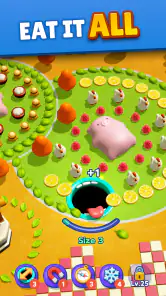
I spent time with O! Hole! - Eating Game as a quick, casual game built around one simple idea: control a hungry black hole and consume objects to make it grow. That premise is immediately understandable, and it gives the game an easy pick-up-and-play feel. You do not need a long explanation before starting; the appeal is visible almost at once.
What makes this kind of game work is the small satisfaction of watching a limited ability become more powerful. At first, the hole feels restricted by what it can reach or swallow. As it grows, the playing space becomes more rewarding because objects that once seemed out of range can become part of the next meal. I found that loop pleasant in short sessions, especially when I wanted something light rather than a game demanding full concentration.
The game comes from SayGames Ltd and sits firmly in the casual category. It is free to download, aimed at Everyone 10+, and supports devices running Android 8.0 or later. The current version is 1.1.8, while its store page shows a 4.6 average from around 8.4 thousand ratings. Those details suggest a game designed for broad accessibility, not for a small audience of specialist players.
How the eating loop feels in everyday play
The central action is deliberately uncomplicated. I guide the hole around a scene, look for things it can consume, and use that progress to reach larger targets. The pleasure comes from turning a small opening into a much more capable one. It is a familiar casual-game rhythm, but the black-hole theme gives the activity a more playful identity than simply collecting points or matching tiles.
The best way to approach a session is to think in terms of order rather than speed. When several objects are available, swallowing everything immediately is not always the smartest move. I get more out of the game when I first scan the area, identify the easiest targets, and leave room to move instead of rushing toward the most tempting object. That habit makes the growth process feel more deliberate and can reduce the frustration of moving around without a clear plan.
A useful tactic is to treat early objects as a route-building tool. Rather than viewing each item as an isolated snack, I use the first available targets to increase the hole's reach, then return to areas that previously felt inaccessible. This is a small but important distinction: the game is more enjoyable when growth changes how I read the scene, not merely when it fills a progress bar.
Another practical tip is to avoid assuming that the largest visible object should always be the immediate goal. A crowded area can make that target awkward to approach, while several smaller objects may provide a faster way to become capable of swallowing it. This gives the simple premise a modest layer of decision-making. It is not a deep strategy game, but paying attention to the sequence of targets makes the experience less automatic.
Gaming Stories You May Enjoy

Dancing Road Turns Short Breaks Into a Test of Rhythm and Timing

Super Stylist Makes Every Outfit a Test of Taste and Patience

Dominoes on Your Terms: Who Should Play and Who Should Pass

Pokémon GO Makes the Familiar World Feel New

Chess.com Turns Rematches Into Rivalries, but Community Has Its Costs

Archery Battle 3D Review: Sharp Aiming, Unclear Feedback
The controls are best suited to short, relaxed play. I would not choose this as a competitive action game where precise timing and complex combinations are the main attraction. Its strength is the low mental entry cost. I can open it, understand the objective, play for a little while, and stop without needing to remember a complicated system.
Why the black-hole theme carries the experience
The theme is more than a visual label because it explains the entire progression. The hole's appetite, increasing size, and ability to consume more substantial objects all fit together naturally. That coherence matters in a casual game: even when the underlying loop is straightforward, the fantasy gives each successful collection moment a clear reason to exist.
I also like that the concept creates an obvious sense of escalation without requiring a long tutorial. A small hole feels limited; a larger one feels useful. That contrast is enough to make ordinary objects feel meaningful. The game does not need a complicated story to provide motivation because the changing scale of the hole is the story during play.
Still, anyone expecting a detailed simulation of gravity or a physics-focused sandbox should adjust their expectations. This is an eating game first. The black-hole idea is presented as a playful casual challenge, not as a realistic scientific model. That is a strength for accessibility, but it also defines the audience: players looking for authentic orbital mechanics or open-ended experimentation will likely find the experience too guided.
What you receive without paying
The important cost point is straightforward: the game is free to access. That makes it easy to try without committing money first, which suits the casual format particularly well. I can decide whether the swallowing-and-growing loop holds my attention before considering any optional spending.
There are in-app purchases ranging from $0.99 to $99.99 per item. Because those purchases span a wide range, I would approach them carefully rather than treating the free download as proof that the complete experience has no cost. The sensible approach is to play first, identify whether the basic loop is already satisfying, and only then decide whether any optional purchase offers enough value for the way I use the game.
For me, the free entry is the strongest value argument. A short waiting-room session, a break between tasks, or a few minutes before bed can justify trying it without turning the game into a major purchase. The higher end of the purchase range changes the value conversation, however. I would not recommend spending at that level casually, especially when the core attraction is a simple repeatable loop rather than a large role-playing system or a content-heavy adventure.
In practical terms, the game works best when free access is treated as the main product and purchases are treated as optional decisions. That distinction helps avoid a common mistake with casual games: paying before knowing whether the basic interaction remains enjoyable after the novelty of the theme wears off.
Where the value comes from
The value is not in complexity. It comes from immediacy, a clear visual goal, and the satisfying transition from limited movement to broader consumption. I can understand the objective quickly, and the game gives me a reason to continue without asking me to study a large collection of rules.
That makes it useful as a mental reset. If I have only a few spare minutes, I do not need to prepare a build, coordinate with other players, or follow a lengthy narrative. The black-hole progression provides a small sense of completion inside a compact session. For casual players, that may be enough to make the game worth keeping installed.
The value is weaker for anyone who needs constant novelty. The basic idea remains focused on moving, eating, and growing. If that loop does not feel satisfying on its own, the theme will not solve the problem indefinitely. I would therefore judge the game by the feel of its central action rather than by expecting it to transform into a deeper genre later.
Compared with a typical match-three game, this offers less emphasis on planning combinations and more emphasis on movement through space. Compared with an endless runner, it is less about surviving a continuous forward flow and more about choosing what to consume next. Compared with a physics sandbox, it gives up experimentation in favor of a clearer casual objective. Those differences make it a good alternative when I want something tactile and visually direct, but a poor replacement for players who prefer puzzles, reflex challenges, or open-ended systems.
Small decisions that improve a session
My first recommendation is to pause briefly at the start of a scene and map the easiest route in your head. The game rewards awareness more than frantic movement. Beginning with accessible objects can create a smoother growth curve and helps prevent wasted movement around targets that are not yet practical.
Second, use the hole's new size to revisit the whole area rather than moving only toward the nearest object. A target that was irrelevant a moment earlier may now be the most efficient next step. This habit makes the game feel more like a sequence of changing opportunities and less like a simple sweep from one side of the screen to the other.
Third, separate progress from purchase temptation. If a session feels slow, I would first change my route and target order before assuming that spending is the answer. The game's basic appeal should remain visible through ordinary play. If I need to buy something to make the central action tolerable, that is a sign the game may not be a good fit for me.
Finally, I would use it in short blocks rather than expecting it to replace a longer gaming session. The format is strongest when the goal is a quick burst of uncomplicated progress. Playing with that expectation makes the straightforward design feel intentional instead of underdeveloped.
Limitations worth considering
The biggest limitation is also the game's defining feature: the loop is narrow. Consuming objects and growing can be satisfying, but it does not offer the same variety as a casual game built around several distinct modes or puzzle types. Players who need frequent changes in rules may find the experience repetitive once the initial novelty fades.
There is also a difference between accessible and effortless. The controls may be simple, but good target order still matters. If I move without looking ahead, I can make a session feel more awkward than it needs to be. That is not a serious flaw, though it means the game is not purely mindless in every moment.
The purchase range is another reason for restraint. Free access is attractive, but the presence of optional items from $0.99 up to $99.99 means families and younger players should pay attention to purchase settings on the device. The age rating is Everyone 10+, so I would be especially careful when the game is installed on a shared phone or tablet.
Device compatibility is reasonably broad for newer hardware, but the minimum requirement of Android 8.0 or later still matters if someone is using an older Android phone. I would check the operating-system requirement before planning to install it on an aging device. For supported users, the casual format should be easy to approach; for unsupported devices, there is no benefit in treating it as a guaranteed option.
The game is also not the right choice for people seeking a strong narrative, competitive multiplayer focus, or a long-term strategic project. Its appeal depends on the physical satisfaction of eating objects and becoming larger. That is a clear promise, but it is not a universal one.
Who is most likely to enjoy it
I think the best audience is someone who likes compact games with an instantly readable objective. If you enjoy watching a small ability expand into a larger one, the black-hole concept gives that progression a satisfying shape. It is particularly suitable for players who want something they can start quickly without investing in a complicated tutorial or story.
It can also work for families sharing a device, provided an adult handles purchase controls and everyone is comfortable with the Everyone 10+ rating. The premise is easy to explain, and a new player can understand the goal by watching a short session. That makes it more approachable than many games that depend on accumulated knowledge or a large collection of menus.
A realistic everyday use case would be a ten-minute break during a commute, between appointments, or while waiting for food. I would open it when I wanted a little interaction but did not want to begin a game that demanded a full uninterrupted session. The clear objective lets me enjoy a small piece of progress and put the phone away without feeling that I abandoned a complicated task.
I would skip it if my ideal casual game is a word puzzle, a carefully balanced match-three challenge, or a competitive score chase. Those alternatives provide different kinds of satisfaction: language, combination planning, or performance improvement. This game is better when the pleasure comes from movement and visual growth rather than from solving a dense problem.
My final recommendation on free value
After trying the core concept, I see O! Hole! - Eating Game as a reasonable free casual download for players who enjoy simple growth loops and playful object consumption. Its strongest quality is that it communicates its purpose immediately, then gives that purpose a satisfying visual progression. SayGames Ltd has chosen a concept that is easy to understand and easy to fit into spare moments.
I would recommend installing it without paying first, then judging whether the basic rhythm remains enjoyable after several short sessions. The free entry makes that test low-risk, while the in-app purchase range means I would avoid spending impulsively. The game offers its clearest value when treated as a lightweight pastime rather than as a premium, content-rich purchase.
My verdict is to try it if you want a quick, uncomplicated eating game with a memorable black-hole theme. The best value is available before you spend anything: learn the movement, experiment with target order, and see whether growing through the scene genuinely keeps you interested. If you want deep strategy, a story, or constant variety, choose another casual genre instead. For short breaks and straightforward progression, though, this one earns a cautious recommendation.
O! Hole! - Eating Game Pros and Cons
Pros
- Simple one-touch controls make it easy to start playing immediately.
- Short levels are ideal for quick sessions during breaks or commutes.
- Colorful visuals and playful animations give the game a cheerful style.
- Growing the hole creates satisfying progress and encourages replaying levels.
- The gameplay is relaxing and does not require complex strategic planning.
Cons
- Repeated eating mechanics can feel monotonous after extended play.
- Later levels may offer limited challenge for experienced puzzle players.
- Ads may interrupt the experience
- depending on the version and device.
- The game may require precise movement near obstacles and level boundaries.
- Progression can feel shallow if you expect upgrades or deeper customization.
Frequently Asked Questions
What is O! Hole! - Eating Game?
O! Hole! - Eating Game is a casual arcade game in which you control a growing hole and move it around the environment to swallow objects. As you eat more items, the hole becomes larger and can consume bigger targets. The gameplay is designed to be simple and accessible, making it suitable for short sessions when you want an uncomplicated game with quick, satisfying progress.
How do you play O! Hole! - Eating Game?
The main objective is to guide the hole across each level and eat as many available objects as possible. Movement is generally controlled through touch gestures, allowing you to steer the hole around the stage. You need to plan your route, collect smaller items first, and use the increased size to reach larger objects before the level ends or the available time runs out.
Is O! Hole! - Eating Game free to download?
O! Hole! - Eating Game can generally be downloaded and played without an upfront purchase, although the exact availability and pricing may depend on whether you use Android or iOS. Like many free casual games, it may include advertising, optional in-app purchases, or both. It is worth checking the store listing before downloading if you want to understand the current monetization model.
Does O! Hole! - Eating Game require an internet connection?
The basic gameplay of O! Hole! - Eating Game may work without a constant internet connection, which makes it convenient for playing during travel or when mobile data is unavailable. However, advertisements, purchases, updates, leaderboards, and other online features can require connectivity. Because offline behavior may change between versions, you should verify the game’s current requirements on the official app store page.
Is O! Hole! - Eating Game suitable for children?
O! Hole! - Eating Game uses a straightforward concept and simple controls, so it can be easy for younger players to understand. Nevertheless, parents should review the age rating, advertising content, privacy information, and any available in-app purchases before allowing children to play. If the game displays frequent ads or offers paid items, parental controls can help prevent accidental purchases.


