

Matiks: Math and Brain Games
- Reviews
- 4.5
- Version
- 1.37.0
- Installs
- 1,000,000+

Screenshots


 Analysis by Frivlyz
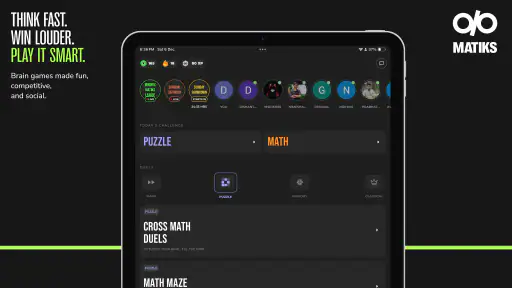
I went into Matiks expecting a small collection of quick brain exercises, and that is still the best way to understand it. This is a free sports-category game from Matiks Developers that turns math, memory, and puzzle rounds into short competitive duels. It is less about building a long adventure and more about making a few focused decisions, seeing how well you perform, and trying again when a careless mistake costs you the round.
That format makes it easy to fit into spare moments. I can imagine opening it while waiting for a bus, taking a short break from work, or using it as a change of pace after scrolling through social media. The game’s appeal is not a large world or a complicated control scheme. It is the immediate challenge of recognizing a pattern, remembering something briefly, or solving a calculation before the other side gains the advantage.
With an average rating of 4.5 from around 31 thousand ratings and more than a million installs, it has clearly found an audience. I would not treat those figures as proof that every player will enjoy it, but they do suggest that the basic idea is easy to understand and broadly appealing. The Everyone age rating also fits the approachable presentation: the challenge comes from thinking quickly, not from mature themes.
How the first sessions establish a reason to keep playing
The strongest early goal is simply learning which type of duel suits you. Math rounds reward quick calculation, memory rounds test concentration, and puzzle rounds ask you to identify the right solution under pressure. That variety matters because a player who dislikes one kind of mental task may still find another mode satisfying. I preferred switching between them rather than repeating a single style for too long.
There is a useful difference between playing these activities alone as exercises and playing them as duels. A normal brain-training app often makes improvement feel private and abstract: you finish a test, receive a score, and move on. Matiks gives each decision more urgency because the result is framed as a contest. Even when the task itself is simple, the possibility of losing makes me slow down just enough to check my thinking while still trying to stay fast.
The early sessions are also a good test of whether the game’s central loop fits your personality. If you enjoy short rounds and immediate feedback, the structure is inviting. If you want a story, character development, or a deep sports simulation, the sports label may set the wrong expectation. This is a brain-duel game presented in a sports-like competitive context, not a replacement for football, basketball, racing, or a traditional management game.
My practical advice is to treat the first few rounds as calibration rather than a final judgement. The three activity types use different skills. A poor result in a calculation round does not necessarily mean the whole game is a bad fit; you may respond much better to memory or visual puzzle tasks. Conversely, enjoying one easy opening session does not guarantee that the later challenge will remain comfortable.
Gaming Stories You May Enjoy

Dancing Road Turns Short Breaks Into a Test of Rhythm and Timing

Super Stylist Makes Every Outfit a Test of Taste and Patience

Dominoes on Your Terms: Who Should Play and Who Should Pass

Pokémon GO Makes the Familiar World Feel New

Chess.com Turns Rematches Into Rivalries, but Community Has Its Costs

Archery Battle 3D Review: Sharp Aiming, Unclear Feedback
What progress feels like during ordinary play
The clearest progress signal is performance itself. I notice whether I am answering with fewer hesitations, spotting familiar structures sooner, or avoiding the same rushed mistake. That is more meaningful here than a decorative reward because the game’s core promise is mental practice through competition. The improvement is personal and immediate: I am trying to make a better decision than I made a few minutes earlier.
Players who need a visible long-term objective may find this approach less satisfying. In a role-playing game, progress is usually represented by levels, equipment, abilities, or a larger map. In Matiks, the motivation is more closely tied to winning duels and sharpening reactions. That can feel refreshingly clean, but it also means the game depends heavily on whether you enjoy repeating short challenges for the sake of mastery.
A useful way to play is to identify one specific weakness after each session. If I lose because I rush simple arithmetic, I can deliberately pause for a moment before committing. If memory rounds expose poor attention, I can focus on grouping information instead of trying to remember every item separately. These are small adjustments, but they turn a sequence of wins and losses into a personal practice routine rather than random tapping.
This is one of the less obvious strengths of the format: the game can work as a quick mental reset without requiring a large time commitment. I would use it before studying or during an afternoon slump, not because it replaces proper rest, but because it asks me to switch from passive consumption to active attention. The short-duel design makes that transition easier than opening a lengthy puzzle campaign.
Difficulty, mistakes, and the point where speed becomes pressure
The difficulty curve is best understood through the relationship between accuracy and speed. A task may look easy when I read it calmly, yet become surprisingly demanding when I know that another player or opponent is part of the contest. That pressure is the main source of challenge. It rewards a fast, reliable thought process rather than occasional flashes of cleverness.
Math games can be especially revealing in this respect. I may know how to solve a problem but still lose time checking an answer. Memory games create a different problem: rushing the first observation can make the later response impossible, while overthinking can waste the advantage of remembering correctly. Puzzle rounds sit between those extremes, asking me to recognize what matters before the clock or duel context makes the decision feel urgent.
For beginners, the most important skill is not maximum speed. It is avoiding preventable errors. A player who answers slightly slower but stays accurate can build a better foundation than someone who guesses quickly and develops bad habits. I found that treating every round as a choice between confidence and panic helped more than trying to force faster reactions immediately.
The trade-off is that competitive tension will not feel motivating to everyone. Some people enjoy brain games as quiet relaxation and may dislike the feeling of being hurried. If that describes you, a conventional solo puzzle app may be a better companion for long, calm sessions. Matiks is more suitable when you want concentration with a little edge, even if that edge occasionally makes a simple task feel harder than it should.
Another practical limitation is repetition. Because the appeal comes from recurring math, memory, and puzzle challenges, players who need constant novelty may eventually want more variety than this compact format provides. I would judge it as a pick-up-and-play game, not as a substitute for a large puzzle library. Its strength is the convenience of returning for another duel, while its weakness is that the same basic loop must remain interesting over time.
How goals and challenge affect the pacing
The pacing works best when I set a modest goal before opening the game. I might aim to complete a few focused duels, improve accuracy in one category, or stop after a particularly careless loss and return later with a clearer head. Without a small personal target, the rounds can blur together because each one is short and easy to restart.
This is where the game’s progression philosophy becomes clear. It does not need a lengthy opening or elaborate preparation to get me into the action. The first goal is immediate competence; the next is consistency. That creates a low barrier to entry, but it also places responsibility on the player to create a reason for continuing. If you enjoy self-directed improvement, that feels empowering. If you expect the game to constantly introduce new objectives, it may feel thin.
I also recommend alternating the three challenge types instead of grinding the same one. Switching from calculation to memory changes the mental rhythm and can prevent fatigue. It also gives a more honest picture of your performance. A player might be strong at quick arithmetic but less comfortable with recall, and that contrast is more useful than repeatedly choosing the easiest category.
There is a subtle pacing benefit in using the game as a break rather than a main activity. A short session can feel complete because the individual duels have a clear beginning and end. By contrast, playing for a long uninterrupted stretch may expose the limited scope more quickly. I would rather return several times during the day than demand an extended gaming session from it.
For parents considering it for a child, the Everyone rating and straightforward mental challenges make the concept approachable. Still, I would frame it as a game to enjoy together or in moderation, not as a guaranteed educational tool. The competitive setting can encourage attention and mental agility, but the value depends on how the child responds to pressure and whether the activity remains enjoyable.
Retention without confusing repetition for progression
The main reason to come back is the desire to perform better in the next duel. That is a legitimate retention loop because the player’s own mistakes provide unfinished business. I often remember the moment I answered too quickly or missed an obvious pattern, and that memory alone can make another attempt appealing.
At the same time, this kind of retention has a limit. If every return feels like repeating the same exercise without a fresh personal target, motivation can fade. The game works best for people who enjoy chasing cleaner execution: fewer errors, quicker recognition, and steadier concentration. It is less convincing for players who need a strong collection system, a narrative reason to advance, or a steadily expanding set of activities.
That distinction is important when comparing it with usual alternatives. A traditional puzzle game generally offers handcrafted stages and a sense of moving through a fixed sequence. A brain-training app may emphasize personal scores and routine exercises. A competitive sports game usually focuses on teams, matches, and tactical control. Matiks sits between these categories: it borrows the contest feeling of sports while using compact mental tests as the actual play.
Because of that middle ground, I would choose it over a standard solo puzzle app when I want quick pressure and variety. I would choose a larger puzzle game when I want exploration, a carefully designed campaign, or a more substantial sense of place. I would choose a conventional sports title when the appeal is controlling athletes or managing a team. The best alternative depends less on quality than on the kind of satisfaction I want from the session.
The free price is another reason it is easy to try. There is little commitment involved in seeing whether the duel format suits you. The current version is 1.37.0, and the game supports devices running Android 7.0 or later, so it is accessible to many Android users. Those details make installation straightforward, but they do not change the central question: do you enjoy returning to short mental contests often enough to make the loop worthwhile?
Who will enjoy it, and who should look elsewhere
I would recommend Matiks to someone who likes short competitive games, wants a mental activity that can fit around a busy day, or enjoys comparing different kinds of quick thinking. It is particularly well suited to players who can motivate themselves with small improvements. The game gives you enough structure to start immediately, then leaves the satisfaction of progress largely in your own hands.
It is also a good choice for friends or family members who want a simple challenge without learning a complicated control system. Math, memory, and puzzle duels are understandable categories, so the barrier to explaining the game is low. Even if players have different strengths, rotating between the categories can keep the contest from becoming a pure test of one narrow skill.
I would skip it if your priority is a deep sports simulation, a story-driven game, or a large solo puzzle journey. I would also be cautious if timed competition makes you anxious rather than engaged. In that case, an untimed alternative may offer more value because it lets you think carefully instead of turning every mistake into a source of pressure.
One realistic everyday use is a ten-minute break between demanding tasks. I could play a couple of duels, notice whether my attention is sharp or scattered, and then stop before the activity becomes tiring. Another is using one category as a warm-up before studying: a few math challenges may encourage active thinking, while memory rounds can make me more aware of whether I am actually concentrating. I would not claim that this replaces study, but it can make a passive break feel more deliberate.
My verdict on the progression and long-term appeal
Matiks succeeds when its goals stay small and personal. The early objective is easy to understand, the progress signal is visible in better decisions, and the difficulty comes from handling speed without sacrificing accuracy. That creates a tidy loop: choose a mental challenge, compete, learn from the mistake, and try again. I appreciate that it does not require a large investment before the basic idea becomes clear.
Its main weakness is the same quality that makes it convenient. The experience is compact. Players who need elaborate unlocks, a strong narrative, or a constantly expanding sense of discovery may find the pacing too repetitive. The game can sustain play through mastery, but it cannot manufacture that motivation for someone who does not enjoy repeating short tests.
For me, the right way to approach it is as a pocket-sized brain-duel game rather than a full sports title or a complete training program. I would keep it installed for quick sessions, rotate its three challenge styles, and use accuracy as my first goal before chasing speed. That approach makes the competitive pressure useful instead of frustrating.
Overall, I think Matiks is worth trying if you want a free, accessible game that turns spare minutes into focused mental contests. Its rating and broad install base reflect an appealing core idea, but the lasting value depends on your appetite for self-directed improvement. If short rounds, quick decisions, and personal mastery sound more rewarding than elaborate progression, this is a smart game to keep within reach.
Matiks: Math and Brain Games Pros and Cons
Pros
- Short daily challenges make it easy to build a consistent practice habit.
- Different puzzle formats keep sessions varied rather than repetitive.
- Clean visuals and simple controls make the game accessible to most users.
- Useful for improving mental calculation
- pattern recognition
- and quick thinking.
- Quick rounds work well for commutes
- breaks
- or other spare moments.
Cons
- Some puzzles may feel too easy for experienced math-game players.
- Timed challenges can make the experience stressful rather than relaxing.
- Progress may depend heavily on repeated practice and memorizing patterns.
- Certain features or content may require an internet connection or subscription.
- Players seeking story-driven gameplay may find the experience quite limited.
Frequently Asked Questions
What is Matiks: Math and Brain Games?
Matiks: Math and Brain Games is a collection of short, interactive puzzles designed to exercise calculation, logic, memory, pattern recognition, and problem-solving skills. Instead of focusing on one traditional math lesson, the app presents different game formats that challenge you to think quickly and accurately. It is suitable for casual play, daily mental workouts, and users who enjoy testing their reasoning skills in short sessions.
Is Matiks suitable for children and beginners?
Matiks can be suitable for children, teenagers, adults, and beginners, depending on the difficulty settings and the specific challenges available in the app. The early puzzles are generally approachable, while later stages may require faster calculations and more careful reasoning. Parents should still review the app’s age rating, advertising, privacy information, and any in-app purchase options before allowing younger children to use it.
Does Matiks require an internet connection to play?
The availability of offline play may vary between the app’s different modes and versions. Some basic puzzles may load and work without a constant connection, while advertisements, updates, leaderboards, cloud features, or certain challenges may require internet access. If you plan to use Matiks while traveling or away from Wi-Fi, open the app beforehand and test the desired modes to confirm what remains accessible offline.
Is Matiks free to download, and does it contain ads or in-app purchases?
Matiks may be available as a free download, but free access can include advertising, optional purchases, or limitations on certain content. Depending on the version offered through Google Play or the App Store, users may encounter premium features, ad-removal options, extra challenges, or subscription-related choices. Check the store listing carefully before downloading, especially if the device is used by a child or shared with family members.
What are the main benefits and possible drawbacks of using Matiks?
The main benefit of Matiks is that it turns short math and logic exercises into quick games, making regular mental practice more engaging than conventional worksheets. It can help develop concentration, numerical fluency, reaction speed, and flexible thinking. However, some users may find timed challenges stressful, repetitive, or overly dependent on speed. Advertisements, difficulty spikes, and optional purchases may also affect the overall experience.


