

Idle Slayer - Pixel RPG
- Reviews
- 4.6
- Version
- 7.0.6
- Installs
- 5,000,000+

Screenshots



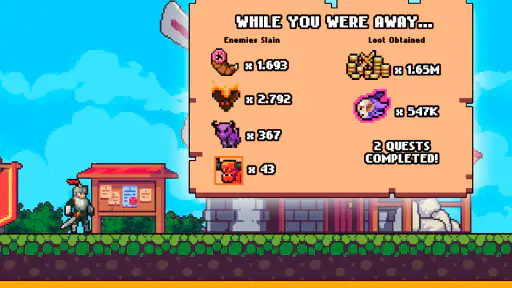
 Analysis by Frivlyz
I approached Idle Slayer - Pixel RPG expecting a lightweight game I could check for a few minutes at a time, and that is exactly where it makes the most sense. It is a simulation game built around incremental progress: I improve my gear, collect coins, and let the game continue to reward short returns instead of demanding one long session. That basic idea sounds simple, but the real appeal is how it turns small decisions into a routine.
What makes the experience worth discussing is not merely that it can be played casually. The important capability is its ability to keep an ongoing upgrade loop in the background of my attention. I can play actively when I feel like it, then step away and come back with a reason to continue. The game works best as a steady habit rather than a single dramatic adventure.
It is free to start, rated for Everyone, and developed by Pablo Leban LLC. The current version is 7.0.6, and it runs on Android 7.1 or later. Its broad audience is reflected in its average rating of 4.6 from around 133 thousand ratings, while more than 5 million installs show that this particular idle format has found a substantial audience.
Why the idle progression is the real attraction
The central strength is the separation between effort and progress. In a traditional action game, I usually need to stay focused to earn anything meaningful. Here, I can make progress through a combination of active play and waiting. That changes how I judge each session. A short visit is not necessarily wasted if it helps me improve equipment or prepare for the next return.
This structure gives the game a useful rhythm. I might open it during a coffee break, collect what has accumulated, spend coins on an upgrade, and play for a little while before closing it again. Later, the same loop gives me another reason to check in. The game does not need to replace a larger RPG in my library; it fills the space between more demanding games.
The incremental design also makes improvement easy to understand. Gear and coins are not abstract rewards that disappear into a complicated menu. They support the obvious question every idle player asks: what can I improve now, and will that improvement make my next visit feel better? When the answer is clear, the loop feels satisfying even without a long story or a large map to explore.
I especially like that the format accommodates different moods. When I want something active, I can engage with the game instead of treating it as a background counter. When I am busy, I can leave it alone and return later. That flexibility is more valuable than it may sound, because many mobile games are either too passive to hold my attention or too demanding to fit into ordinary interruptions.
Gaming Stories You May Enjoy

Dancing Road Turns Short Breaks Into a Test of Rhythm and Timing

Super Stylist Makes Every Outfit a Test of Taste and Patience

Dominoes on Your Terms: Who Should Play and Who Should Pass

Pokémon GO Makes the Familiar World Feel New

Chess.com Turns Rematches Into Rivalries, but Community Has Its Costs

Archery Battle 3D Review: Sharp Aiming, Unclear Feedback
What happens during a normal session
My usual session starts with checking the available coins and looking at the next useful improvement. I try not to spend automatically. If an upgrade is close enough to reach after a little active play, I prefer to work toward it rather than scatter resources across several smaller purchases. This gives each visit a modest target and prevents the interface from becoming a mindless collection screen.
After that, I decide whether to continue actively or leave the game again. The choice depends on how much time I have. A short session is still worthwhile because it can move the next purchase closer, while a longer session gives me more control over the pace. The game’s best quality is that neither approach feels like the only correct way to play.
This also creates a practical routine for people who dislike losing progress between sessions. I can close the game without feeling that I have abandoned a complicated mission or missed a precise event window. The next return is about continuing the same progression rather than rebuilding momentum from the beginning.
One useful habit is to choose a purpose before opening the game. I might play specifically to reach a gear improvement, or I might simply collect and leave. Without that small decision, idle games can blur into repeated tapping with no clear satisfaction. With it, even a short visit has a beginning and an end.
The difference between active play and waiting
The idle element is helpful, but I would not describe it as a complete replacement for interaction. Waiting alone can become passive, especially if I open the game only to gather currency and immediately close it. The more enjoyable pattern is to use the passive progress as a starting point, then add active play when I want to influence the pace.
That balance is the capability I found most valuable. The game gives me permission to play in fragments without making every fragment feel pointless. At the same time, it leaves room for me to participate rather than turning the whole experience into an unattended timer. Players who want constant action may still find the idle structure too slow, but players who enjoy gradual improvement will understand the appeal quickly.
There is also a psychological trade-off. Because the next improvement is always visible as a future goal, I can keep finding reasons to return. That is motivating when I am enjoying the loop, but it can also make the game feel repetitive if I am no longer interested in the underlying routine. The system is good at maintaining momentum; it cannot create excitement from nothing.
How I would use it in everyday life
The clearest scenario is a day filled with small gaps: waiting for transport, taking a lunch break, sitting in a queue, or winding down before bed. I can open the game, collect the result of the previous interval, make one sensible upgrade, and decide whether to continue. I do not need to reserve an uninterrupted evening for it, and I do not have to remember a long chain of objectives.
For example, if I am waiting for an appointment, I can use the first minute to check my resources and then spend the remaining time playing actively. If the appointment starts, I can stop without feeling that I have lost a carefully prepared run. Later, I return to the same progression. That is a much better fit for mobile life than an RPG that punishes me for pausing at the wrong moment.
It is also suitable for someone who wants a secondary game alongside a more demanding title. I would not install it as my only game if I wanted exploration, character dialogue, or a strong narrative campaign. I would install it because it offers a different kind of satisfaction: a small, persistent project that can be advanced whenever I have attention to spare.
Families may appreciate the Everyone rating, but I would still pay attention to how a child approaches the purchase system. The game is free, with in-app purchases ranging from $1.99 to $99.99 per item. That does not make purchases necessary, but it does mean I would use device-level purchase controls before handing the game to a child. For an adult, the practical question is whether optional spending improves convenience enough to justify the cost.
Three habits that make the loop more satisfying
First, I recommend treating coins as a planning tool rather than a reward to spend instantly. Saving toward a meaningful gear improvement gives the idle period a purpose. The temptation to buy the first available option is understandable, but a little patience makes the progression easier to feel.
Second, I use active sessions when I have a clear reason to play, not simply because the game is open. If I am distracted or tired, collecting and leaving is fine. If I have several uninterrupted minutes, I can use that time to push progress forward. This avoids the common idle-game problem of turning every spare moment into the same repetitive action.
Third, I judge the game by the quality of its return loop, not by the length of a single session. If I close it and feel curious about what the next upgrade will change, the system is working for me. If I return only out of obligation, that is a sign to take a break. This distinction matters because idle games can become chores when the habit continues after the enjoyment has gone.
These habits are not complicated, but they reveal an important trade-off. The game offers freedom from constant attention, yet the player still needs to create personal goals. Without that involvement, the progression can feel like watching numbers move. With modest planning, the same system feels more like managing a small, ongoing project.
Where it fits among other mobile RPGs
Compared with a conventional mobile RPG, this game asks much less from my schedule. A standard RPG usually gives me missions, battles, equipment screens, and a story that expects regular attention. That can be more rewarding for players who want a sense of place and character development, but it also makes interruptions more frustrating. Idle Slayer - Pixel RPG is better when I want progress without committing to a full quest session.
Compared with a pure clicker, it has a more recognizable RPG identity through its focus on gear, coins, and gradual improvement. I still would not choose it over a story-driven role-playing game when I want emotional stakes or exploration. Its strength is narrower and more practical: it makes incremental advancement easy to fit around the rest of my day.
It also differs from competitive mobile games. There is no reason for me to treat every session as a contest against another player. That reduces pressure, which is a benefit when I want to relax. On the other hand, people who need direct competition, team coordination, or a constantly changing multiplayer environment may find the solitary progression too limited.
The comparison with offline puzzle games is useful too. A puzzle gives me a complete mental task that begins and ends in one sitting. This game gives me an unfinished progression that continues across visits. I choose the idle RPG when I want continuity; I choose a puzzle when I want a self-contained challenge. Neither format is universally better.
The friction I noticed
The biggest limitation is repetition. The core loop is intentionally narrow, so players who need frequent surprises may lose interest. Gear upgrades and coin accumulation can be satisfying for a while, but the pleasure depends on enjoying gradual change. If I want every session to introduce a new mechanic or dramatic event, this is probably the wrong choice.
The other limitation is the danger of passive play becoming too passive. A game that lets me step away is convenient, but that same convenience can reduce the sense of achievement. I sometimes need to set a small personal target to make the return feel meaningful. Players who prefer immediate, skill-based feedback should look toward an action game instead.
The purchase range is another point to consider. Since the game is free to begin, I can test the loop without paying, which is useful. However, the presence of optional items means I would avoid making a purchase simply because a progression pause feels inconvenient. I would first ask whether I am enjoying the game itself or merely trying to remove friction from it.
Device compatibility is fairly broad because the minimum requirement is Android 7.1, but the experience can still depend on the phone or tablet being used. I would keep expectations realistic on older hardware and make sure the game fits my preferred screen size before settling into long sessions. The format is naturally suited to mobile, but comfort still matters.
Who gets the most from this game
I would recommend it to players who like incremental systems, modest goals, and the satisfaction of returning to a stronger setup than the one they left. It is particularly well suited to people who play in short bursts and do not want a game to punish them for putting the phone down. The free entry point makes it easy to discover whether that rhythm suits you.
It is also a good match for players who enjoy managing progression more than following a story. The focus on gear and coins gives me a clear sense of improvement without requiring a large cast of characters or a complicated narrative. If your favorite part of an RPG is deciding what to improve next, this is where the game earns its place.
I would be more cautious recommending it to someone who wants a complete adventure with a definite ending. The ongoing nature is the point, so the game may feel directionless if you need a campaign structure. I would also steer away from it for players who dislike idle mechanics on principle, because no amount of pixel presentation changes the fundamental emphasis on gradual accumulation.
For younger players, the Everyone rating is reassuring, but I would still supervise access to in-app purchases. For adults, the main decision is simpler: can you enjoy a game whose rewards arrive gradually, and can you stop playing when the loop stops being fun? If the answer is yes, the format is easy to live with.
My recommendation after spending time with it
Idle Slayer - Pixel RPG succeeds because it understands the value of a low-pressure return. I can make progress actively, step away, and come back without needing to reconstruct a complicated plan. That makes it a comfortable companion for spare moments, especially when I want an RPG-flavored upgrade loop rather than a demanding campaign.
I would not call it a universal replacement for action RPGs, clickers, puzzles, or multiplayer games. Its appeal depends on patience and a willingness to enjoy small improvements. The repetition and optional purchase structure are real considerations, and the game asks me to supply some of my own goals. Still, when I use it as a compact, ongoing hobby instead of expecting constant novelty, it feels well suited to mobile play.
My final advice is to approach it with one simple expectation: you are not downloading a short story to finish in a weekend. You are starting a gradual progression routine. If that sounds pleasant, the free version gives you a sensible way to try the experience, and the broad compatibility makes it accessible to many Android users. If you need fast action, deep narrative, or a clear final chapter, another type of game will serve you better.
Idle Slayer - Pixel RPG Pros and Cons
Pros
- Simple idle mechanics make progress possible during short play sessions.
- Pixel-art visuals give the game a distinctive retro atmosphere.
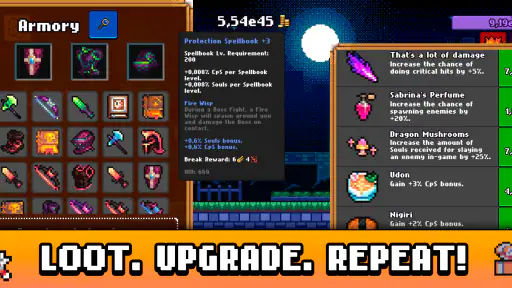
- Frequent upgrades provide clear goals and a satisfying sense of growth.
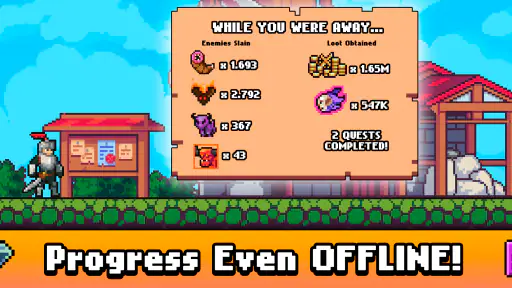
- Offline earnings help maintain progress when the game is closed.
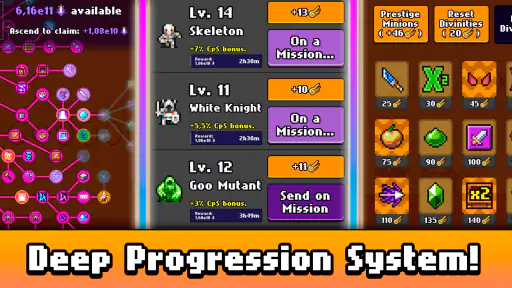
- Multiple currencies and systems add depth beyond basic tapping.
Cons
- Progress can become heavily dependent on waiting or repeated grinding.
- Some upgrades take a long time to afford without active play.
- The interface may feel crowded as more mechanics unlock.
- Random events can make progression feel inconsistent at times.
- Long-term play may become repetitive for users seeking constant action.
This Game in Other Languages
Frequently Asked Questions
What is Idle Slayer - Pixel RPG about?
Idle Slayer - Pixel RPG is an incremental adventure game that combines automatic progression with active platforming and combat-style challenges. You control a pixel-art hero who collects coins, upgrades abilities, unlocks new areas, and continues earning rewards while away from the game. It is designed for short sessions, but regular interaction helps you progress faster and discover more content.
Can I play Idle Slayer - Pixel RPG offline?
Much of the core gameplay can generally be enjoyed without a constant internet connection, especially collecting resources, navigating basic stages, and managing upgrades. However, online access may be required for advertisements, cloud synchronization, special events, updates, or certain reward systems. Availability can also depend on the version installed and whether you are using Android or iOS.
Does Idle Slayer - Pixel RPG contain advertisements or in-app purchases?
The game may include optional advertisements and in-app purchases, as is common with free-to-play idle RPGs. Watching an advertisement can provide bonuses such as extra coins, temporary boosts, or additional rewards, while purchases may speed up progression or remove some limitations. You can usually play without spending money, although progress may feel slower compared with using boosts.
Is Idle Slayer - Pixel RPG suitable for beginners?
Yes, the game is relatively approachable for newcomers because its main systems are introduced gradually. Early progress explains how to collect currency, improve the character, and use automated rewards. Nevertheless, later stages may require more strategic decisions about upgrades and timing. Players who enjoy incremental games will understand it quickly, while completely new players may need some time to learn the progression system.
What devices are needed to run Idle Slayer - Pixel RPG?
Idle Slayer - Pixel RPG is built around simple pixel-art visuals and generally does not require high-end hardware. Most modern Android phones and iPhones should handle the game smoothly if they have a supported operating system and enough free storage. Performance can still vary on older devices, particularly during advertisements or extended sessions, so checking the current store requirements before downloading is recommended.


