

Hello Neighbor
- Reviews
- 3.9
- Version
- 2.3.15
- Installs
- 50,000,000+

Screenshots


 Analysis by Frivlyz
What makes Hello Neighbor interesting to me is the tension between curiosity and caution. I’m not chasing a score or racing through a string of fights; I’m trying to understand a house that feels like it is resisting my investigation. That makes each attempt personal: I notice a route, get caught, then wonder whether I should try again the same way or rethink the plan. If you enjoy playful suspense and learning through trial and error, that setup has a real pull.
What the free entry point means
The game is free to download, so you can try its particular blend of stealth and puzzles without paying upfront. It also offers in-app purchases priced from $0.99 to $14.99 per item. I would treat those as a reason to check the purchase details before spending, rather than assume that every part of the experience is included or that a purchase is necessary. The practical value is clear at the start: you can see whether sneaking through this odd, unsettling world suits you before deciding whether to spend anything.
That distinction matters because “free” is most useful when it lets you make an informed choice. If you’re downloading it for a short break, begin with the free access and see how the controls and puzzles feel on your device. If you’re considering an in-app purchase, pause to check what it offers and whether it addresses something you actually want. I wouldn’t pay simply because a tense moment has made me impatient; the satisfaction here comes partly from figuring things out for yourself.
Unraveling the Mystery
In Hello Neighbor, you play as a curious protagonist who suspects something isn’t right with the neighbor. The premise is simple: sneak into your neighbor’s house to discover the secrets lurking in his basement. However, simplicity ends there. The game’s AI is impressively adaptive. Every time you think you’ve found a loophole, the neighbor seems to be one step ahead, setting traps and changing tactics to thwart your efforts.
Gameplay Dynamics
The game is all about strategy and stealth. You’re constantly on your toes, thinking two steps ahead, plotting your moves, and sometimes just winging it! The controls are intuitive, though mastering them takes a bit of practice. And let’s talk about the environment – it’s vibrant, with a touch of eeriness that keeps you engaged and slightly on edge.
The puzzles? Oh, they’re a mix of “Aha!” moments and “Wait, what?” challenges. Just when you think you’ve cracked one, another pops up, keeping the gameplay fresh and intriguing.
Turning failures into a plan
The adaptive opponent changes the way I think about a failed attempt. Getting spotted is not only a setback; it can tell me that a familiar route or habit is no longer safe. I get more from the game when I change one thing at a time—try another entrance, approach a puzzle from a different angle, or pay attention to what seems to trigger the neighbor’s response. That makes experimentation more useful than repeating the exact same approach in frustration.
Gaming Stories You May Enjoy

Dancing Road Turns Short Breaks Into a Test of Rhythm and Timing

Super Stylist Makes Every Outfit a Test of Taste and Patience

Dominoes on Your Terms: Who Should Play and Who Should Pass

Pokémon GO Makes the Familiar World Feel New

Chess.com Turns Rematches Into Rivalries, but Community Has Its Costs

Archery Battle 3D Review: Sharp Aiming, Unclear Feedback
A small practical tip: if you’re stuck, take a moment to recall what you have already tested before wandering back in. The house can make several possible actions feel equally plausible, and aimless trying can blur what you have learned. A simple mental note—what failed, what changed, and what remains unexplored—helps turn the game’s cat-and-mouse loop into a series of manageable questions. It won’t make every puzzle obvious, but it can keep a confusing stretch from feeling like pure guesswork.
When the tension helps—and when it doesn’t
The stealth pressure is the main attraction, but it is also the clearest limitation. Being watched and interrupted gives exploration a nervous edge; it can also make careful puzzle-solving harder when you would rather have time to inspect a room. If you want a calm, linear adventure that lets you absorb clues at your own pace, this is a less natural fit. I’d choose a quieter puzzle game for that mood, and save this one for when being pursued sounds fun rather than tiring.
It also rewards short, focused sessions better than distracted play. If you start while multitasking, it is easy to lose track of what you tried or why a route stopped working. I’d play when I can give the house my attention, then stop at a natural pause instead of forcing progress while annoyed. That is especially useful for younger players: the age rating is Everyone 10+, but the suspense and chase moments may still be more intense than a child expects from the cartoon-like look.
Graphics and Sound
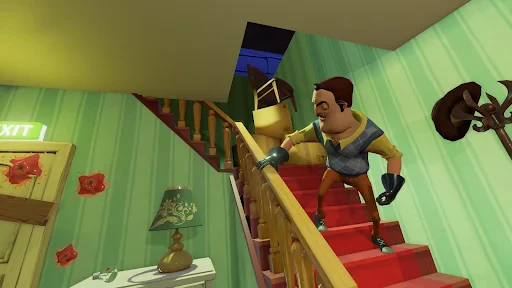
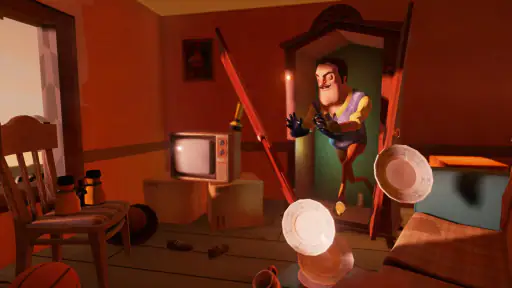
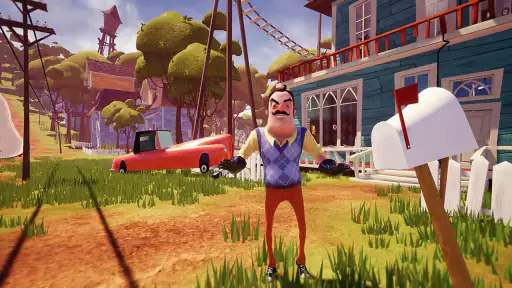
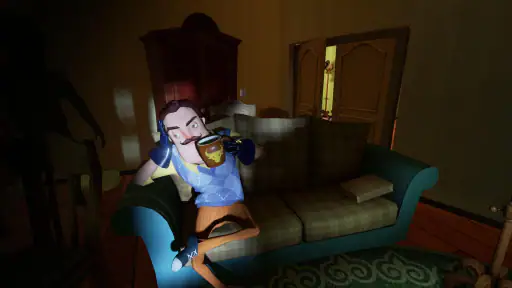
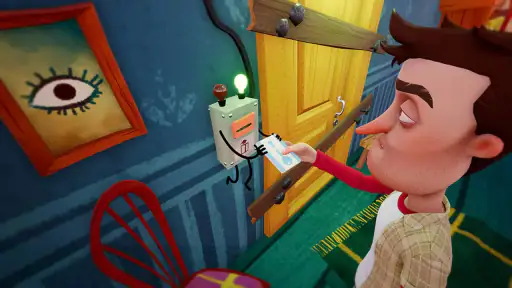
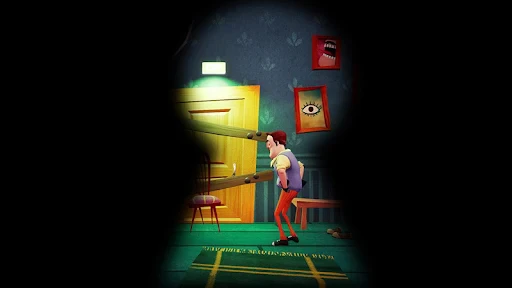
Visually, Hello Neighbor sports a unique art style that’s both cartoonish and creepy. The graphics aren’t hyper-realistic, which adds to the game’s quirky charm. The sound design complements the visuals perfectly. The eerie background music and sudden sound effects will keep your adrenaline pumping. And let’s not forget the neighbor’s footsteps echoing, sending shivers down your spine!
Where it sits among adventure games
Compared with a conventional adventure built around a fixed sequence of clues, this one makes the threat part of the problem-solving. I find that gives its familiar exploration-and-puzzle ingredients a more unpredictable feel. The trade-off is that it may be less satisfying for someone who wants every obstacle to behave consistently or prefers a story delivered at a steady pace. It is closer to a tense hiding-and-investigating game than a relaxed sightseeing adventure, so choose it for that particular mix rather than for the genre label alone.
It also differs from action-heavy horror: the appeal here is not simply confronting danger, but deciding when to move, where to look, and whether a plan is still safe. If you want a game centered on combat or constant spectacle, I’d look elsewhere. If you enjoy being cautious, reading a space, and testing a hypothesis under pressure, its unusual rhythm is the point.
Who is likely to get the most from it?
I’d recommend it to players who like asking “what if I try this?” and don’t mind that an answer may involve getting caught. It can work well as an after-school or evening game when you have enough quiet time to concentrate on a puzzle and remember your previous attempts. It is also a good choice for someone curious about stealth but not looking for a realistic, grim horror presentation.
For a realistic everyday scenario, imagine you have twenty minutes before dinner and want to make progress without committing to a long story session. You can focus on one small objective: inspect an area, test a route, or work out why a previous attempt failed. If you make a useful discovery, that short session feels worthwhile even if you do not reach the basement. If you need a game that guarantees a neat conclusion in every brief break, though, the uncertainty may leave you wanting a more self-contained alternative.
The game is published by tinyBuild and has an average rating of 3.9 from around 526,000 ratings, with about 20,000 written reviews and over 50 million installs. Those figures suggest that it has reached a broad audience, but they don’t tell me whether its particular mix of pursuit and puzzle-solving will suit you. I’d put more weight on whether you enjoy learning through repeated attempts than on popularity alone.
Compatibility and a sensible first session
The current version is 2.3.15, and the listed minimum operating-system requirement is Android 8.0. Before downloading, I’d check that your device meets that requirement and has enough room for another game; that simple check can save the annoyance of starting a download only to find the phone is not a fit. Since controls take practice, I’d also give yourself a few minutes to get comfortable before tackling a puzzle that already has you under pressure.
My first-session approach would be deliberately modest: learn how movement and interaction feel, explore without expecting to solve everything immediately, and notice how the neighbor reacts when you are detected. That gives you a baseline for later attempts. If the camera or controls feel awkward to you, give them a little time before judging the whole game; if they still get in the way, that friction is a fair reason to move on rather than force yourself to adapt.
Final Thoughts
Overall, Hello Neighbor offers an exciting blend of horror and strategy. It’s a game of cat and mouse that keeps you coming back for more, despite the occasional frustration. So, if you’re up for a challenge and love the thrill of sneaking around, give this game a go. Just remember, your neighbor is always watching!
My buy-or-skip verdict
I’d try it if I wanted a free-entry adventure with stealth, strange puzzles, and a pursuer who makes familiar plans feel risky. Its appeal is specific, not universal: the adaptive pressure can make discovery memorable, but it can also interrupt the slower thinking some puzzle fans prefer. The Everyone 10+ rating is a useful guide, though I’d still consider how comfortable the player is with suspense and being chased.
For me, the sensible choice is to start without spending, decide whether the trial-and-error loop is enjoyable, and only consider an in-app purchase after checking its exact value in the game. Skip it if you want a peaceful puzzler, predictable progression, or a story that never makes you repeat an attempt. Choose it if the idea of studying a suspicious house while an unpredictable neighbor tries to stop you sounds like a good way to spend your playtime.
Hello Neighbor Pros and Cons
Pros
- Engaging storyline with mystery elements.
- Visually appealing graphics and design.
- Challenging AI that adapts to player actions.
- Exploration encourages creative problem solving.
- Regular updates and community support.
Cons
- Steep learning curve for new players.
- Occasional glitches can disrupt gameplay.
- Limited in-game tutorials for guidance.
- Can be repetitive after multiple playthroughs.
- Requires high device performance.
This Game in Other Languages
Frequently Asked Questions
What is the objective of Hello Neighbor?
Hello Neighbor is a stealth horror game where the main objective is to sneak into your neighbor's house to uncover the secrets hidden in the basement. Players must solve puzzles, avoid traps, and outsmart the AI-driven neighbor to progress through the game. The thrill comes from the neighbor's adaptive behavior, making each attempt more challenging.
Is Hello Neighbor suitable for children?
Hello Neighbor is rated for players aged 10 and above due to its cartoonish graphics and mild horror elements. However, parents should be aware that the tension and suspense might be unsettling for younger children. It's recommended to consider your child's tolerance for suspense and mild scares before allowing them to play.
How does the AI in Hello Neighbor work?
The AI in Hello Neighbor is designed to learn from the player's actions. This means that if you take the same route multiple times, the neighbor will set traps and become more vigilant in those areas. The adaptive AI adds an element of unpredictability and requires players to constantly change strategies to succeed.
Are there different versions or sequels to Hello Neighbor?
Yes, Hello Neighbor has expanded beyond the original game. There are sequels and spin-offs such as Hello Neighbor: Hide and Seek, which explores the backstory, and Secret Neighbor, a multiplayer version of the game. These additional games offer new perspectives and challenges, keeping the Hello Neighbor universe fresh and engaging.
What platforms is Hello Neighbor available on?
Hello Neighbor is available on multiple platforms, including PC, Xbox, PlayStation, Nintendo Switch, and mobile devices (iOS and Android). This wide availability ensures that players can enjoy the game on their preferred device, whether at home or on the go, making it accessible to a broad audience.


