

Draw To Smash: Logic puzzle
- Reviews
- 4.6
- Version
- 1.22.69
- Installs
- 10,000,000+

Screenshots
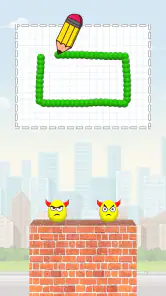
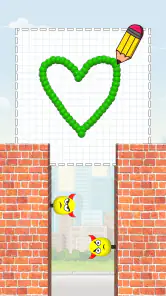
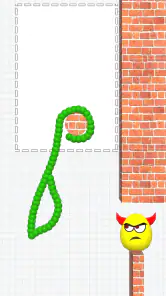
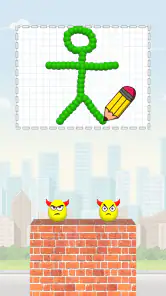
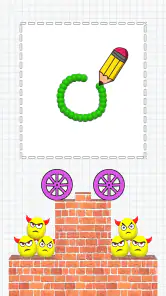
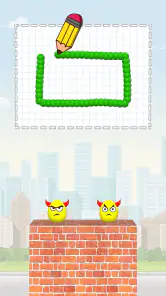
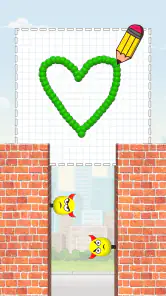
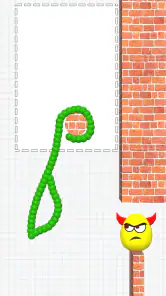
 Analysis by Frivlyz
I like puzzle games that give me room to think without asking me to learn a long list of rules first, and this one gets to its central idea quickly. I draw on the screen, watch the objects react, and adjust my approach when the result is not what I expected. That simple loop gives each level a playful, hands-on feel: I am not just choosing an answer from a menu; I am making something and seeing what it does.
A quick, inviting first impression
The game is a free puzzle title from HYPERCELL, and its basic appeal is easy to understand: use drawn shapes to deal with the problem in front of you. I find that approachable setup useful when I want a short mental break, because I can start experimenting without first memorizing complicated controls. It is also a good fit for people who enjoy visual reasoning more than word riddles or number grids.
Draw To Smash: Logic puzzle has an average rating of 4.6 from around 135,000 ratings, and it has been installed over 10 million times. Those figures suggest that its pick-up-and-play premise has reached a broad audience, but they do not tell me whether its particular style will suit you. The important question is whether you enjoy testing an idea, observing the result, and trying again when a drawing behaves differently than you pictured.
A playful world built around readable action
The look and subject matter keep the puzzles light. The bad eggs give the task a clear target, while the colorful presentation makes the screen feel more like a playful toy than a stern logic test. I appreciate that visual clarity because the drawing itself is already the main thing I need to judge: where a shape goes, what it might touch, and how the scene responds.
The game’s visual language also encourages experimentation. A line is not merely a mark on the screen; it is a proposed solution that changes the scene. That makes the act of drawing feel connected to the puzzle rather than like decoration. The style should appeal to players who prefer cheerful, readable boards, though anyone seeking a detailed story world or a serious, minimalist brain-training atmosphere may want a different kind of puzzle game.
Sound and pacing that keep the mood light
Playful sound effects support the game’s bouncy tone and help give actions a bit of feedback. I see the sound as seasoning rather than the main attraction: the satisfaction comes from watching a plan work, and the audio helps keep that moment lively. If I am playing somewhere quiet, I can still follow the visual cause and effect; the puzzle idea does not depend on a spoken explanation or a dramatic soundtrack.
The early levels ease me into the drawing mechanic, then later puzzles ask for more thought. That gradual change gives me time to learn by doing instead of being hit with every possible complication at once. It also means the pace is best for short sessions with occasional pauses to think. When I want a rapid sequence of obvious wins, a simpler casual game may feel more immediate; when I want to reason through a small physical problem, this rhythm works well.
Gaming Stories You May Enjoy

Dancing Road Turns Short Breaks Into a Test of Rhythm and Timing

Super Stylist Makes Every Outfit a Test of Taste and Patience

Dominoes on Your Terms: Who Should Play and Who Should Pass

Pokémon GO Makes the Familiar World Feel New

Chess.com Turns Rematches Into Rivalries, but Community Has Its Costs

Archery Battle 3D Review: Sharp Aiming, Unclear Feedback
Where the drawing mechanic earns its place
I find the drawing mechanic most rewarding when I treat each mark as a small test rather than a finished answer. Starting with one simple shape makes it easier to notice which contact or movement changed the outcome, so a retry can teach me something instead of feeling like guesswork. That habit also makes the game’s physical puzzles easier to read, and it leads naturally to the question of how its playful presentation supports the thinking.
Experimenting instead of hunting for one answer
Each level presents a problem and asks me to solve it with a drawing. I may need to guide a ball toward a particular area or make a shape interact with objects in the scene. That open-ended approach is the game’s strongest idea: I can treat a failed attempt as useful feedback and revise the drawing, rather than assuming there is only one exact line to copy.
One practical tip is to begin with the smallest drawing that could plausibly affect the scene. A large, elaborate sketch may obscure what caused the result, while a simple line makes it easier to see which contact or movement mattered. If that first attempt fails, I can change one part at a time. This turns trial and error into a kind of informal experiment and makes the eventual success feel earned rather than lucky.
When it fits into an ordinary day
I can imagine opening it while waiting for a bus, during a short break, or when I want something more engaging than scrolling but do not have time to settle into a long game. A useful way to play is to give a stubborn level a few thoughtful attempts, then put the phone down and return later. A fresh look can make the arrangement easier to read, and the game’s draw-and-observe loop does not require me to keep a complicated story or build in my head between sessions.
It is suitable for a wide age range: the content rating is Everyone, and the basic interaction is easy to grasp. That does not mean every puzzle will be effortless. Children may enjoy the drawing and movement, while adults who like spatial reasoning can focus on why one shape works and another does not. I would still choose a different game for someone who wants a guided narrative, competitive matches, or a purely verbal challenge.
How it compares with other puzzle habits
Compared with a crossword or a number puzzle, this is much more visual and physical. I do not solve clues in sequence; I predict how a drawn shape will behave in a scene. Compared with tightly scripted logic games, the freedom to try different drawings feels less like finding a single prescribed answer and more like testing a small hypothesis. That freedom is appealing, but it can also make a failed attempt harder to diagnose if several parts of a drawing affect the outcome at once.
That is why I would not recommend treating every level as a race. Pause to inspect the objects and think about what needs to move, then make a modest first attempt. The trade-off is clear: players who enjoy tinkering get room to explore, while players who prefer crisp rules and unambiguous deductions may find the physical interactions less satisfying. For the latter, a traditional grid-based logic puzzle is likely a better match.
What to expect from a free download
The game is free, carries an Everyone age rating, and its current version is 1.22.69. It was released on March 14, 2023, and works on Android 7.0 or later. I would check that minimum operating-system requirement before installing it on an older Android device. Its large audience is reassuring as a sign of broad interest, but the useful decision point remains the same: do you want a casual puzzle built around drawing and cause and effect?
There is also a practical difference between enjoying the concept and enjoying every level. The introductory ease makes the rules approachable, but a later challenge may call for several revisions. If you dislike repeating an attempt to understand what happened, that friction could outweigh the charm. I find it more rewarding when I approach retries deliberately: change one feature, observe the outcome, and keep the result in mind rather than redrawing at random.
A measured verdict on its mood
Draw To Smash works best when its cheerful presentation, quick-to-grasp drawing, and physical puzzle-solving all point in the same direction. The result is a light mood with enough resistance to make a successful solution satisfying. HYPERCELL’s game is a good choice for casual players, families, and anyone who likes spatial experiments in short bursts; it is less suited to people seeking a deep narrative, a competitive challenge, or the strict certainty of a conventional logic grid.
When I first downloaded Draw To Smash: Logic puzzle, I was intrigued by its concept. Imagine a game where you don't just follow a set path, but instead, you get to decide how to solve puzzles. The game starts off easy, gently introducing you to its mechanics. You use your finger to draw shapes on the screen, and these shapes help you achieve the game's objectives. It's like combining art class with logic puzzles!
Gameplay and Features
The gameplay in Draw To Smash is as straightforward as it is addictive. Each level presents you with a problem, and your task is to figure out how to solve it using drawings. For example, you might need to draw a line to direct a ball into a specific area or create a shape that interacts with objects in the game environment. The possibilities are endless, and that's what makes it so much fun. You're not just playing a game; you're crafting your own solutions.
One of the standout features of this app is its variety. The levels are designed to keep you on your toes, constantly challenging your problem-solving skills. I found myself thinking outside the box more often than not, and it was immensely satisfying. Plus, the game’s vibrant graphics and playful sound effects add to the overall experience, making each puzzle feel fresh and exciting.
Challenging Yet Fun
What sets Draw To Smash apart is its perfect balance between challenge and enjoyment. Some levels had me scratching my head for a while, but the "aha!" moment when you finally figure out the solution is worth the effort. The game does a great job of ramping up the difficulty without ever feeling unfair, which is crucial for maintaining interest.
Another aspect I appreciate is how the game encourages replayability. Once you complete a level, you can always go back and try to find alternative solutions. This not only extends the game's lifespan but also keeps things interesting as you experiment with different strategies.
Final Thoughts
In conclusion, Draw To Smash: Logic puzzle is a gem for anyone who loves puzzles and creativity. It's a game that challenges your brain while letting your creativity flow freely. Whether you're a casual gamer looking for something light and fun or a puzzle enthusiast seeking a new challenge, this app has something for you. So why not give it a try? You might just find yourself hooked on drawing and smashing your way through its delightful puzzles!
Draw To Smash: Logic puzzle Pros and Cons
Pros
- Challenging puzzles enhance logic skills.
- User-friendly interface for easy navigation.
- Regular updates with new levels and features.
- Offline mode available for on-the-go play.
- Stimulates creative problem-solving abilities.
Cons
- Advertisements can be intrusive.
- Limited hints available in free version.
- Some levels may be overly challenging.
- Occasional in-app purchase prompts.
- No multiplayer or social sharing options.
Frequently Asked Questions
What is Draw To Smash: Logic Puzzle?
Draw To Smash: Logic Puzzle is an engaging mobile game that combines elements of drawing and logic puzzles. Players are tasked with solving various challenges by drawing lines or shapes to smash objects. The game's unique blend of creativity and problem-solving makes it a delightful experience for those who enjoy brain-teasing activities.
How do I play Draw To Smash: Logic Puzzle?
To play Draw To Smash: Logic Puzzle, you must draw lines or shapes on your screen to interact with the game's environment and solve puzzles. Each level presents a different challenge, requiring you to think strategically and use your drawing skills to achieve the objective of smashing specific objects.
Is Draw To Smash: Logic Puzzle suitable for all ages?
Yes, Draw To Smash: Logic Puzzle is designed to be family-friendly and is suitable for players of all ages. Its intuitive controls and gradually increasing difficulty make it accessible to both younger players and adults who enjoy logic-based games. However, younger children might need some guidance to understand the more complex puzzles.
Does Draw To Smash: Logic Puzzle require an internet connection?
No, Draw To Smash: Logic Puzzle does not require an internet connection to play. This makes it an ideal game for on-the-go entertainment, allowing you to enjoy solving puzzles anytime and anywhere without worrying about connectivity issues.
Are there any in-app purchases in Draw To Smash: Logic Puzzle?
Yes, Draw To Smash: Logic Puzzle offers in-app purchases that provide players with the option to enhance their gaming experience. These purchases can include additional levels, hints, or cosmetic items. While the game can be enjoyed without spending money, these options are available for those who wish to accelerate their progress or customize their game.


