

Downhill Skate Race
- Reviews
- 4.5
- Version
- 1.6.2
- Installs
- 5,000,000+

Screenshots
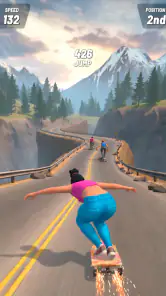


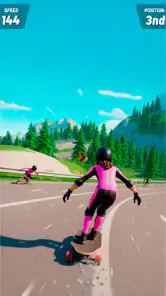


 Analysis by Frivlyz
I expected Downhill Skate Race to be a quick arcade distraction, and that is exactly where it makes its best first impression. It puts the focus on downhill skateboarding, short bursts of speed, and the simple pleasure of trying to handle a moving course without turning the experience into a complicated simulation. After spending time with it, I found a game that is easy to understand within minutes, but more difficult to judge fairly after the initial novelty fades.
That distinction matters. Many arcade games are enjoyable for a few sessions because the basic idea is immediately clear, then become background noise once the first surprise disappears. This one has a stronger chance of staying installed if you enjoy repeating a compact challenge and improving your own control. If you need a large variety of modes, a deep progression system, or a substantial single-player campaign, I would look elsewhere. If you want a free, accessible racing game that fits into small breaks, it has a more convincing case.
What the first week feels like
The first thing I liked was how little preparation the game demands. Its premise is straightforward: take a skateboard downhill and try to race effectively. You do not need to learn a fictional universe, understand a complicated upgrade tree, or commit to a long opening tutorial before finding out whether the handling suits you. That makes it a natural choice for a short session while commuting, waiting for an appointment, or taking a break from a more demanding game.
The arcade identity is important here. This is not the kind of skateboarding title I would choose when I want realistic trick planning or a broad sandbox to explore. The appeal comes from motion, timing, and the immediate pressure of a downhill run. I found myself paying attention to the next part of the course rather than thinking about long-term strategy. That narrow focus gives each attempt a clean purpose: react well, avoid losing momentum, and see whether the next run can be better.
That simplicity also makes the game approachable for younger players. It carries an Everyone content rating, so it is positioned as a family-friendly option rather than a mature racing experience. I would still suggest that parents try it themselves before handing over a device, simply because the most important question is not age suitability but whether the child enjoys repetition. Some players love retrying a short challenge until their timing improves; others quickly ask for more variety.
During the first several sessions, the best habit is to resist treating every mistake as a reason to rush into another attempt. I got more from watching where a run went wrong: was I reacting too late, committing to a line without enough room, or simply losing concentration because I was trying to go faster than my control allowed? That kind of self-review is where the game becomes more than a reflex toy. The useful skill is not just speed, but learning when speed has stopped being helpful.
For a realistic everyday example, I can see this working well during a ten-minute break. One run gives me a quick reset, while several attempts create a small personal challenge without requiring the same uninterrupted attention as a console racing game. It is also easy to stop after a short session, which is valuable for a mobile game. I would not open it when I want a relaxing, hands-off experience, though. Even a brief run asks me to stay alert, and that can feel tiring when I am already mentally drained.
Gaming Stories You May Enjoy

Dancing Road Turns Short Breaks Into a Test of Rhythm and Timing

Super Stylist Makes Every Outfit a Test of Taste and Patience

Dominoes on Your Terms: Who Should Play and Who Should Pass

Pokémon GO Makes the Familiar World Feel New

Chess.com Turns Rematches Into Rivalries, but Community Has Its Costs

Archery Battle 3D Review: Sharp Aiming, Unclear Feedback
The developer, Freeplay Inc, has chosen a clear lane rather than trying to make this an all-purpose skateboarding package. That clarity helps the opening experience. The game’s store summary presents it as a high-speed skateboard simulation, but my practical reading is closer to fast arcade racing with a skateboarding theme. That is not a criticism; it simply sets the right expectation. Players seeking authentic board physics may find the presentation lighter than the word “simulation” suggests.
Why the basic loop works at first
The first-week appeal comes from a familiar arcade rhythm: attempt, fail or improve, and immediately try again. There is very little friction between deciding to play and being back in the action. I appreciate that because mobile games often lose their appeal through menus, waiting, or too many interruptions. Here, the central activity remains the reason to return.
The strongest early motivation is personal improvement. I did not need a leaderboard or a dramatic reward to feel that a cleaner run was worthwhile. A small improvement in timing can make the next attempt feel noticeably more controlled. That is a modest form of progression, but it is honest. The game works best when I treat each run as practice rather than expecting a constant stream of new content.
There is also a useful trade-off between caution and pace. Playing too safely can make a run feel flat, while pushing aggressively increases the chance of a mistake. I recommend first learning a course or sequence at a controlled speed, then adding risk once the basic route feels familiar. This approach is more effective than immediately chasing the fastest possible result, especially on a touchscreen where rushed input can become imprecise.
What remains after the novelty fades
The more important test is whether the game can support a habit beyond the opening week. In my experience, its recurring value depends heavily on what kind of player you are. If you enjoy score chasing, repeated practice, and compact arcade sessions, the core loop can remain satisfying because there is always room to make a cleaner attempt. If your enjoyment depends mainly on unlocking a large stream of new environments or mechanics, the experience may feel limited sooner.
That makes it different from a typical mobile racing alternative built around a long career structure. A larger racing game may offer more vehicles, customization, events, or a broader sense of collection. Those games can provide stronger long-term variety, but they often ask for more time and attention. Downhill Skate Race has the opposite advantage: it is easier to pick up, easier to understand, and less demanding when I only have a few minutes.
Compared with a skateboarding sandbox, the contrast is even clearer. A sandbox is better when I want to experiment, wander, and create my own objectives. This game is better when I want the course to give me a direct task. There is less freedom, but also less indecision. I do not spend time wondering what to do next; I focus on completing the run and improving my response to the terrain.
Compared with an endless runner, it offers a more specific fantasy. The downhill skateboard setting gives the action a distinct identity instead of making the character simply run through an abstract stream of obstacles. However, fans of endless runners who enjoy constantly changing patterns may find the repetition here less exciting. The choice comes down to whether you prefer a recognizable racing challenge or an unpredictable sequence designed to continue indefinitely.
One of the more useful ways to preserve interest is to create a small personal routine. I would play a few deliberate runs rather than leaving the game open for a long, unfocused session. Before starting, I would choose one goal: cleaner control, fewer mistakes, or a faster finish. This prevents the familiar arcade problem where every attempt blends into the next. The game does not need to provide a new reward each time if I give the session a clear purpose.
Another practical tip is to separate learning from performance. On the first attempts in a difficult section, I would concentrate on recognizing the timing and safe line rather than trying to produce a perfect result. Once the sequence feels predictable, I would switch to speed. This two-stage approach reduces frustration and makes improvement easier to notice. It is a small adjustment, but it turns repeated failure into information instead of wasted time.
Who gets lasting value from it
I think the best audience is someone who likes arcade games with a focused loop and does not need a huge amount of content to stay interested. It suits players who enjoy testing reflexes, refining short attempts, and filling spare moments with something more active than a puzzle. It can also work as a casual introduction to racing games for someone who finds full-featured racers intimidating.
I would be more cautious recommending it to players who want realistic skating technique, extensive customization, multiplayer competition, or a story-driven structure. Those expectations are likely to create disappointment, even if the basic controls and downhill idea are appealing. It is also not my first choice for someone who dislikes repeating the same type of challenge. The game’s strength is focus, and that same focus can feel narrow.
The free price lowers the barrier to trying it, which is especially helpful for a game whose appeal depends so much on personal taste. I can install it without treating the decision as a major purchase, play enough to understand the loop, and decide whether repetition feels rewarding or monotonous. Free does not automatically mean frictionless, of course, but it makes the evaluation process easier for casual players.
Maintenance, fatigue, and the everyday cost of returning
When I think about keeping a mobile game installed, I consider more than whether it is fun once. I ask whether it earns attention repeatedly and whether returning feels effortless. This title has a relatively low mental maintenance burden because its premise stays understandable. I do not need to remember a complicated build, a long plot, or a set of daily obligations before playing effectively.
That is a genuine advantage over more elaborate racing games. Those alternatives can be rewarding, but they may also make me feel that I am falling behind if I stop playing. A focused arcade game is easier to leave for a week and revisit without studying patch changes or rebuilding a strategy. For someone who wants a game rather than a second routine, that simplicity is valuable.
At the same time, the game’s low maintenance can become low attachment. If there are no broader goals that matter to me, I may finish a session feeling entertained but not especially motivated to return tomorrow. The difference between a healthy habit and a fading installation is whether I still have a personal reason to play. For me, that reason would be improving control, not collecting obligations.
The main source of fatigue is repetition without a fresh objective. A few attempts can feel sharp and satisfying; too many can turn into automatic retries where I am no longer learning anything. I recommend stopping when concentration drops rather than forcing a result. In a reflex-based downhill game, tired play is especially unproductive because it produces mistakes that teach very little and can make the controls seem worse than they are.
Another point of friction is the narrow emotional range. The game is built around speed and performance, so it may not provide much relief when I want a calmer mood. It can also feel frustrating if a run is lost near a promising finish, particularly when I am already repeating the same section. Taking a short break is not just general advice here; it directly protects the part of the experience that makes the game enjoyable.
For a healthier month-to-month routine, I would use it as a short challenge rather than a default app to open whenever I am bored. I might play after a break from work, set a small target, and close it once the target is met. That keeps the game associated with focused fun instead of endless scrolling. It also makes returning feel more deliberate, which helps preserve the novelty of speed and motion.
Device expectations and version context
The game supports Android devices running version 6.0 or later, so it is not restricted to only the newest phones. That broad compatibility makes it easier to consider for an older spare device or a family tablet, provided the hardware offers a comfortable touchscreen experience. I would avoid judging it solely by the age of the operating system, though; responsive input matters more than having a recent version number for this type of game.
The current version is 1.6.2, and that is the version I would look for when installing or checking whether an update is available. Keeping the app current is sensible for stability, but I would not assume that an update alone changes the long-term character of the game. The recurring question remains whether the downhill loop itself continues to hold my attention.
Its audience scale suggests that it has reached a substantial mobile audience: the game has passed five million installs and holds an average rating of 4.5 from around sixty thousand ratings. Those figures make it easier for me to take the game seriously as an established casual arcade option, but they do not replace personal testing. A high average can reflect broad accessibility, while a player who wants deep systems may still find the experience too concise.
The game has also been available since December 25, 2024, which places it in a relatively recent part of the mobile arcade landscape. I would treat that as context rather than a guarantee of long-term support or content growth. For my decision, the more useful question is whether the current experience already justifies space on the phone, not whether future additions might eventually change its appeal.
My long-term verdict
After the first rush of speed wears off, Downhill Skate Race earns its place as a focused arcade game rather than a complete skateboarding platform. I like that it does not demand a large time commitment, and I appreciate how quickly a short session becomes playable. The downhill theme gives the familiar retry loop a clear personality, while the free price makes it easy to test without much risk.
Its limitations are equally clear. The experience is best for players who find satisfaction in repetition and gradual control. Anyone expecting a deep career, broad exploration, or realistic skating simulation should choose a different type of game. Even fans of arcade racing may eventually need another title alongside it if they want more variety, because a focused loop can only carry long-term interest when the player enjoys setting personal challenges.
My recommendation is to keep it installed if you can describe your ideal mobile session as “a few fast attempts with one clear goal.” That is where the game feels most useful and least tiring. I would skip it if I tend to abandon games once the opening idea is understood, or if I want progression to provide the main reason to return.
In the end, the game does not need to become a daily habit for it to be worthwhile. A title that remains enjoyable for occasional, concentrated sessions can be more valuable than one that constantly asks for attention. For me, its lasting appeal comes from that modest role: a quick downhill challenge when I want active arcade play, with enough room for improvement to make another run tempting but not compulsory.
My final advice: try it with a short-session mindset, judge the control rather than the store promise, and give yourself a specific target for each visit. If the satisfaction comes from making one cleaner run, this is a good fit. If you need constant novelty to stay engaged, the same simplicity that makes the opening friendly will probably make the game fade from your phone.
Downhill Skate Race Pros and Cons
Pros
- Fast downhill races are easy to start and fun for short play sessions.
- Simple controls make the game accessible to casual players.
- Varied tracks keep the scenery and challenges from feeling repetitive.
- Unlockable boards and upgrades add useful progression between races.
- Offline play lets you enjoy races without a constant internet connection.
Cons
- Steering can feel imprecise during sharp turns and narrow sections.
- Later tracks may rely heavily on memorizing obstacles and routes.
- Progression can become repetitive once the main race mechanics are familiar.
- Ads may interrupt the experience
- especially after completing races.
- Limited customization reduces the sense of personalizing your skater.
Frequently Asked Questions
What is Downhill Skate Race?
Downhill Skate Race is an action racing game focused on fast downhill runs, skating challenges, and obstacle-filled tracks. Players guide a skater through slopes while trying to maintain control, avoid hazards, collect useful items, and reach the finish line quickly. Its simple concept makes it easy to understand, but later courses can require accurate timing and quick reactions.
How do you play Downhill Skate Race?
The game is designed around straightforward touch controls, allowing you to steer the skater and react to turns, ramps, barriers, and other track elements. Success depends on balancing speed with control rather than simply moving as fast as possible. During testing, the most reliable approach was to anticipate corners, stay focused on the route, and avoid unnecessary risks when obstacles appear close together.
Is Downhill Skate Race free to download and play?
Downhill Skate Race can generally be downloaded without an upfront purchase, although the exact availability of advertisements, optional purchases, or other monetization features may depend on the version and platform. Before installing, it is worth checking the official store listing for current details. Players who prefer uninterrupted sessions should also review whether ads or in-app purchases are included.
Can Downhill Skate Race be played offline?
The core racing experience may be suitable for short offline sessions, which is convenient when you are traveling or have limited mobile data. However, some features, such as advertising, progress synchronization, leaderboards, updates, or promotional content, may require an internet connection. Because requirements can change between versions, check the store description and test the game once installed before relying on offline access.
Is Downhill Skate Race suitable for children and casual players?
Downhill Skate Race is approachable for casual players because its objective is easy to understand and the controls do not require extensive tutorials. It can also appeal to children who enjoy colorful racing and reflex-based gameplay, but parents should check the official age rating, advertising practices, and purchase settings before allowing unsupervised play. Difficulty may increase as tracks become faster and more demanding.


