

Doodle God™
- Reviews
- 4.2
- Version
- 3.3.9
- Installs
- 500,000+

Screenshots


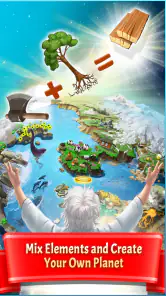
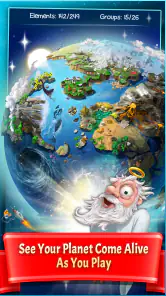
 Analysis by Frivlyz
I enjoy puzzle games that invite me to experiment rather than race a timer, and this one makes that kind of curiosity its whole appeal. Doodle God™ starts with a small set of building blocks and asks me to discover what happens when I combine them. The pace is generally suited to short, thoughtful sessions: I can try a few ideas, take a break, and return when I feel like puzzling something out. That relaxed rhythm is a better fit here than expecting a fast-moving action game.
A puzzle built around curiosity
Made by JoyBits Ltd., this is a puzzle game for people who enjoy testing possibilities and spotting connections. It has a 4.2 average from around 18,000 ratings, and has been installed over 500,000 times. Those figures suggest a well-established audience, but the more useful question is whether its particular style suits you: progress comes from exploring combinations, not from reflexes or competing against other players.
The basic idea is easy to grasp, but it can take patience to make progress. A combination either leads somewhere or leaves you with a clue about what to try next. I find that makes the game comfortable to pick up without a long tutorial, while still leaving room for the puzzle to become less obvious as the available possibilities grow. Its Everyone age rating also makes it an approachable option for a broad range of players, though younger players may appreciate an adult nearby when they reach a tricky stretch.
Speed, pauses, and getting unstuck
In ordinary play, the experience is less about demanding quick reactions and more about how smoothly I can move through a chain of experiments. The central loop is simple: choose elements, test a pairing, and consider what the result suggests. That makes the game easy to fit into a quiet break or a few minutes while waiting. I would not choose it when I want a constant stream of action; its satisfying moments come from thinking, and sometimes that means stopping to reconsider rather than tapping faster.
When I hit a wall, hints can help me regain momentum without turning every puzzle into a solved answer. I prefer to use them after I have tried a few sensible combinations, since reaching for help immediately can take away the pleasure of making a discovery myself. A useful habit is to pause and review what I have already learned before using a hint: an old result may suggest a new line of thought. This kind of methodical retrying is more rewarding than repeatedly testing random pairs.
The game is listed at $1.49, with optional in-app purchases ranging from $0.99 to $99.99 per item. I would check the purchase prompts carefully, particularly if a child will be playing, and decide in advance whether optional spending is welcome. The initial price and those optional purchases are worth weighing together rather than assuming every extra is necessary to enjoy the core puzzle.
The Art of Creation
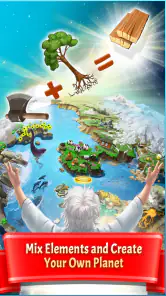
Starting off with the four basic elements: earth, fire, water, and air, Doodle God™ gives you the thrilling task of combining them to create new elements. It’s quite exciting to see how mixing simple elements can lead to the creation of something entirely new. I mean, who knew combining water and fire would give you alcohol? It’s these little moments of discovery that make the game so engaging.
Gaming Stories You May Enjoy

Dancing Road Turns Short Breaks Into a Test of Rhythm and Timing

Super Stylist Makes Every Outfit a Test of Taste and Patience

Dominoes on Your Terms: Who Should Play and Who Should Pass

Pokémon GO Makes the Familiar World Feel New

Chess.com Turns Rematches Into Rivalries, but Community Has Its Costs

Archery Battle 3D Review: Sharp Aiming, Unclear Feedback
Gameplay and Mechanics
The gameplay is surprisingly intuitive. You simply drag and drop elements onto each other to see if they combine into something new. As you progress, the combinations become more complex, and that’s where the real challenge comes in. There are over 300 elements to discover, so you’re in for a long and satisfying journey.
One feature I really appreciate is the game’s hint system. If you ever find yourself stuck—and trust me, you will—the hints are there to nudge you in the right direction without giving too much away. It’s like having a helpful friend who’s always there to assist but never spoil the fun.
Choosing the right kind of session
A realistic way to use this game is to open it during a short wait, make a handful of deliberate attempts, then stop while the next idea is still forming. I try to remember the combinations I have already tested, because repeating a failed pairing wastes time and can make the puzzle feel more arbitrary than it is. If I am playing for longer, I take a brief pause when progress stalls instead of turning the session into a guessing marathon. Returning with fresh eyes often makes an old clue feel more useful.
That approach also helps answer whether it works for a casual player: yes, if casual means low-pressure and easy to revisit, rather than a game that constantly rewards rapid progress. It can also suit puzzle fans who like deduction, but players who want strict logic with every answer derivable from explicit rules may find some combinations more playful and associative than formal. The best mindset is curious experimentation, not the expectation that each answer will follow a perfectly predictable scientific rule.
How it compares with other puzzle games
Compared with a conventional match puzzle, where the board and objective are immediately visible, this game puts more emphasis on discovering the rules through combinations. Compared with a word riddle, it gives you tangible elements to manipulate instead of asking you to solve a clue in isolation. That makes it a distinctive choice when I want a slower puzzle with a sense of building a personal catalogue of discoveries. If I want a clear level goal, a brisk run, or a puzzle with one tightly defined solution at a time, a classic match game or logic-grid title is probably a better pick.
There is a trade-off to that open-ended structure: a failed experiment may not explain exactly why it failed. I recommend treating each attempt as information, not just a yes-or-no result. Try pairings that share a theme, and make one change at a time so you can notice what led to a new result. It is a small adjustment, but it makes exploration feel more intentional and helps keep the growing set of possibilities manageable.
Presentation and longer sessions
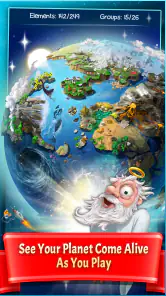
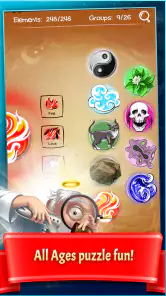
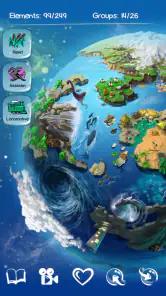
Visually, the game is a treat. The graphics are vibrant and colorful, making each element distinct and easy to identify. The whimsical art style adds a layer of charm that fits perfectly with the game’s theme. The sound effects and background music are subtle yet effective, enhancing the overall experience without being intrusive.
During heavier play, the main demand is attention rather than quick reactions: keeping track of discoveries and staying patient when a promising idea does not work. I would avoid assuming that a longer session will always be more productive. If I start testing combinations without a plan, the process can become repetitive, so I set myself a small goal, such as exploring one promising line of thought, then take a break. That keeps the game relaxing instead of turning it into homework.
Reliability and device fit
The current version is 3.3.9, and the minimum operating-system requirement is 7.0. A device that meets that requirement is within the stated compatibility range, but the number alone cannot tell you exactly how it will feel on every phone or tablet. For a puzzle based on selecting and combining items, I would prioritize a responsive touch screen and a display that makes the elements comfortable to read over raw processing power. I would also keep the game updated through the usual store route when updates are available.
I cannot promise that every device will behave identically, so if smooth operation matters to you, try a short session before settling in for a long one. If an interruption happens, the practical question is whether you can return to the puzzle and pick up your line of thought; I recommend noting a promising combination before switching away, especially if you are deep into experimentation. This is a useful habit for any game that asks you to remember what you have already tested.
It is not the right choice if you need a competitive challenge, a story-led adventure, or a puzzle that tells you exactly what to do next. It is also less appealing if you dislike trial and error or prefer every rule to be laid out from the start. In those cases, a structured level-based puzzle may feel fairer and more directed. But when I want a gentle, imaginative way to occupy a few spare minutes, this game’s combination-driven format has a clear appeal.
But what truly sets Doodle God™ apart is its ability to make you think outside the box. It’s not just about mixing elements randomly; you need to be strategic, and sometimes a bit creative, to unlock new combinations. It’s like solving a puzzle where the pieces constantly change.
Final Thoughts
In conclusion, Doodle God™ is more than just a game; it’s a journey of discovery and creativity. Whether you’re a casual gamer looking for something lighthearted or a puzzle enthusiast eager for a challenge, this game has something for everyone. The satisfaction of discovering new elements and the joy of creation makes it a must-try for anyone with a curious mind.
If you haven’t yet experienced the thrill of being a god, now’s your chance! Download it today and unleash your inner creator.
My performance verdict
Overall, I would judge this game by its calm, experiment-first design rather than by assumptions about demanding graphics or intense action. Its core interactions are straightforward, and the puzzle can be enjoyed in small bursts, but a long run of unsuccessful guesses may feel slow. I get the best experience when I play deliberately, use hints sparingly, and stop when my ideas dry up. If that sounds like your kind of puzzle, it is an inviting little world to explore; if you want speed, strict logic, or a guided sequence of wins, I would choose a different style of game.
Doodle God™ Pros and Cons
Pros
- Creative puzzle gameplay
- Wide variety of elements
- Challenging brain teasers
- Regular updates
- Offline mode available
Cons
- Ads can be intrusive
- In-app purchases expensive
- Some puzzles repetitive
- Requires logical thinking
- Limited tutorial guidance
Frequently Asked Questions
What is Doodle God™ and how do you play it?
Doodle God™ is a creative puzzle game that allows players to mix and match different elements to create new ones, ultimately building a universe. The gameplay involves combining various elements such as fire, earth, water, and air to discover new items. As you progress, you unlock more complex combinations and can build increasingly intricate worlds. The game is both a test of creativity and logic, providing hours of engaging entertainment.
Is Doodle God™ suitable for all ages?
Yes, Doodle God™ is suitable for players of all ages. Its intuitive controls and simple premise make it accessible for children, while the depth of gameplay and strategic element combinations provide a challenge for older players. Parents can rest assured that the game content is family-friendly, with no inappropriate material or themes.
Does Doodle God™ require an internet connection to play?
Doodle God™ can be played offline, making it a great option for gaming on the go without worrying about internet connectivity. However, some features, such as leaderboards or certain in-game purchases, may require an internet connection to access. Players can enjoy the core gameplay and explore element combinations without needing to be online.
Are there any in-app purchases in Doodle God™?
Yes, Doodle God™ includes in-app purchases that allow players to buy hints, additional content, or remove ads for a more streamlined experience. While the game can be enjoyed without spending any money, purchasing these extras can enhance the gameplay by providing additional resources and features. It's important to manage in-app purchases, especially when children are playing.
What platforms is Doodle God™ available on?
Doodle God™ is available on a variety of platforms, including Android and iOS devices. This makes it accessible to a wide audience, whether you prefer to play on your smartphone or tablet. The game can be downloaded from the respective app stores, ensuring a seamless installation process across devices. Check the compatibility with your device to ensure optimal performance.


