

CookieRun: Kingdom
- Reviews
- 4.8
- Version
- Varies with device
- Installs
- 10,000,000+

Screenshots







 Analysis by Frivlyz
I’d start CookieRun: Kingdom expecting two games braided together: a character-driven role-playing adventure and a home base you build up between battles. That mix is the main appeal, but it also shapes the pace. Some sessions are about choosing a team and pushing through a fight; others are about checking the kingdom and keeping its growth moving. I find it more satisfying when I treat both sides as part of the same routine rather than expecting a nonstop action game.
For a first-time player, the useful question is not whether there is a lot to do, but whether you enjoy switching between these kinds of tasks. If you like collecting characters, adjusting a party, and seeing a settlement gradually take shape, the opening has a clear path to follow. If you mainly want a quick game with little planning or a story you can finish in one sitting, this may feel busier than you want.
A Sweet Start, Then a More Strategic Routine
I find the best way to approach the game is to think of each visit as a small step toward a stronger team or a more useful kingdom, rather than trying to clear every task at once. That makes its mix of role-playing and town management easier to settle into, especially when I’m still learning what deserves attention. Once that rhythm feels comfortable, the next useful question is how to make team choices more deliberate.
What to expect from the first sessions
In CookieRun: Kingdom, you’re not just running through endless levels; you’re building and managing your very own cookie kingdom. Trust me, it’s as delightful as it sounds. The game kicks off with a charming backstory about the brave cookies who rebel against the evil witch who wants to devour them. Yeah, it’s like something out of a fairy tale, but with way more sugar.
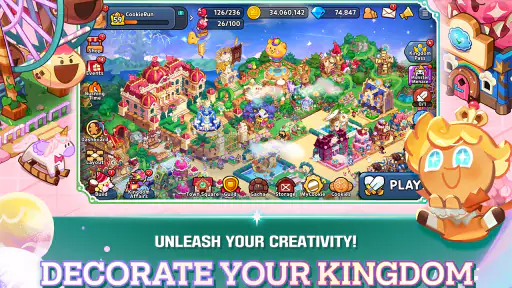
What makes this game stand out is its blend of RPG and city-building elements. You’ll be collecting resources, constructing buildings, and leveling up your cookie characters to fend off enemies. It’s all about strategy here, folks! Choosing which cookies to upgrade and how to plan your kingdom’s layout can be as intricate as any chess game. You get the satisfaction of watching your little cookie soldiers grow stronger and your kingdom more magnificent.
That combination gives the game a different rhythm from a straightforward mobile RPG, where most of your attention stays on battles, or a pure builder, where the town is the whole point. Here, the kingdom is not just decoration: it gives you a second kind of progress to manage. I like that change of focus, though it means someone who wants to jump straight from one fight to the next may find the town tasks interrupt the momentum.
Getting set up without overthinking it
When I begin a game with a roster and an upgrade path, my first instinct is to improve everything I can. I would resist that here. Early on, it is easier to understand what is helping if I focus on the cookies I actually use and avoid spreading resources across every character at once. The same goes for the kingdom: follow the immediate objectives first, then pause to look at what the next task needs before starting several things at once.
Gaming Stories You May Enjoy

Dancing Road Turns Short Breaks Into a Test of Rhythm and Timing

Super Stylist Makes Every Outfit a Test of Taste and Patience

Dominoes on Your Terms: Who Should Play and Who Should Pass

Pokémon GO Makes the Familiar World Feel New

Chess.com Turns Rematches Into Rivalries, but Community Has Its Costs

Archery Battle 3D Review: Sharp Aiming, Unclear Feedback
This is a practical way to avoid a common new-player frustration: having plenty of activity on screen but not knowing which action will move the adventure forward. I treat the current objective as a guide, not an order to ignore everything else. If it points toward a battle, I make sure my active team is in reasonable shape; if it points toward the settlement, I handle the relevant construction or resource work and return to the story afterward.
The game is free to start, and Devsisters Corporation made it as a role-playing game with town-building woven into the adventure. It was released on January 19, 2021, and runs on Android 7.0 or later. The age rating is Everyone 10+, a useful detail for families deciding whether its fantasy battles and story suit a younger player. I’d also keep in mind that optional in-app purchases range from $0.99 to $99.99 per item, so it is worth setting a spending boundary before playing if purchases are a concern.
The Cookie Cast: More Than Just a Snack
Let’s talk about the characters, because they’re the real stars here. Each cookie has its own unique abilities, and they’re all endearing in their own right. You’ve got the brave GingerBrave, the wise Wizard Cookie, and my personal favorite, the sassy Strawberry Cookie. The diversity in abilities means you can customize your team to suit your play style, whether you’re a defensive strategist or an all-out attacker.
For me, the first meaningful success is not owning a huge roster; it is getting a team through a troublesome encounter and understanding why that setup worked. When a fight goes badly, I try changing one thing at a time instead of upgrading every cookie or rebuilding the entire party. That makes the outcome easier to read: if a different mix helps, I have learned something about the team; if it does not, I can return to the previous setup without having spent resources everywhere.
That small habit matters because collecting characters can tempt you to treat every new arrival as an automatic replacement. I prefer to think about what a cookie contributes to the group, then give the established team a fair chance before switching. It is a more deliberate approach than simply picking favorites, but it lets the roster feel like a set of choices rather than a checklist. The trade-off is that experimenting takes attention, so players who dislike comparing abilities may prefer a more direct action game.
Why the kingdom changes the pace
And let’s not forget the art style—it’s like a sugar-coated explosion of colors. The graphics are vibrant, bringing each cookie and their environment to life in the most charming way possible. It’s the kind of game that’s as much a treat for the eyes as it is for the mind.
The settlement side is also where I would make a small planning habit part of the routine: check what the next objective asks for before spending time on unrelated tasks. It helps keep kingdom management from turning into a collection of interruptions. I also like using it as a lower-pressure part of a session. If I have time for a longer stretch, I can give the adventure my attention; if I only want to check in briefly, I can focus on the kingdom and leave the next fight for later.
This is one reason the game can suit people with different play styles, but it is not a promise that every session will be short. The two systems create several kinds of progress, and keeping track of them can feel like a chore if you want a clean beginning and ending every time you open a game. I would not choose it for a few seconds of distraction; I would choose it when I am happy to make a little progress and return to the same growing world later.
A useful everyday way to play
Picture a typical evening: I open the game after dinner, check the kingdom’s current needs, and take care of the task that seems most useful rather than tapping through every available activity. Then I use the adventure to work toward a clear next step. If a battle is difficult, I stop and reconsider the team before spending resources. That gives me a satisfying endpoint: one kingdom task handled, or one fight understood, rather than a vague sense that I should keep playing until everything is done.
For a new player, that approach also helps keep purchases in perspective. The game can be enjoyed without treating every slow point as a reason to spend, but free-to-play progress may ask for patience. I would first use the ordinary progression and see whether I still enjoy the routine before considering any purchase. If a family shares a device or a child is playing, it is sensible to discuss purchase limits in advance; the game’s age rating does not remove the need for household rules around spending.
The game has a substantial audience, with a 4.8 average from around 1.3 million ratings and over 10 million installs. Those figures suggest it has found many players, but they do not tell me whether its particular blend will fit you. I would weigh the actual loop more heavily: team choices, battles, and kingdom upkeep are the draw, and the same combination is the main reason someone might decide it is not for them.
Where it sits among mobile RPGs
Compared with a battle-focused role-playing game, this one asks for more attention outside combat. That can be a welcome change if I like having a home base to improve, but it is less suitable if I want every upgrade to happen through fighting. Compared with a conventional town builder, the character roster and adventure give the kingdom a purpose beyond expansion. The result sits between those familiar styles rather than replacing either one outright.
I would pick it over a simpler, combat-only alternative when I want both a story-led goal and a reason to revisit my settlement. I would choose a more focused RPG if I wanted the fights and team-building without town management, and a dedicated builder if designing and tending a settlement were the only activities I wanted. That is the clearest way to decide: the hybrid is a strength only when both halves sound appealing.
It also rewards a little restraint. New players can be tempted to chase every visible objective, try every cookie, and spend resources as soon as they become available. I get more out of it by choosing one near-term goal, keeping a dependable team, and letting the kingdom support that progress. This is not a hidden shortcut; it is simply a way to make the number of moving parts feel manageable.
When patience helps—and when it does not
Now, I know what you’re thinking—“Is it all just sugar and rainbows?” Well, mostly, but there are a few crumbs on the table. The game does have its moments where progress can feel a bit slow unless you’re willing to spend some dough (pun intended) on in-app purchases. But hey, that’s the nature of the beast with free-to-play games, right?
That slower rhythm is the main limitation I would want a friend to know about before installing. If I am stuck, I would rather take a break, return to the team and kingdom with fresh eyes, and decide what to improve than make a purchase just to force progress. A player who dislikes waiting or gradual character development may find that irritating, even if the colorful presentation and cast are appealing. Someone comfortable with steady progress is more likely to see patience as part of the strategy.
The game is free, but purchases are available at prices from $0.99 to $99.99 per item. That is a broad range, so I would treat spending as optional and decide on a limit before getting invested. If I am looking for a game with no purchase prompts or no temptation to speed things up, I would choose something with a different free-to-play structure—or a paid game instead. This is also a reasonable one to skip if I want a fully self-contained story rather than an ongoing game that gives me reasons to return.
There is a useful distinction between being stuck and simply not having the strongest possible team. I try to ask whether I have understood the encounter and made a sensible choice before assuming that more upgrades are the only answer. Adjusting the lineup can be more informative than pouring resources into one favorite, while taking care of the kingdom can make a later session feel more productive. If neither the tactical puzzle nor the slower town routine sounds enjoyable, the game’s charm probably will not be enough to make the loop click.
Why it can become a keeper
That said, CookieRun: Kingdom keeps you coming back with daily missions, events, and updates that add new layers of fun and challenges. It’s a game that rewards patience and strategizing, and that makes every victory taste even sweeter.
For me, it works best as a game I return to in manageable sessions, not one I try to clear in a single sitting. A small routine—check what the kingdom needs, make one considered team decision, then attempt the next adventure goal—keeps the play focused. I would avoid turning every visit into a race to complete everything. Leaving with a clear next step makes it easier to pick up again without feeling that the game has become a second job.
It is a particularly good fit for players who enjoy a friendly visual style alongside choices that matter over time. The cookies make the world approachable, while team building and settlement management give me reasons to think beyond the next screen. It is less ideal for someone who wants realistic art, a purely competitive challenge, or a role-playing game with no home-base chores. Those are not defects so much as a reminder that this game has a specific personality.
To wrap it up, CookieRun: Kingdom is a delightful concoction of story, strategy, and irresistible charm. Whether you’re a casual gamer or a hardcore strategist, this game serves up something for everyone. So, go ahead, dive into this cookie-licious adventure and let your inner cookie architect shine!
CookieRun: Kingdom Pros and Cons
Pros
- Engaging storyline and characters
- Stunning and colorful graphics
- Strategic and diverse gameplay
- Frequent updates and events
- Strong community engagement
Cons
- Can be pay-to-win at higher levels
- May consume significant battery life
- Requires internet connection
- Steep learning curve for beginners
- Some features locked behind paywall
This Game in Other Languages
Frequently Asked Questions
What is CookieRun: Kingdom about?
CookieRun: Kingdom is a mobile RPG game where players build and manage a kingdom inhabited by Cookie characters. The game combines elements of city-building and adventure, allowing players to explore various lands, battle enemies, and engage in strategic planning to grow their cookie empire. It offers vibrant graphics and engaging storylines that captivate both casual and dedicated gamers.
Is CookieRun: Kingdom free to play?
Yes, CookieRun: Kingdom is free to download and play. However, it includes in-app purchases that allow players to buy items, currency, and other enhancements. These purchases can accelerate gameplay and improve the gaming experience but are not mandatory to enjoy the game. Players should manage their spending and be aware of these options when playing.
What platforms is CookieRun: Kingdom available on?
CookieRun: Kingdom is available for download on both Android and iOS platforms. Interested players can find it on the Google Play Store for Android devices and the Apple App Store for iOS devices. The game is optimized for a wide range of smartphones and tablets, ensuring a smooth gaming experience across different devices.
Does CookieRun: Kingdom require an internet connection?
Yes, an internet connection is required to play CookieRun: Kingdom. This connection is necessary for accessing real-time features such as events, updates, and multiplayer modes. Players should ensure they have a stable internet connection to fully enjoy all the features and updates that the game offers.
Are there any age restrictions for playing CookieRun: Kingdom?
CookieRun: Kingdom is generally suitable for players aged 9 and above. The game features colorful graphics and engaging storylines that appeal to children and adults. However, due to its in-app purchase options and online interaction capabilities, parental guidance is recommended for younger players to ensure a safe and controlled gaming environment.


