

Connections Connect The Words
- Reviews
- 4.5
- Version
- 1.0.74
- Installs
- 10,000+

Screenshots
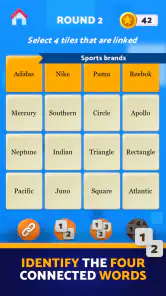

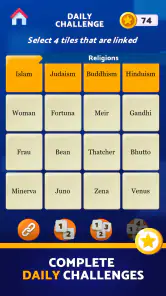

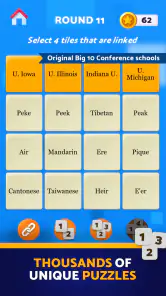
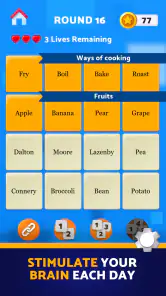
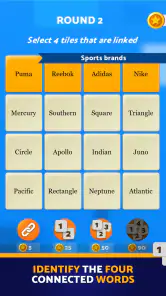

 Analysis by Frivlyz
I spent time with Connections Connect The Words as a casual word-game player, paying particular attention to how comfortably it works in different everyday situations. It is a free word game from InQuisiTiVe Media, built around making connections between words rather than simply solving one clue at a time. That basic idea is familiar enough to understand quickly, but the challenge comes from deciding which words genuinely belong together and which ones are tempting distractions.
The game is listed for Everyone, which fits its general tone and subject matter. It does not feel aimed only at expert puzzle fans, though some groups can become surprisingly demanding. I found it most enjoyable in short sessions: a few minutes while waiting, a quiet break during the day, or a longer sitting when I wanted something more thoughtful than a simple matching game. Its average rating is 4.5 from around 400 ratings, and the game has passed 10 thousand installs, so it has found a modest audience without feeling like an overcrowded social platform.
How the word connections feel to play
The central appeal is the moment when several apparently unrelated words begin to form a pattern. A good puzzle makes me consider meanings, categories, phrases, and associations at the same time. I may first group words by their literal meaning, then notice that another set is connected by a familiar expression or a shared context. That second look is where the game earns its place among word puzzles.
What I like is that the task encourages careful reading instead of fast tapping. Guessing immediately can be counterproductive because an attractive group may contain one word that belongs elsewhere. I learned to pause, read the full set again, and ask what the remaining words have in common before committing. That habit is useful for anyone who enjoys language puzzles but does not necessarily want a timed competition.
The design also creates a useful difference between knowing a word and recognizing its intended relationship. A player can understand every word on the screen and still struggle because the connection is indirect. That makes the game more interesting than a basic vocabulary quiz, but it also means that a puzzle can occasionally feel unfair if the intended association is outside a player’s everyday experience.
For a realistic daily use case, I would keep it on my phone for a commute or a waiting room, provided I was not relying on a network connection or a quiet environment for concentration. I could play one puzzle, stop without losing a large block of time, and return later when I wanted another mental exercise. It works better for that kind of flexible break than for someone looking for a story, a character system, or a large progression map.
Readability and navigation during a puzzle
The most important interface question for this type of game is whether I can understand the board without fighting the screen. In my experience, the word-based format keeps the visual task relatively direct: I am looking for readable terms and comparing them, not scanning a busy action scene or interpreting several layers of tiny icons. That simplicity helps when my attention is divided.
Gaming Stories You May Enjoy

Dancing Road Turns Short Breaks Into a Test of Rhythm and Timing

Super Stylist Makes Every Outfit a Test of Taste and Patience

Dominoes on Your Terms: Who Should Play and Who Should Pass

Pokémon GO Makes the Familiar World Feel New

Chess.com Turns Rematches Into Rivalries, but Community Has Its Costs

Archery Battle 3D Review: Sharp Aiming, Unclear Feedback
Navigation is also easier to judge when the game’s main action is obvious. A word puzzle should let me focus on selecting, checking, and reconsidering groups rather than searching through menus. Connections Connect The Words benefits from having a narrow purpose. I open it to solve word relationships, so it does not carry the same navigational burden as a broad game packed with shops, inventories, events, and multiple currencies.
Still, readability is not only about whether letters are technically visible. Word games demand repeated comparison, and that can be tiring if I am playing on a small phone, in dim light, or with the display held farther away. I found that increasing general device text size or choosing a brighter setting can help, although those adjustments depend on the phone rather than on a promise that every visual preference is supported inside the game.
A useful technique is to avoid rushing through the first scan. I read every word once before selecting anything, then mentally mark possible categories. This reduces the need to repeatedly move my eyes across the whole board and makes the experience more manageable for anyone who finds dense word layouts tiring. It also improves accuracy, so the same approach helps both accessibility and puzzle performance.
The game is available in current version 1.0.74 and supports devices running Android 6.0 or later. That broad operating-system range is helpful for people who keep an older phone, but the experience can still vary with screen size, display quality, and the device’s own accessibility settings. I would check those practical details on the phone I intend to use rather than assuming that an older handset will feel as comfortable as a newer one.
Motor effort, sensory load, and pace
From a motor perspective, a word game is generally less demanding than a title built around rapid movement, repeated swipes, or precise timing. Connections Connect The Words does not ask me to react to an approaching obstacle or coordinate several controls at once. That makes it a more approachable option for players who prefer deliberate interaction and want time to think before making a selection.
There is still a difference between low motor intensity and no motor barrier. Selecting several words can require repeated taps, and accuracy matters when words are close together. Someone with limited fine-motor control may find closely positioned choices tiring or may accidentally select the wrong item. I would use a stable grip, place the phone on a table when possible, and make each selection slowly rather than trying to complete a group in one quick burst.
This slower method has another advantage: it turns the game into a reasoning activity instead of a dexterity test. I do not feel pressured to prove that I can tap quickly. If I am playing with a friend who has a different movement range or speed, we can discuss the possible groups and allow more time without changing the basic nature of the puzzle.
Sensory considerations are more mixed. Word games usually avoid the visual intensity of action games, and the focus on text can make the screen feel calmer. On the other hand, a player with low vision, dyslexia, visual fatigue, or difficulty distinguishing a selected state may need more support than the basic presentation provides. I would not assume that a clean-looking word board automatically works for every reader.
Audio is not central to the way I solve these puzzles, which is useful if I am in a quiet place where sound would be unwelcome or if I prefer to play without relying on hearing. At the same time, a player who benefits from spoken feedback should not count on the game’s word content being fully available through audio unless the device and app experience demonstrate that directly. The safest approach is to test a short session and see whether the visual presentation remains comfortable.
Another practical trade-off is cognitive rather than physical. The game asks me to hold several possible meanings in mind, reject attractive but incorrect groups, and remember what remains. That can be pleasantly stimulating when I am alert, but it may feel draining after work, during illness, or when concentration is already limited. In those moments, a simpler word search or a straightforward matching game may be a kinder choice.
Using it in different places and circumstances
The flexible pace makes the game suitable for many short sessions. I can imagine using it during a lunch break, while waiting for an appointment, or at home with another person offering suggestions. Because the challenge is based on language rather than reflexes, it is also a good conversation starter. One person can explain why a group seems plausible while another points out a hidden connection that changes the whole board.
That shared use reveals one of the game’s strengths: it does not require everyone to have the same gaming background. A friend who never plays action games can still contribute an idea, and someone with a strong vocabulary can enjoy the challenge without needing elaborate controls. However, differences in cultural knowledge or familiarity with particular expressions can affect difficulty. If a connection depends on a phrase I rarely use, I may need more time even when the puzzle is well constructed.
For public places, the low-action format is convenient, but I would still be aware of the screen. Word puzzles require sustained reading, so glare, movement, and poor lighting can make them less comfortable than expected. On a crowded bus, I might prefer solving only when seated because holding the phone steady while comparing words is more demanding than playing a one-touch game.
For family use, the Everyone rating makes the game a natural candidate for mixed-age puzzle sessions, but age alone does not determine suitability. Younger players may know fewer expressions, while older players may bring broader life experience but prefer larger text or more time. I would treat it as a cooperative thinking activity rather than assuming that every child or adult will find the same puzzles equally accessible.
The free entry point is useful for trying the game without committing money. In-app purchases range from $2.99 to $18.99 per item, so I would be careful if a child uses the device or if I am trying to keep the experience entirely free. The presence of optional purchases does not ruin the puzzle itself for me, but it is a reason to review the phone’s purchase controls before handing it to someone else.
Where the experience still creates barriers
The biggest barrier is the nature of the puzzle itself. Connections depend on interpretation, and interpretation is not universal. A word can belong to more than one plausible category, especially when the game uses broad associations. That ambiguity is part of the challenge, but repeated near-misses can frustrate players who need very explicit rules or who prefer answers with only one obvious route.
Vocabulary is another dividing line. A player with limited English vocabulary, a reader learning the language, or someone unfamiliar with certain cultural references may face difficulty that has little to do with reasoning ability. I would recommend it more confidently to comfortable English readers than to someone using it as a language-learning tool, because the game’s purpose is solving connections rather than teaching each term step by step.
Screen-based reading can also become a problem over longer sessions. Even if the words are clear enough at first, repeatedly comparing them may cause eye strain. I would use shorter sessions, adjust the phone’s brightness to match the room, and stop when reading becomes effortful. Those habits do not change the game, but they make the experience more sustainable.
Players who need strong customization should approach with realistic expectations. I can judge the game by its word challenges and straightforward format, but I would not choose it solely because I require a particular text scale, contrast treatment, voice output, or input alternative. Those needs are important, and the right decision is to install it briefly and test the exact puzzle screen with the device settings that matter to you.
It is also not the best alternative for every kind of word-game fan. If I want a traditional crossword with intersecting answers, a spelling-focused quiz, or an endless word search where I can relax without second-guessing categories, another title will serve me better. Connections Connect The Words is specifically strongest when I enjoy grouping ideas and tolerating a little uncertainty while I work out the intended relationship.
What makes it worth trying, and who should skip it
I would recommend this game to someone who likes language, categorization, and puzzles that reward stepping back before answering. It suits players who want a quiet challenge rather than a fast reflex test, and it can work well as a shared activity because the reasoning is easy to discuss aloud. The free price makes experimentation simple, while the Everyone rating broadens its potential audience.
I would be more cautious with someone who becomes frustrated by ambiguous clues, needs guaranteed large-text support, or wants a highly structured learning path. I would also suggest another type of game for anyone seeking a strong sense of progression, competitive multiplayer, or a rich visual world. This is a focused word experience, and its focus is both its identity and its main limitation.
One of my more useful discoveries was that solving improves when I separate certainty from possibility. I first identify groups that have a clear shared meaning, then leave suspicious words untouched until I understand the leftovers. This prevents one appealing association from controlling the whole puzzle. It is a small strategy, but it makes the game feel less like guessing and more like testing a theory.
A second practical tip is to play with the phone positioned for comfortable reading instead of holding it at an awkward angle. Since the challenge depends on comparing several words, posture and viewing distance matter more here than in a quick tap game. A third is to use the game socially when a puzzle feels opaque: explaining a possible connection often exposes whether it is genuinely strong or merely the first idea that came to mind.
In the wider word-game category, I see this as a middle ground between a casual matching title and a demanding vocabulary puzzle. It asks for more interpretation than a simple pair-matching game, but it is less formal than a crossword or a dictionary-style quiz. That makes it approachable for a broad range of players, although the same open-ended thinking can make it less predictable than conventional alternatives.
InQuisiTiVe Media has kept the concept focused enough that I can understand the appeal quickly. The game does not need a complicated premise to create a satisfying pause in the day; the interest comes from discovering the relationship hiding among the words. Its 1.0.74 release and support for Android 6.0 or newer also make it practical for a range of Android devices, assuming the individual screen remains comfortable to read.
My overall view is positive, with an important qualification: the best feature is the thinking space it gives you, not speed or spectacle. I enjoy it when I want to examine language carefully, and I appreciate that motor demands are modest compared with action-oriented games. But accessibility is situational rather than automatic. Text-heavy puzzles, ambiguous associations, and dependence on comfortable visual reading can still exclude some players.
For me, Connections Connect The Words is worth trying if I want a free, compact word challenge that can fit around ordinary life. I would begin with a short session, adjust my device for comfortable reading, and see whether the puzzle style matches my tolerance for indirect connections. If it does, the game offers a thoughtful way to fill spare minutes; if I need extensive presentation controls or a more predictable vocabulary exercise, I would choose a different word game instead.
Connections Connect The Words Pros and Cons
Pros
- Simple rules make it easy to start without a tutorial.
- Word connections offer satisfying moments of discovery.
- Short puzzles fit well into quick breaks.
- Clean presentation keeps attention on the word groups.
- Useful for practicing vocabulary and lateral thinking.
Cons
- Some categories may feel subjective or open to interpretation.
- Difficulty can vary noticeably between consecutive puzzles.
- Repeated word themes may reduce the sense of novelty.
- Progress may feel slow for players seeking fast rewards.
- A missed connection can require considerable trial and error.
Frequently Asked Questions
What is Connections: Connect The Words?
Connections: Connect The Words is a word puzzle game based on grouping related terms. Each round presents a collection of words, and your goal is to identify four groups of four words that share a common connection. The challenge comes from misleading overlaps, tricky definitions, and words that could reasonably fit into more than one category.
How do you play Connections: Connect The Words?
To play, select four words that you believe belong together, then submit your choice to check the category. Correct groups are removed from the board, while incorrect guesses may reduce the number of mistakes available for the round. You need to discover all the hidden connections before using up your allowed attempts, so careful comparison is more effective than guessing quickly.
Is Connections: Connect The Words suitable for beginners?
Yes, the game is easy to understand and does not require previous experience with word puzzles. However, some rounds can become surprisingly difficult because a word may appear to fit several possible categories. Beginners can start by looking for obvious relationships, such as objects, names, actions, or phrases, and then use the remaining words to solve the harder groups.
Can Connections: Connect The Words be played offline?
Offline availability may depend on the version of the app and how its puzzles are delivered. Some installations may allow previously loaded content to remain playable without an internet connection, while features such as daily updates, advertisements, synchronization, or leaderboards can require access to the web. Check the app’s store listing and permissions before downloading if offline play is important to you.
Is Connections: Connect The Words free to download and play?
The game is generally offered as a free download, allowing users to try its core word puzzles without an upfront purchase. Depending on the edition, it may include advertisements, optional in-app purchases, extra puzzle packs, or other paid features. Review the Google Play or App Store listing for the current pricing, subscription details, and any restrictions before installing.


