

Bus Escape: Traffic Jam
- Reviews
- 4.5
- Version
- 1.6.32
- Installs
- 10,000,000+

Screenshots
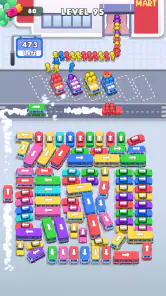
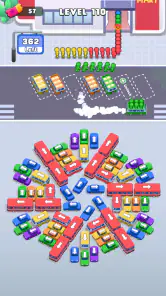
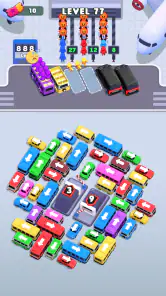
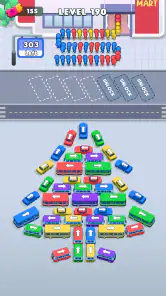
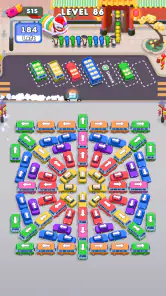
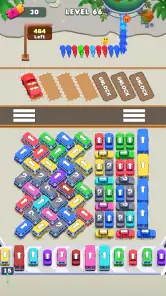
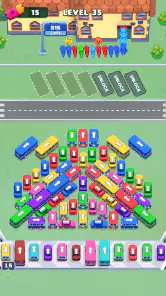
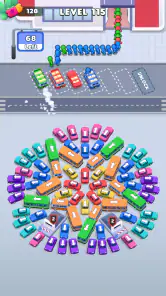
 Analysis by Frivlyz
I tend to judge a puzzle game less by the first few levels than by whether I still want to open it once the basic trick feels familiar. Bus Escape: Traffic Jam has an immediately understandable premise: a crowded road, vehicles in one another’s way, and a bus that needs a route out. That clarity makes it easy to try without a tutorial-heavy commitment, but it also raises the important question of how long rearranging traffic stays satisfying. My view is that it works best as a compact, occasional brain teaser rather than a game that needs to become part of every day.
The appeal of the first few sessions
The opening attraction is the satisfying mismatch between a simple goal and a messy-looking traffic puzzle. I can look at a jam and see several possible moves, but choosing one that actually opens a path takes more care than it first appears. That small pause to scan the layout is the useful part: instead of reacting quickly, I’m testing an order of moves in my head and checking whether shifting one vehicle blocks another.
That makes the game a natural fit for short gaps in the day. I might play while waiting for a meal, during a quiet break, or when I want something more active than scrolling but less demanding than a story-driven game. A practical approach is to treat each puzzle as a little sequence-planning exercise: identify what must move first, then look for the vehicles that have room to move without creating a new bottleneck. If I start moving pieces at random, I can lose track of the original route and make a manageable layout feel confusing.
The game is a free puzzle game from ABI GLOBAL LTD., with an Everyone age rating. Its first release was on September 16, 2024, and version 1.6.32 is listed for devices running Android 6.0 or later. It has a 4.5 average from around 53,000 ratings and over 10 million installs, which suggests that its straightforward traffic-clearing idea has found a broad audience. Optional in-app purchases range from $1.99 to $99.99 per item, so I would keep that in mind if I prefer games with no paid extras at all.
How the traffic puzzles hold up
As soon as you dive into Bus Escape: Traffic Jam, you're thrust into a world where strategic thinking and quick reflexes are your best friends. The goal is simple: navigate your bus through a gridlocked traffic scenario, maneuvering around cars, trucks, and all sorts of obstacles. Sounds easy, right? But as you progress, the levels become increasingly challenging, requiring you to think ahead and plan your moves carefully. It’s like a jigsaw puzzle, but with the added thrill of a ticking clock!
Graphics and Sound: A Sweet Treat for the Senses
The developers have done a stellar job with the graphics. The game is visually appealing, with vibrant colors and smooth animations that make the experience enjoyable. Whether it’s the detailed designs of the vehicles or the bustling cityscapes, everything is crafted with care. The sound design also deserves a mention. The honking of horns, the hum of engines, and the occasional siren in the background add a layer of realism that makes you feel like you’re right there in the middle of the action.
Why You’ll Love It
What really sets this game apart is its addictive nature. It’s one of those games where you tell yourself, “Just one more level,” and before you know it, hours have passed. It’s perfect for those moments when you need a quick mental workout or just want to kill some time. Plus, the sense of accomplishment after finally clearing a particularly tricky level is incredibly satisfying.
Gaming Stories You May Enjoy

Dancing Road Turns Short Breaks Into a Test of Rhythm and Timing

Super Stylist Makes Every Outfit a Test of Taste and Patience

Dominoes on Your Terms: Who Should Play and Who Should Pass

Pokémon GO Makes the Familiar World Feel New

Chess.com Turns Rematches Into Rivalries, but Community Has Its Costs

Archery Battle 3D Review: Sharp Aiming, Unclear Feedback
Another great feature is the game's accessibility. Whether you’re a seasoned gamer or someone who just plays casually, you’ll find something to enjoy. The controls are intuitive, making it easy to pick up and play, yet challenging enough to keep you engaged.
Getting more from a puzzle session
For a more deliberate run, I find it useful to pause before the first move and trace the bus’s intended exit path. Then I work backward: which vehicle occupies that lane, and what space would it need to move aside? This reverse check can prevent the common mistake of clearing nearby traffic that looks troublesome but has no bearing on the exit. It also gives a useful stopping point. If I cannot see a sensible next move, I can leave the puzzle and return later with fresh eyes instead of turning a short break into a frustrating trial-and-error session.
There is a trade-off in that method. Planning makes each solution feel earned, but it can also make the game feel slower than other casual puzzles. Players who enjoy quick matching, falling pieces, or a steady stream of instantly obvious actions may prefer those alternatives. This is more suited to someone who likes spatial reasoning and can enjoy thinking through a small traffic layout without needing a deep plot or a large collection of mechanics.
When it fits—and when it doesn’t
It suits people who want a clear objective and a puzzle they can approach in brief bursts. A realistic use is opening it for a few minutes while waiting for a friend who is running late: one layout can provide a focused distraction, and the traffic theme is easy to understand even if I have not played for several days. It may also suit a casual player who wants to share a simple “what would you move first?” challenge with someone nearby, since the board can be discussed without explaining a complicated control scheme.
I would be less likely to recommend it to someone who wants a long-form puzzle campaign, a strong narrative, or a game where every session introduces a substantially different kind of task. The central appeal is arranging vehicles to make a route, so anyone who tires quickly of repeating a core puzzle pattern may run out of reasons to return. It is also not the best match for players who dislike interruptions from advertising or prefer to avoid optional purchases altogether. The game is free to start, but the listed purchase range means it is sensible to avoid tapping purchase prompts casually, especially if a child is using the device.
Value after the novelty fades
In the first week, the traffic-jam premise can do a lot of work: each board invites a quick attempt, and a difficult clearance gives a neat moment of relief. Month to month, the value depends less on novelty and more on whether I enjoy the repeated act of inspecting lanes and choosing a sequence. That is a modest but real kind of replay appeal. It does not require a daily habit to make sense; I can come back when I want a small logic challenge and leave it alone when I want variety.
Compared with the usual alternatives in the puzzle category, this has a more concrete spatial theme than a word puzzle and a more deliberate pace than many match-based games. That focus is its strength and its limit. It gives me a clear problem to solve, but it does not offer the broad variety of a puzzle collection with several unrelated modes. If I want one specific kind of traffic-blocking challenge, that focus is welcome. If I want something that keeps changing its rules, I would choose a different puzzle game.
Maintenance, friction, and staying power
The maintenance burden is light in the ordinary sense: I do not need to build a complicated routine around it or remember a sequence of systems just to enjoy a short puzzle. I can pick it up, read the board, and decide whether I have the patience for another attempt. The more relevant cost is attention. When a layout becomes difficult, repeated moves without a plan can make the session feel like work, so I recommend treating a reset or a break as a sensible choice rather than proof that the puzzle has beaten you.
Ads are the clearest friction noted in play, because an interruption can break the concentration that a spatial puzzle needs. The challenge can also feel steep later on, which is rewarding for patient players but may turn a relaxed pastime into a source of irritation. If either issue outweighs the pleasure of finding a route, there is little reason to force a daily habit. A puzzle should earn a place in a routine by being enjoyable, not by making a player feel behind.
What to expect before keeping it installed
The practical question is whether I need to be online, whether every level can be solved without help, or whether purchases are necessary to continue. I would not assume particular answers to those questions when deciding to try it; the safest expectation is to judge the experience directly and pay attention to any prompts shown in the game. Since purchases are optional extras rather than part of the free download, I would also check device purchase settings if someone else, especially a child, may play. The Everyone rating makes the game broadly approachable, but it does not remove the need for an adult to manage spending choices.
For a fair test, I would play a handful of sessions on different days rather than judge it by one unusually easy or difficult board. Notice whether the traffic layouts make you curious enough to plan, whether you enjoy retrying after a wrong move, and whether an interruption spoils the mood. Those answers tell you more about lasting fit than the initial novelty. If the core act of opening a route remains satisfying, the game can stay useful as an occasional pocket puzzle; if it starts to feel repetitive, you can move on without losing a larger investment of time.
A measured recommendation
While the game is generally smooth, there are occasional ads that can disrupt the flow. It’s a minor gripe, but something to be aware of. Also, some players might find the difficulty curve a bit steep, especially in the later levels. But hey, that’s part of the fun, right?
All in all, Bus Escape: Traffic Jam is a delightful game that combines clever puzzles with an engaging premise. It’s perfect for anyone looking to escape the daily grind, even if it’s just for a few minutes. So, go ahead, give it a whirl, and see if you can outsmart the traffic. Happy gaming!
Bus Escape: Traffic Jam Pros and Cons
Pros
- Engaging puzzle gameplay.
- Variety of challenging levels.
- Simple and intuitive controls.
- Colorful graphics and design.
- Free to play with optional purchases.
Cons
- Contains in-app ads.
- Requires internet connection.
- Some levels may feel repetitive.
- Frequent update notifications.
- Limited character customization.
Frequently Asked Questions
What is the main objective of Bus Escape: Traffic Jam?
Bus Escape: Traffic Jam is a strategy-based puzzle game where players must navigate a bus through a congested city by solving traffic jams. The primary goal is to clear the path for the bus to reach its destination without any delays or accidents. Players need to strategically move other vehicles to unblock the bus, making it both a fun and challenging experience.
Is Bus Escape: Traffic Jam suitable for all ages?
Yes, Bus Escape: Traffic Jam is designed to be family-friendly and suitable for all age groups. The game has simple controls and colorful graphics, making it appealing and easy to understand for both children and adults. However, the increasing difficulty levels ensure that even seasoned puzzle enthusiasts will find it engaging and challenging.
Does Bus Escape: Traffic Jam require an internet connection to play?
Bus Escape: Traffic Jam can be played offline, making it a perfect choice for users who are on the go or have limited access to the internet. While an internet connection is not required for the core gameplay, certain features such as in-game purchases and leaderboards might need connectivity for the best experience.
Are there in-app purchases in Bus Escape: Traffic Jam?
Yes, Bus Escape: Traffic Jam offers in-app purchases that allow players to buy additional hints or special features to enhance their gaming experience. These purchases are entirely optional, and players can enjoy the full game without spending money. It is also equipped with parental controls to prevent unauthorized purchases.
What platforms is Bus Escape: Traffic Jam available on?
Bus Escape: Traffic Jam is available on both Android and iOS platforms, making it accessible to a wide range of smartphone and tablet users. The game is optimized for various devices, ensuring a smooth and enjoyable experience regardless of the screen size or operating system. Users can download it from the Google Play Store or Apple App Store.


