

Bud Farm: Idle Tycoon
- Reviews
- 4.7
- Version
- 1.29.1
- Installs
- 5,000,000+

Screenshots
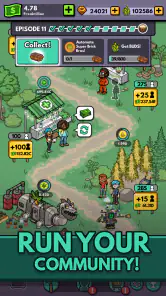




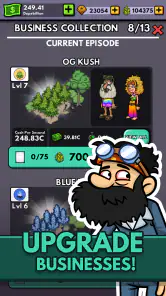
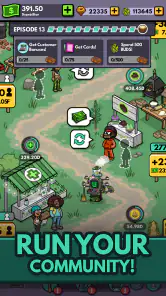

 Analysis by Frivlyz
I spent time with Bud Farm: Idle Tycoon as a casual simulation game, and my first impression was that it understands the appeal of a farm that keeps moving while I am away. The central idea is simple: grow cannabis plants, expand the operation, and improve the business through repeated upgrades. That gives the game an easy rhythm for short sessions, although its subject matter and purchase structure make it a more specific recommendation than a typical farming title.
Developed by LDRLY Games, it is aimed at mature players rather than children. The game is free to start, which makes trying it relatively straightforward, but optional in-app purchases range from $0.99 to $199.99 for an item. That wide range matters when judging value: I can access the game without paying, yet the most expensive purchase is far beyond what many people would consider a casual add-on. I would approach it as a free-to-play game first, not as a product whose full value can be judged from the download alone.
How the farm loop feels in everyday play
The most enjoyable part is the steady sense of building momentum. I begin with a modest operation, collect progress, and decide where the next improvement should go. The appeal is less about dramatic surprises and more about watching a small setup become more capable over time. That makes it a natural fit for the moments when I have a few minutes to spare: waiting for an appointment, taking a break from work, or checking my phone before bed.
Unlike a traditional farming game that may ask me to walk around a large map, decorate a property, or manage many different crops, this one keeps its identity focused on the cannabis-growing business. The narrower theme gives the progression a clear personality. I am not simply planting vegetables and selling them; I am managing a stylized operation built around production and upgrades. Players who enjoy idle management should understand the attraction quickly.
The tap-driven design also lowers the learning curve. I do not need to study a complicated rulebook before making progress. I can tap through the early actions, watch the operation develop, and gradually learn which improvements make the next cycle more efficient. That accessibility is a strength, especially for someone who wants a light simulation rather than a demanding strategy game.
Why the idle format works
The idle structure changes how I think about progress. Instead of expecting every reward to come from constant attention, I can leave the game and return later to continue the cycle. In practice, that encourages a routine: check the farm, collect what has accumulated, spend carefully, and close the app when the next upgrade is out of reach. The game works best when I treat it as a small habit rather than a main gaming session.
One useful approach is to avoid spending every resource immediately. When several upgrades are available, I first look for the one that improves the operation’s future earning potential rather than the option that merely feels quickest. That small pause makes the management layer more meaningful. It also prevents the common idle-game problem of tapping through rewards without making a real decision.
Gaming Stories You May Enjoy

Dancing Road Turns Short Breaks Into a Test of Rhythm and Timing

Super Stylist Makes Every Outfit a Test of Taste and Patience

Dominoes on Your Terms: Who Should Play and Who Should Pass

Pokémon GO Makes the Familiar World Feel New

Chess.com Turns Rematches Into Rivalries, but Community Has Its Costs

Archery Battle 3D Review: Sharp Aiming, Unclear Feedback
Another practical tip is to play in short, intentional visits. Opening the game repeatedly without a goal can make the loop feel repetitive. I get more value when I decide whether I am checking accumulated progress, saving for a particular improvement, or simply seeing what has changed. This is not a game I would recommend forcing myself to play for long stretches; its strengths are convenience and gradual development.
What the free entry really means
The free starting price is important because it lets me test the basic loop before committing money. I can find out whether the tapping, waiting, collecting, and upgrading rhythm suits me without purchasing the game upfront. For a free-to-start simulation, that is a sensible arrangement, particularly if I am unsure whether the cannabis theme will hold my interest.
However, “free” should not be confused with unlimited value at no cost. The game includes optional purchases, and individual items can cost from $0.99 up to $199.99. I would therefore set a personal spending limit before playing, especially if I am prone to buying convenience items in games with repeated upgrade cycles. The presence of a very high-priced option does not mean I need it, but it does make self-control part of the decision.
For me, the strongest value comes from treating payment as entirely optional. If the basic progression feels satisfying, I can keep playing without turning every delay into a reason to spend. If I only enjoy the game when progress is accelerated, its free access may feel less generous in practice. That distinction is more useful than simply calling it free.
The value of the progression
The reward comes from seeing decisions accumulate. A single improvement may seem modest, but several sensible choices can make the farm feel more productive and organized. This is the kind of satisfaction that appeals to people who enjoy incremental progress, checklists, and the visual or numerical sense of an operation becoming larger.
I also like that the theme gives the upgrades a recognizable purpose. In a generic idle game, I may be improving abstract businesses with little emotional connection. Here, the growing operation supplies a consistent context for the decisions. That does not turn the game into a deep economic simulator, but it does help the loop feel more coherent than a collection of disconnected buttons.
The trade-off is that the same structure can become predictable. Once I understand the basic pattern, the pleasure depends heavily on whether I enjoy repeating it. Someone looking for complex negotiation, detailed crop science, or a large open-world farm will probably find this too streamlined. It is closer to a focused idle tycoon experience than a full agricultural simulation.
Where the experience can lose momentum
The main weakness is repetition. Tapping, collecting, and upgrading are pleasant when I am in the mood for a low-pressure routine, but they do not offer the same variety as a more hands-on farming game. If I want constant new challenges, the deliberately relaxed pace may feel thin. The game asks me to appreciate gradual improvement, and that will not work for everyone.
Waiting is another trade-off. Idle progression is convenient because it continues while I am away, but it can also make active play feel limited. There are moments when I have completed the available action and must simply wait for the next meaningful step. Players who prefer direct control and immediate objectives may be happier with a farming game that gives them tasks to complete manually.
The mature theme should also be considered before installing it. This is not a suitable choice for a child’s device or for someone who wants a family-friendly farm setting. Even if the presentation is playful, the subject is central to the game’s identity. I would recommend checking the age suitability of the person using the device rather than assuming that a cartoon-like simulation is automatically appropriate for all ages.
Finally, the purchase range changes the way I evaluate the game. A low-cost optional item may be easy to justify for a committed player, while a purchase priced at $199.99 is a completely different level of spending. I do not see that range as a reason to reject the game outright, because the game can be started for free, but I do see it as a reason to disable impulse buying or use a strict budget.
How it compares with other simulation choices
Compared with a conventional farm simulator, this game is more focused and less labor-intensive. I do not come to it for realistic planting schedules, animal care, landscape design, or a detailed rural story. I choose it when I want the business-growth side of farming presented in a quick, tap-friendly format. That makes it easier to fit into a busy day, but it also means there is less room for creativity and personal expression.
Compared with a general idle tycoon game, the cannabis-farm theme gives it a stronger identity. The setting will attract players who find ordinary shops, factories, or restaurants too familiar. On the other hand, anyone uncomfortable with that theme will not gain much from the otherwise accessible mechanics. In that situation, a neutral business simulator would be the better alternative, even if its progression system is similar.
Compared with a premium game that asks for payment once, the free entry here is more flexible but requires more attention to optional spending. A paid alternative may feel cleaner for someone who wants a predictable cost and no temptation to make repeated purchases. Bud Farm is better suited to a player who values trying before paying and is comfortable deciding independently whether any optional item is worth the money.
Small habits that improve the experience
I recommend choosing a clear upgrade priority instead of reacting to every new prompt. Saving toward a meaningful improvement can make the farm feel strategic, even within a simple idle structure. If I spend resources as soon as they appear, the game becomes a sequence of automatic taps. If I save with a purpose, I feel more involved in the tycoon side.
I also use the game as a background activity rather than a replacement for a longer gaming session. A quick visit during a commute or lunch break is a good match for its design, while an uninterrupted evening may expose the limited variety more quickly. This distinction helped me enjoy it more: the game is strongest as a compact routine, not as an all-day commitment.
For anyone considering a purchase, I would wait until the free loop has answered three questions: Do I enjoy returning to collect progress? Do upgrades still feel satisfying after the novelty fades? Can I play comfortably without paying? If the answer to the last question is no, spending more may only mask a mismatch between the game and my preferences rather than solve it.
Who should give it a try
I think it is a good match for mature players who like idle games, incremental upgrades, and a specialized theme. It is particularly suitable for someone who wants a simulation that can be checked in short bursts rather than played with constant concentration. The free starting point also makes it easy to test during a spare afternoon without making a purchase decision first.
The game may also appeal to players who enjoy management choices but do not want the complexity of a spreadsheet-heavy tycoon. Its approachable structure gives me enough direction to feel productive without demanding detailed planning at every moment. That balance is useful for casual players who still want a sense of ownership over the operation.
I would tell younger players, families seeking a child-friendly title, and people who dislike cannabis-related themes to skip it. I would also point more demanding strategy fans toward a deeper simulation with more systems and direct control. Likewise, players who want a one-time purchase with a fixed total cost should consider a premium alternative instead.
Platform details and long-term fit
The game was released on March 26, 2019, and the current version is 1.29.1. It supports devices running Android 7.0 or later. Those details make it accessible to many older Android phones, although actual comfort will still depend on the device and the player’s tolerance for a compact idle interface.
Its audience is substantial, with more than five million installs, a 4.7 average from about 199 thousand ratings, and roughly 28 thousand written reviews. Those figures suggest that the format has found a large audience, but they do not remove the personal questions about theme, repetition, and spending. I would treat the strong reception as a reason to try it, not as proof that it will suit every player.
The developer, LDRLY Games, has positioned the experience around a very specific kind of casual management. That focus is both its identity and its limitation. I know fairly quickly whether the concept appeals to me, which is helpful: there is little reason to force myself through the early game if the premise itself is not interesting.
My recommendation before downloading
I would download it if I wanted a free-to-start idle simulation with a cannabis-growing theme and I was comfortable setting boundaries around optional purchases. I would begin without spending, learn the progression loop, and decide later whether the convenience of an item genuinely improves my enjoyment. That approach preserves the game’s strongest advantage: the ability to sample it without an upfront price.
I would skip it if I expected a detailed agricultural simulator, a story-led adventure, or a completely fixed-cost experience. The game’s value is in its accessible idle routine, not in realism or deep control. Its mature rating and purchase range are also practical considerations, not minor footnotes.
My final view is positive but measured. Bud Farm: Idle Tycoon is worth trying for the right player, not blindly recommending to everyone. I enjoy its compact progression and clear identity, especially when I use it for short check-ins. The free access makes experimentation easy, while the repetitive loop and optional purchases mean I should play with realistic expectations. If that combination matches what you want from a simulation game, it can become a pleasant little daily habit; if you need richer systems or a guaranteed one-time price, another category of game will serve you better.
Bud Farm: Idle Tycoon Pros and Cons
Pros
- Simple idle mechanics make steady progress easy
- even during short play sessions.
- Cartoon-style visuals and humorous characters give the game a lighthearted personality.
- Multiple production stations create a satisfying sense of expansion over time.
- Offline earnings help maintain progress when you are not actively playing.
- Frequent objectives provide clear short-term goals beyond simply upgrading buildings.
Cons
- Progress slows noticeably when upgrade costs begin outpacing your earnings.
- Premium currency can be tempting for players who want faster production times.
- The gameplay loop may feel repetitive after the initial farm-building phase.
- Some rewards and upgrades require watching ads or waiting through timers.
- The cannabis-themed humor may not appeal to every player or younger audience.
Frequently Asked Questions
What is Bud Farm: Idle Tycoon?
Bud Farm: Idle Tycoon is a casual idle-management game in which you build and expand a cannabis-themed farming business. You begin with a small operation, grow and harvest crops, unlock new production areas, and earn money even when you are not actively playing. Its humorous presentation, simple controls, and steady upgrade system make it accessible to players who enjoy relaxed tycoon games.
How does the gameplay work when I am offline?
The game is designed around idle progress, so your businesses can continue generating resources while you are away. When you return, you can collect accumulated earnings, reinvest them in upgrades, and improve production efficiency. Offline rewards are helpful for maintaining progress, although the most efficient advancement usually comes from checking in regularly and making strategic decisions about which buildings, workers, and upgrades to prioritize.
Is Bud Farm: Idle Tycoon free to download and play?
Bud Farm: Idle Tycoon can generally be downloaded and played for free, but it includes optional in-app purchases. These purchases may provide premium currency, speed up production, unlock useful bonuses, or offer special packages. You can progress without spending money, although free players may encounter longer waiting periods and more frequent advertisements. Review the payment settings before playing if the device is shared with children.
Does the game require an internet connection?
An internet connection may be needed for certain features, including advertisements, cloud-related services, event content, account synchronization, and in-app purchase verification. Some basic gameplay may remain available when you are temporarily offline, but the experience is usually more reliable while connected. If you switch between devices, linking the game to a supported account can also help protect your progress, depending on the platform and current game version.
Is Bud Farm: Idle Tycoon suitable for children?
The game uses a cartoon-style presentation and uncomplicated management mechanics, but its theme is centered on cannabis cultivation and related humor. Because of that subject matter, it may not be appropriate for younger children or for families looking for a completely neutral farming game. It is better suited to mature players, and parents should check the store age rating, advertising content, and purchase controls before allowing access.


