

Bricks n Balls
- Reviews
- 4.5
- Version
- 3.32.1
- Installs
- 10,000,000+

Screenshots


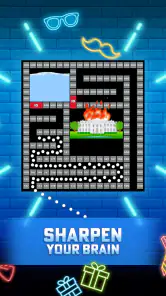
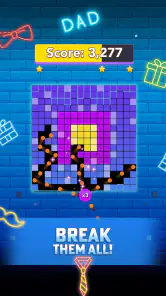




 Analysis by Frivlyz
I tend to reach for Bricks n Balls when I want a puzzle that starts quickly and asks for small decisions rather than a long stretch of concentration. Its brick-breaking idea is easy to understand, but aiming each launch gives a simple turn a little tactical weight. That makes it a handy fit for a short break, though its repeating core loop may not hold the attention of someone looking for a story or a broad range of puzzle types.
What the quick pace feels like
Rounds are built around choosing an angle and sending balls through a field of bricks. The satisfying part is spotting a route that lets a shot travel through gaps and hit several targets before returning. When I have only a few minutes, that immediate setup is a strength: I can get into the puzzle without first learning a complicated set of rules or managing a long sequence of tasks.
The pace is not the same as constant pressure. A shot still invites a moment of thought, and a poor angle can make the next situation less comfortable. I find it works best when I treat each launch as a small planning exercise instead of tapping as quickly as possible. If you prefer puzzles that reward careful observation but do not demand an elaborate strategy guide, that balance is appealing.
How I approach a crowded board
When bricks begin to stack up, I look for openings near the lower part of the formation rather than aiming only at the nearest target. A ball that gets behind a row can keep striking bricks from an unexpected direction, which is often more useful than a direct hit. That is the kind of adjustment that makes the familiar brick-breaker format feel like a puzzle rather than a simple reflex test.
I also try not to spend a helpful power-up merely because it is available. In a difficult layout, I first check whether an ordinary shot can create a useful path or weaken a troublesome section. Saving a special effect for a board that genuinely needs it can make the difference between a clever recovery and using it on a turn that would have gone well anyway. The trade-off is that deciding when to wait can add a little friction if you would rather play without thinking much between shots.
Those small choices make it suitable for an everyday pause. I can imagine opening it while waiting for a coffee, taking a few turns, and putting the phone away when my order is ready. It is less suited to a commute or break where I need to stop instantly at unpredictable moments: a puzzle may be easy to enter, but attention still matters if I want to make a thoughtful shot.
Power-ups and the limits of variety
The special effects give me another option when the board is becoming awkward, and they can change how I think about a turn. Rather than treating them as automatic shortcuts, I use them to address a specific problem, such as a path that is difficult to open with a standard launch. That makes their value depend on the layout and timing, not just on having one available.
Gaming Stories You May Enjoy

Dancing Road Turns Short Breaks Into a Test of Rhythm and Timing

Super Stylist Makes Every Outfit a Test of Taste and Patience

Dominoes on Your Terms: Who Should Play and Who Should Pass

Pokémon GO Makes the Familiar World Feel New

Chess.com Turns Rematches Into Rivalries, but Community Has Its Costs

Archery Battle 3D Review: Sharp Aiming, Unclear Feedback
There is a limit to how much novelty this adds. The main pleasure remains aiming balls at bricks, so players who quickly tire of repeating a central mechanic may find the experience less rewarding over a longer session. I would choose a collection of different puzzle formats if I wanted frequent changes of rules; this is a better match for someone who enjoys refining one straightforward skill and seeing how each new arrangement changes the shot.
Difficulty, retries, and a fair expectation
The challenge grows as I progress, and some layouts call for more precise angles than the early stages do. Replaying a level can be satisfying when I can identify what went wrong and adjust my next attempt. It is less enjoyable if I am already impatient or expect every board to yield to a quick, obvious move. The game asks for persistence, but the appeal is in learning to read a setup, not in a deep strategic system.
For a casual player, a useful habit is to pause briefly before launching and trace where the ball might travel after its first impact. That simple check can reveal a route into the interior of the bricks and help avoid a shot that only clears the easiest target. It will not make every attempt successful, but it gives each turn a purpose and makes retries feel more informative.
Ads, spending, and who will enjoy it
The game is free to start, and the listed in-app purchases range from $0.99 to $99.99 per item. I would treat those as optional spending rather than a reason to install it: the basic attraction is the aiming puzzle, and a purchase is worth considering only if the particular interruption or convenience it addresses matters to you. Ads appear from time to time, so anyone who expects a completely uninterrupted session should keep that in mind before settling in for a long run.
PeopleFun is the developer, and the game has a 4.5 average from around 58,000 ratings, alongside more than 10 million installs. That level of uptake suggests the simple premise has broad appeal, but it does not mean the pacing will suit everybody. I would recommend it to players who like repeatable, short-form puzzles and enjoy improving their decisions. If you want a narrative, extensive customization, or a constantly changing set of mechanics, I would look elsewhere.
How it compares with other puzzle breaks
Compared with a word puzzle, this asks more of your spatial judgement and less of your vocabulary. Compared with a match-style puzzle, it puts the emphasis on predicting a path rather than arranging a board through repeated swaps. That distinction is useful when choosing what to play: I reach for it when I want to visualize a shot, not when I want a quieter word challenge or a puzzle with several different kinds of objectives.
It also occupies a middle ground between a pure arcade distraction and a slower logic game. The launches give each turn a clear action, while the angle choice gives me a reason to think before tapping. If I am tired and want something almost automatic, even that small decision can feel like work. If I am alert enough to plan a route but do not want a demanding session, the balance is more satisfying.
Speed, stability, and device fit
In ordinary play, the straightforward one-shot rhythm makes it feel like a game I can dip into without a lengthy setup. I would not confuse that with a promise about loading speed or performance on every phone; those can depend on the device and its condition. The most useful expectation is simply that the core interaction is easy to understand, while a crowded or difficult board may take more attention than a quick glance suggests.
Its current version is 3.32.1, and the minimum operating-system requirement is 8.0. Before installing, I would check that the device meets that requirement and has enough available space for the download and normal updates. Older or heavily loaded devices can behave differently from newer ones, so I would avoid assuming that smooth animations on one phone guarantee the same experience elsewhere.
For reliability, I find it sensible to close the game normally when I am finished rather than rely on an interrupted session to preserve exactly where I was. If a call, low battery, or another app pulls me away, I would reopen it and check the current board before making a move. That is a practical habit for any short-session game, especially when a carefully planned shot would be frustrating to lose.
A balanced performance verdict
My overall impression is that the game’s strongest performance quality is its uncomplicated rhythm: aim, launch, assess the result, and decide again. The design does not need elaborate controls to make a turn engaging. Its weak point is the same simplicity viewed from another angle: once the brick-breaking loop stops feeling fresh, there is not necessarily enough variety to keep every player invested.
Bricks n Balls is free and rated for Everyone, which makes it easy to consider for a broad range of casual players. I would still keep purchases and occasional ads in mind, and I would choose it for short bursts rather than expecting a rich, uninterrupted campaign. If that is the kind of puzzle break you want, its mix of direct action and angle planning is a pleasant fit; if not, a word game or a more varied logic puzzle will probably serve you better.
Unleashing the Fun
When I first downloaded Bricks n Balls, I wasn't quite sure what to expect. The concept seemed simple enough: launch balls to break bricks and clear the levels. Sounds easy, right? Wrong! This game has a way of pulling you in deeper with each level. The graphics are bright and engaging, making it visually appealing without being overwhelming. I found myself lost in the vibrant colors and smooth animations.
Gameplay That Keeps You Hooked
Now, let's talk about the gameplay. It starts off pretty straightforward, but as you advance, the levels get trickier. You have to strategize the angle and power of your shots to maximize the number of bricks you hit. The game mechanics are intuitive, and the controls are easy to master, making it accessible for players of all ages. It’s a bit like playing pool, but much more exciting and fast-paced.
One feature I particularly enjoyed is the variety of power-ups. You can collect them as you progress, and they can really turn the tide when you’re stuck on a tough level. Whether it’s splitting your balls into three or getting a laser beam to clear a path, these power-ups add an extra layer of strategy to the game.
The Challenge Factor
What really sets the game apart is its challenge factor. As you progress, the levels become increasingly difficult, requiring more precision and strategic thinking. There’s a satisfaction that comes with figuring out the perfect angle to clear a tricky level. Sometimes, I found myself replaying levels just to try and beat my previous score.
Another thing I appreciate is that the game doesn’t bombard you with ads. Sure, they pop up every now and then, but they’re not intrusive. Plus, you have the option to remove them altogether with a small purchase, which is always a plus in my book.
Final Thoughts
In conclusion, if you're looking for a game that's both relaxing and challenging, the game is a fantastic choice. It’s a great way to unwind after a long day or kill some time while waiting for an appointment. With its easy-to-learn mechanics and increasing difficulty, it offers plenty of entertainment. So, go ahead and give it a shot; you might just find yourself hooked like I did!
Bricks n Balls Pros and Cons
Pros
- Addictive gameplay with simple controls
- Challenging levels with increasing difficulty
- Colorful graphics enhance visual appeal
- Free to play with optional in-game purchases
- Frequent updates with new levels
Cons
- Contains ads that can be intrusive
- In-app purchases can be expensive
- Limited lives can hinder continuous play
- Requires internet connection to access features
- Some levels may feel repetitive
Frequently Asked Questions
What is Bricks n Balls and how does it work?
Bricks n Balls is a popular puzzle game available on both Android and iOS platforms. The game involves shooting balls to break a series of bricks arranged in various patterns. Players must aim strategically to ensure that all bricks are destroyed before they reach the bottom of the screen. The simple yet challenging mechanics, coupled with its colorful graphics, make it highly addictive for puzzle lovers.
Is Bricks n Balls free to play?
Yes, Bricks n Balls is free to download and play on both Android and iOS devices. However, like many free-to-play games, it offers in-app purchases. These purchases include additional balls, power-ups, and the option to remove ads, which can enhance the gaming experience but are not necessary to enjoy the game itself.
What are the in-app purchases in Bricks n Balls?
In Bricks n Balls, players have the option to buy in-game currency, which can be used to acquire extra balls, power-ups, or to remove advertisements. The game offers various packages at different price points, allowing players to choose according to their preferences and budget. It's important to note that these purchases can enhance gameplay but are not essential to progress through the game.
Does Bricks n Balls require an internet connection?
Bricks n Balls does not require a constant internet connection to play, which makes it convenient for users who want to enjoy the game offline. However, certain features such as in-app purchases and watching ads for bonuses may require an internet connection. Players can enjoy the core gameplay without needing to be online, making it ideal for on-the-go gaming.
Are there any ads in Bricks n Balls?
Yes, Bricks n Balls includes advertisements that appear between levels or during gameplay. These ads are a common feature in free-to-play games and help fund the development and maintenance of the app. Players have the option to remove ads through an in-app purchase if they prefer an uninterrupted gaming experience. The ads are generally non-intrusive and do not significantly disrupt gameplay.


