

Brainrot Tip Tap Challenge
- Reviews
- 3.1
- Version
- 0.0.9
- Installs
- 10,000,000+

Screenshots
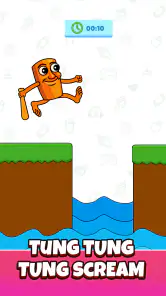
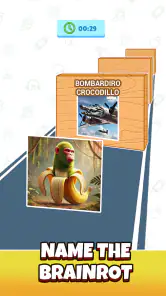

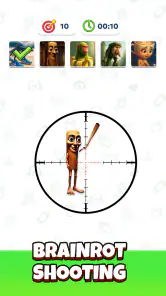

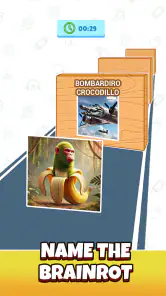

 Analysis by Frivlyz
If you are trying Brainrot Tip Tap Challenge for the first time, it helps to think of it as a quick-hit casual game rather than a long puzzle campaign. I would open it when I have a few spare minutes and want something lively to focus on, not when I’m looking for a deep story or a carefully explained tutorial. Its appeal is the mix of rapid interaction and light mental pressure: you need to pay attention, respond promptly, and adjust when a challenge catches you off guard.
What to expect from a first session
The game’s premise points toward short, playful minigames built around brainrot-style humor. That gives it a different feel from a conventional logic puzzler, where you might sit with one problem until you solve it. Here, I’d expect variety and quick changes of pace to be part of the attraction. The trade-off is that a rotating set of small challenges can feel less substantial than a single mode with a clear long-term arc. If you enjoy switching tasks, that can be a plus; if you want a game to sink into for an hour, it may not be the best fit.
It is a free casual game from TSACom, with a Teen content rating. The current version is 0.0.9, and it runs on Android 7.1 or later. Its audience is broad: the game has passed 10 million installs, while its average rating is 3.1 from around 2,400 ratings. I’d read that rating as a reminder to keep expectations measured rather than assume every player will enjoy the same style of humor or challenge. It was released on May 9, 2025, so the version number is also useful context when deciding how much polish or depth to expect from a relatively early release.
Getting started without overthinking it
For a first run, I’d keep the setup simple: install the game, open it, and spend the first few minutes learning what each challenge asks you to do before trying to chase a score. In a fast-tapping game, it is easy to mistake a confusing instruction for a lack of skill. Read the prompt, look at the screen’s cues, and make one deliberate attempt before speeding up. That small pause is often more useful than repeatedly tapping at random.
I’d also choose a moment when you can give the screen your full attention. The game sounds suited to spare-time play, but quick reactions and small visual details are hard to manage while walking, watching something else, or being interrupted. A short, focused session is a better first test than opening it during a hectic commute. If the first challenge feels awkward, try another round after you understand its rhythm; early hesitation does not necessarily mean the game is wrong for you.
The Addictive Gameplay
Trust me when I say, once you start playing Brainrot Tip Tap Challenge, you’ll find it hard to stop. The game is designed to test both your mental agility and your finger dexterity. You’ll be navigating through various levels, each more challenging than the last, with tasks that require you to tap, swipe, and think quickly. The combination of speed and strategy is what makes it so addictive.
The app offers a variety of challenges that are not only engaging but also immensely rewarding when you finally crack them. It's almost like your brain gets a little pat on the back every time you solve a puzzle or complete a level.
Gaming Stories You May Enjoy

Dancing Road Turns Short Breaks Into a Test of Rhythm and Timing

Super Stylist Makes Every Outfit a Test of Taste and Patience

Dominoes on Your Terms: Who Should Play and Who Should Pass

Pokémon GO Makes the Familiar World Feel New

Chess.com Turns Rematches Into Rivalries, but Community Has Its Costs

Archery Battle 3D Review: Sharp Aiming, Unclear Feedback
Visually Appealing and User-Friendly
What I really appreciate about this app is its sleek, colorful design. The visuals are easy on the eyes, which is a blessing when you’re glued to your screen trying to beat your high score. Plus, the interface is super intuitive. Even if you're not a tech-savvy person, you’ll find navigating through the app a breeze.
Another thing worth mentioning is the sound design. The background music and sound effects are quite catchy, adding an extra layer of fun to the gameplay. It’s like having your own little soundtrack to motivate you as you tap away.
Learning the rhythm and handling rough patches
One practical way to get past a confusing round is to separate the instruction from the action. I’d read the prompt once, identify the one thing the game is asking me to notice, and then make a clean attempt. If I keep failing, I’d change only one part of my approach—slowing down to check the cue, for example, rather than changing both my timing and my interpretation at once. This makes it easier to tell whether the challenge is testing speed, attention, or a particular response.
That approach also helps with a common frustration in fast minigames: a mistake can feel like proof that you are bad at the game when it may simply mean you moved before understanding the rule. The best first success is not necessarily a perfect score. It is recognizing what a challenge wants and completing it once with a controlled response. After that, repeating it can become more satisfying because you know what you are trying to improve.
Where it fits in an ordinary day
Picture having a short wait before an appointment, with enough time to play but not enough to start a long adventure. This is the kind of gap where a small challenge can work well: focus on one round, put the phone away when your name is called, and return later if you feel like another attempt. I would avoid treating it as a background game, since the tapping and quick decisions are the point; it is more enjoyable when you can actually look at the screen.
It may also suit friends or family members who want to compare how they handle the same sort of quick challenge, provided everyone is comfortable with the game’s humor and Teen rating. I would treat any score comparison as informal fun rather than the main reason to install it. The more useful question is whether the minigames make you smile and want to try again, not whether you can turn every session into a contest.
How it compares with other casual games
Compared with a standard match-three game, a word puzzle, or a familiar endless runner, this title leans more on changing tasks and quick reactions than on building a single strategy over many moves. That can make it a refreshing alternative when a routine puzzle starts to feel predictable. On the other hand, players who prefer calm, unhurried decisions may be happier with a traditional word or number game, where there is less pressure to respond rapidly.
It is also a different choice from a deep puzzle game that steadily teaches a central mechanic. The variety suggested by its minigame format can keep a brief session lively, but it may not provide the same sense of mastery as learning one complex system. I’d choose it for variety and short bursts, and choose a focused puzzle title when I want a more deliberate challenge with a longer learning curve.
Challenges and Rewards
The game doesn’t just test you; it rewards you too. Every time you clear a level or achieve a milestone, you earn points and badges. It’s these little rewards that keep you coming back for more. There’s something incredibly satisfying about seeing your progress and knowing that your efforts are paying off.
The app also features a leaderboard where you can compete with friends or players worldwide. It adds a competitive edge to the game, pushing you to improve and climb up the ranks.
Who will enjoy it—and who may prefer something else
I’d recommend giving it a try if you like playful, quick challenges and do not mind switching between different kinds of tasks. It is especially suitable for someone who wants a light game to dip into, or for a player who enjoys improving through repeated attempts rather than following a long story. The free price makes it easy to sample, but I would still judge it by the first few sessions: if the humor or pace does not click, there is no need to force yourself to keep playing.
I’d skip it if you want quiet concentration, a substantial narrative, or a predictable difficulty curve. The Teen rating is worth considering for younger players and for anyone choosing a game to share with children; it is a sensible prompt to check whether the tone suits the people who will be using the device. Likewise, if rapid tapping is uncomfortable or you prefer slower controls, a turn-based puzzle is likely a better everyday option.
Small habits that make play smoother
For a more comfortable session, I’d keep the phone steady and use whichever hand position lets me see the whole screen without straining. That sounds basic, but quick prompts are easier to follow when your thumb is not covering the area you need to watch. If the soundtrack stops being enjoyable, the game’s sound can be treated as a preference rather than a requirement; the visual prompt should remain your main guide. I would also stop after a few frustrating misses and return later, instead of letting a casual game turn into an irritating test.
Another useful habit is to notice what caused a failed attempt before immediately replaying. Was the instruction unclear, did you react too soon, or did you overlook a visual cue? Naming the mistake gives the next try a purpose. It is a small adjustment, but it can turn repetition from mindless tapping into a genuine little skill-building loop.
What to keep in mind before installing
The game’s early version and mixed average reception make it sensible to approach it with curiosity rather than high expectations. A lower average does not tell me exactly what any one player will experience, but it does suggest that this is not a universally loved casual game. The best way to decide is to see whether its particular combination of humor, quick responses, and varied challenges suits you. Since it is free, trying it is a low-commitment choice; your time and attention are the bigger investment.
If you are wondering whether it works for a very short break, that is the role I would test first: play one challenge while you have a few uninterrupted minutes and see whether the instructions and pace feel natural. If you are asking whether it is a substitute for a serious brain-training routine, I would not frame it that way. It is entertainment with moments that ask you to think and react, rather than a structured study plan or a promise of measurable cognitive improvement.
A lighter kind of challenge
In summary, Brainrot Tip Tap Challenge is more than just a game; it's a test of your quick-thinking and reflexes, wrapped up in an engaging and visually appealing package. Whether you're looking to kill some time or challenge yourself, this app has got you covered. So, if you haven’t tried it yet, give it a go and see for yourself why it’s capturing the attention of so many gamers out there.
My recommendation is to start with an open mind, learn each prompt before chasing speed, and decide after a few rounds whether the humor and pace are genuinely fun for you. It is at its best as a brief, bright change of pace—not as a demanding puzzle project or a game you have to keep playing. If that sounds like the kind of small distraction you want, it is worth a try; if you would rather relax without reacting quickly, another casual game will probably serve you better.
Brainrot Tip Tap Challenge Pros and Cons
Pros
- Engaging gameplay keeps you hooked.
- Intuitive controls enhance user experience.
- Regular updates with new levels.
- Vibrant graphics and sound design.
- Challenging puzzles increase mental agility.
Cons
- In-app purchases can be expensive.
- Requires internet connection to play.
- Occasional ads interrupt gameplay.
- Limited free levels available.
- Battery consumption is high during play.
Frequently Asked Questions
What is the main objective of Brainrot Tip Tap Challenge?
Brainrot Tip Tap Challenge is a fast-paced, reflex-based game where the main objective is to tap the screen as quickly as possible to achieve high scores. The game challenges players' reaction times and coordination, providing a fun and engaging way to test and improve these skills. The higher your score, the better you rank against other players globally.
Is Brainrot Tip Tap Challenge suitable for all ages?
Yes, Brainrot Tip Tap Challenge is designed to be suitable for players of all ages. The game features simple mechanics with no inappropriate content, making it a great choice for both children and adults. However, younger children may require some guidance to understand the gameplay mechanics fully.
Are there any in-app purchases in Brainrot Tip Tap Challenge?
Brainrot Tip Tap Challenge offers several in-app purchases that enhance the gaming experience. Players can purchase additional lives, power-ups, and customization options. While these purchases can enhance your gameplay, they are entirely optional, and players can still enjoy and progress in the game without spending money.
Does Brainrot Tip Tap Challenge require an internet connection to play?
Brainrot Tip Tap Challenge can be played offline, allowing players to enjoy the game without an internet connection. However, to access certain features such as global leaderboards and updates, an internet connection is required. Playing online also enables players to compete with friends and other players around the world.
How can I troubleshoot technical issues in Brainrot Tip Tap Challenge?
If you encounter any technical issues while playing Brainrot Tip Tap Challenge, start by ensuring that your app is updated to the latest version. Restarting your device can also help resolve minor glitches. If problems persist, you can contact the app's support team through the in-game help menu or by visiting their official website for assistance.


