

Boxing Gym Story
- Reviews
- 4.7
- Version
- 1.3.5
- Installs
- 100,000+

Screenshots






 Analysis by Frivlyz
I like sports games that let me think about the work behind a win, not just control the action in the ring. Boxing Gym Story takes that management angle: you run a boxing gym, make choices about training and resources, and watch your fighters’ progress play out in competition. It is a focused premise, and its appeal depends on whether you enjoy shaping a team over time more than throwing punches yourself.
What the management loop asks of you
Boxing Gym Story is a sports simulation from Kairosoft, whose pixel-art management games often turn a simple starting point into a longer chain of decisions. Here, the gym is the center of the experience. Training, competing, and improving the facilities are connected, so I find it more satisfying to think about how one decision supports the next than to treat each match as a separate event.
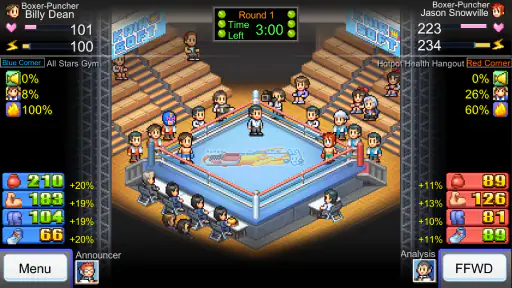
That makes the game a different proposition from a conventional boxing title. If you want direct control over movement, timing, and attacks, this is not the kind of boxing game to choose. Matches are automated, so the hands-on part is the planning around them: preparing fighters, managing your available resources, and deciding where to invest. The result is less about reflexes and more about seeing whether your preparation pays off.
The early pace is useful for learning the basic rhythm, but it also asks for patience. A small gym and a limited roster give you room to understand the management loop before the wider challenge takes shape. I’d avoid rushing through decisions just to reach the next bout. Taking a moment to check what you are trying to improve makes the training choices feel more deliberate, even when the game’s pace is relaxed.
Make training choices with a purpose
When I first launched Boxing Gym Story, I was greeted with the familiar pixel art style that Kairosoft is famous for. It’s charming, colorful, and immediately inviting. The tutorial does a great job of walking you through the basics, which is helpful because there’s a lot to manage here. From setting up training schedules to managing your fighters’ diets, there’s never a dull moment.
The game starts slow, allowing you to get a grip on the mechanics. You begin with a small gym, a few basic facilities, and a couple of hopeful boxers. Your job is to train them, improve their skills, and gradually upgrade your gym to attract more talented fighters.
A useful way to approach the training is to give each change a clear reason. Rather than altering a regimen simply because you can, decide what you hope it will accomplish, then pay attention to how the boxer develops and how that preparation feels when competition arrives. This makes experimentation more informative: if you change several things at once, it is harder to tell which choice helped. The game rewards a bit of record-keeping in your head, even if you play casually.
Gaming Stories You May Enjoy

Dancing Road Turns Short Breaks Into a Test of Rhythm and Timing

Super Stylist Makes Every Outfit a Test of Taste and Patience

Dominoes on Your Terms: Who Should Play and Who Should Pass

Pokémon GO Makes the Familiar World Feel New

Chess.com Turns Rematches Into Rivalries, but Community Has Its Costs

Archery Battle 3D Review: Sharp Aiming, Unclear Feedback
There is also a trade-off between improving the gym and investing attention in the people already training there. Facility upgrades may help the broader operation, while a carefully considered regimen is a more direct way to work on a boxer. I would not assume that one kind of investment is always best. When progress feels slow, look at whether your resources are being spread across too many priorities before making another change.
That’s one reason the game can fit short, ordinary play sessions. I can imagine opening it during a quiet break, reviewing what the gym needs, making a training decision, and returning later to see how the next match goes. It is not a game I would pick for a quick burst of real-time action; its pleasure is in setting up a plan and letting the simulation reveal the result.
Automated bouts make planning the main event
The core gameplay revolves around balancing your resources. Money and time are your primary concerns, as you’ll need to invest both wisely to see your gym thrive. The game offers a satisfying loop of training, competing in matches, and upgrading facilities. The matches themselves are automated, which might not be everyone’s cup of tea, but it fits well within the game’s strategic framework.
One of the most interesting aspects for me was the ability to customize training regimens. You can experiment with different combinations of exercises to find what works best for your fighters. It’s rewarding to see your boxer improve and climb the ranks, thanks to your carefully crafted training plan.
The automated format is worth considering before you buy. A match is not an invitation to rescue a poor plan with quick inputs; the satisfaction comes from choices made beforehand. I find that a useful distinction when comparing this with other sports games: arcade boxing puts the bout itself first, while this one treats the gym’s development as the main attraction. A manager who enjoys watching the consequences of preparation may find the automation calming. Someone who wants tactical control during every round may find it distancing.
For a more thoughtful session, I’d check the state of the gym before committing to upgrades, then choose one area to focus on rather than spending impulsively across every available option. After a bout, use the outcome as feedback rather than proof that the entire approach was right or wrong. A single result can be affected by more than one part of your preparation, so changing everything at once risks losing the thread of what you were testing.
This also helps answer whether the game is suitable for a newcomer to management sims. The tutorial introduces the basics, and the gradual opening gives you time to learn, but there are still several things to balance. If you enjoy learning a system through small decisions, that complexity is part of the appeal. If you prefer a game that explains every consequence in detail or keeps the number of choices very low, the management side may feel like work rather than play.
A retro presentation with a clear focus
Boxing Gym Story doesn’t break new ground in terms of graphics, but its retro charm is undeniable. The pixel art is detailed enough to give each character personality, and the animations are smooth and pleasing to watch. The sound design complements the visuals well, with upbeat music and satisfying sound effects that enhance the overall experience.
The presentation suits a game where I spend much of my attention on the gym and its progress rather than on realistic ring spectacle. Pixel art gives the characters an approachable look, while the management structure keeps the screen from needing to imitate a televised boxing match. That is a strength if you enjoy Kairosoft’s style, but it is also a matter of taste: players seeking a serious sports broadcast aesthetic should look elsewhere.
Because the central pleasure is gradual development, this is best approached as a game to revisit rather than one whose appeal depends on a dramatic first match. A sensible routine is to check what needs attention, make a limited set of adjustments, and let the results emerge over time. That keeps the choices legible and helps prevent the resource-management side from turning into aimless tapping.
Price, audience, and the right expectations
This is a paid game at seven dollars and forty-nine cents, so I would judge it as a complete purchase rather than assume there is a free version to try. That price makes the central question simple: do you want a boxing-themed management simulation enough to spend on it? The game has a 4.7 average from around 4,700 ratings and more than 100,000 installs, signs of a solid audience, though popularity alone cannot guarantee that its hands-off matches will suit you.
It is rated Everyone 10+, and the current version is 1.3.5. The game was released on February 9, 2021, and lists Android 5.1 as its minimum operating system. If you are choosing a game for a younger player, the age guidance is a useful starting point, while the slower management style is worth considering alongside it. For anyone checking device compatibility, that minimum OS detail is more practical than assuming every older phone will run it comfortably.
I see the strongest value for players who enjoy Kairosoft’s compact, systems-driven simulations, sports fans curious about the business and training side of boxing, and anyone who likes setting up a plan and watching it unfold. It is also a reasonable fit for a relaxed routine: a few decisions during downtime can be more appealing than a game that demands constant attention. The price is harder to justify if you only want the spectacle of a fight or are unsure whether management games hold your interest.
It is less suitable for someone looking for a realistic boxing simulator, direct fighter control, or a fast competitive game. It may also frustrate players who want every match to be a hands-on test of timing. Those are not minor preferences here; automated bouts are a defining part of the design. If that sounds like a deal-breaker, an action-focused boxing game is the better alternative. If you enjoy running the preparation behind the contest, this game offers a more distinctive angle than another ring-only experience.
One practical question is whether you need to understand boxing deeply to enjoy it. I don’t think you need specialist knowledge to appreciate the management loop; the game’s focus is on developing a gym and making training decisions, not on teaching real-world boxing technique. Still, players who already enjoy the sport may get extra pleasure from seeing the build-up to a bout as part of the experience.
Another consideration is how much control you want over progression. You do make choices about training and spending, but the automated matches mean you should not expect to dictate the action once a contest starts. I’d treat it as a planning game with boxing flavor, not a tactical ring simulator. That expectation makes a big difference to whether the purchase feels worthwhile.
As a sports game, it sits closer to a management sim than to the usual action alternatives. That comparison is not a knock against it; it tells you where to look for enjoyment. The best moments come from seeing a boxer develop in response to decisions you made earlier, while the weakest fit is for anyone who considers the fight itself the only part that matters. I would choose it for the gym-building angle, not as a substitute for controlling a boxer.
My verdict: buy it for the gym, not the punches
Overall, Boxing Gym Story is a delightful addition to the Kairosoft lineup. It’s a game that rewards strategic thinking and careful management, and it’s easy to lose hours trying to perfect your gym. While it might not be for everyone, especially those looking for a more hands-on boxing experience, fans of simulation games are likely to find a lot to love here. Whether you’re a seasoned Kairosoft fan or a newcomer to their games, Boxing Gym Story is worth a look.
My recommendation comes with one clear condition: be comfortable paying for a management-focused game whose bouts are automated. If you are, the combination of training choices, resource balancing, and a charming presentation gives the purchase a coherent purpose. If you want direct control, high realism, or instant action, save your money for a different kind of boxing game. For me, the appeal is not landing the winning punch; it is building a gym that gives its fighters a better chance to succeed.
Boxing Gym Story Pros and Cons
Pros
- Engaging storyline with character development.
- Variety of training exercises keeps it fresh.
- Customizable gym and equipment options.
- Multiplayer mode for competitive fun.
- Regular updates with new features.
Cons
- Graphics are a bit outdated.
- Can be slow to progress without purchases.
- Limited tutorial for beginners.
- Some features require internet connection.
- In-app purchases can be pricey.
Frequently Asked Questions
What is Boxing Gym Story and what can I do in the game?
Boxing Gym Story is a simulation game where players manage a boxing gym. You can train your fighters, organize matches, and strive to become the best gym in the world. The game allows you to hire trainers, expand your gym facilities, and compete in tournaments to gain fame and fortune. Players enjoy the strategic aspect of managing resources and making tactical decisions to train champions.
Is Boxing Gym Story free to play, or does it require in-game purchases?
Boxing Gym Story is available for a one-time purchase on both Android and iOS platforms. Unlike many free-to-play games, it does not rely on in-app purchases to enhance gameplay. Once you buy the game, you have full access to all its features, making it a great choice for those who prefer a complete gaming experience without the need for additional spending.
What are the main features of Boxing Gym Story?
Boxing Gym Story features detailed gym management mechanics, a variety of training options for your boxers, and the ability to customize and expand your gym. The game also includes competitive tournaments, engaging storylines, and unique characters. With its charming pixel art and intuitive controls, it offers a rich and immersive gameplay experience for fans of management simulation games.
Can I play Boxing Gym Story offline?
Yes, Boxing Gym Story can be played offline, which is perfect for gamers who want to enjoy the game without needing a constant internet connection. This feature is particularly beneficial for those who travel frequently or have limited access to Wi-Fi, ensuring uninterrupted gameplay anytime and anywhere.
What devices are compatible with Boxing Gym Story?
Boxing Gym Story is compatible with a wide range of devices on both Android and iOS platforms. To ensure smooth gameplay, it's recommended that players use devices with updated operating systems and sufficient processing power. The game is designed to run efficiently on most smartphones and tablets, making it accessible to a broad audience of mobile gamers.


