

BitLife - Life Simulator
- Reviews
- 4.4
- Version
- 3.16.2
- Installs
- 10,000,000+

Screenshots
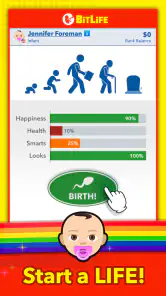




 Analysis by Frivlyz
I like that BitLife - Life Simulator treats a life as a sequence of decisions rather than a world to explore with a character on screen. Its plain presentation gets out of the way, so I can start a run during a spare moment and quickly find myself weighing choices that send a virtual person in an entirely different direction. The mood is playful, sometimes dark, and deliberately unpredictable; the appeal is less about building a perfect life than seeing what happens when plans meet chance.
A small screen, a whole life to steer
The first impression is closer to opening an interactive diary than starting a traditional simulation game. I read a short situation, choose how to respond, and watch the consequences accumulate as the character grows older. That setup makes the game easy to understand without a long tutorial, but it also means the quality of a session depends on whether I enjoy reading and making decisions. Anyone expecting detailed character movement or a richly animated setting may find the presentation too spare.
As a mobile game, it suits the little gaps in a day: a few minutes waiting for an appointment, a commute when I can comfortably look at my phone, or a quiet break after work. I can make a decision, advance the character’s age, and put the game down without needing to keep a real-time world running. The trade-off is that a quick session can turn into a much longer one when I want to see the result of a risky choice or carry a particular plan through another stage of life.
The Thrill of Choices
Life is all about choices, and BitLife - Life Simulator nails this concept with precision. From the moment you're born until your final breath, every decision you make is in your hands. Will you become a brain surgeon, a famous actor, or maybe a notorious criminal? The possibilities are endless, and each path is as entertaining as the next.
Gameplay Mechanics
The game operates on a simple yet engaging interface. You start as a newborn, and with each "year" you age, you make critical life decisions. It's like flipping through the pages of a "choose your own adventure" book, only with a much broader scope. As a player, you're responsible for your education, career, relationships, and even your moral compass. Every choice influences your future, making each playthrough uniquely different.
One useful way to approach a run is to decide what kind of story I want before I start making choices. I might try to keep a character steady and responsible, or deliberately take chances and see how the consequences reshape the rest of their life. That small bit of intent makes the individual decisions feel connected rather than like unrelated prompts. It also gives me a reason to begin another life: I can test a different approach instead of trying to repeat the same outcome.
There is a trade-off between control and surprise. I can make choices about education, work, relationships, and behavior, but the game’s chance events can disrupt even a sensible plan. I try not to treat every setback as a puzzle with a guaranteed correct answer; part of the fun is seeing how a life changes when an unexpected event arrives. If you prefer simulations where careful planning reliably produces a predictable result, this looser structure may feel frustrating.
Gaming Stories You May Enjoy

Dancing Road Turns Short Breaks Into a Test of Rhythm and Timing

Super Stylist Makes Every Outfit a Test of Taste and Patience

Dominoes on Your Terms: Who Should Play and Who Should Pass

Pokémon GO Makes the Familiar World Feel New

Chess.com Turns Rematches Into Rivalries, but Community Has Its Costs

Archery Battle 3D Review: Sharp Aiming, Unclear Feedback
What's really cool is the randomness of life events. You might win the lottery, end up in jail, or even get abducted by aliens. The unpredictability keeps the game fresh and exciting every time you play.
Making each run feel different
A practical tip is to pay attention to the consequences that appear after a choice, not just the immediate outcome. When a decision affects more than one part of a character’s life, I use that result to adjust the next move instead of continuing on autopilot. This turns the year-by-year format into a light experiment: make a choice, observe what changes, and decide whether to commit to that direction or change course. It is especially satisfying when a small decision creates a chain of complications much later.
For example, if I have only a short break, I can start a fresh character and follow one simple idea, such as prioritizing a stable career or taking a more reckless route. I don’t need to map out every future year. I can make a handful of decisions and leave the run at a natural pause. When I have more time, I can continue a life whose relationships or career have become interesting. That flexibility is a stronger everyday advantage than a complicated set of controls would be.
The game is also a better fit for playful experimentation than serious life planning. Its outcomes are there to create stories, not to offer reliable advice about real careers, relationships, or money. I enjoy testing questionable choices because the consequences stay within the game, but I would not use those outcomes as a guide to what someone should do outside it. That distinction keeps the humor and moral dilemmas enjoyable without taking the simulation too literally.
Graphics and User Experience
While the graphics are simple, they suit the game’s text-based nature perfectly. The minimalistic design ensures that you focus on your decisions rather than flashy visuals. The user experience is smooth, with intuitive controls that make it easy for anyone to pick up and play.
The visual restraint creates a consistent mood: I am reading the outline of a life, not watching a dramatic scene unfold. That makes the experience quick to scan and keeps attention on the decisions, but it also limits emotional texture. A tense or sad event is conveyed through the text and its consequences rather than expressive animation or a detailed environment. I think that is a sensible choice for this format, though players who want atmosphere built from art, character animation, or exploration should look elsewhere.
Sound is not what gives the game its identity for me. The central rhythm comes from reading, choosing, and advancing through another year, so it works as a quiet phone game that does not demand the attention of an audio-led experience. This is useful in places where I would rather keep my phone unobtrusive. It also means players who want a strong soundtrack or sound effects to drive the mood may find the experience less immersive than a conventional, visually rich simulation.
The pacing has a distinctive stop-and-start quality. A choice can be made quickly, but a run gains momentum as I become curious about the next stage of a character’s life. I like that I can pause between those beats, although the repeated cycle of reading a prompt and selecting a response can feel samey during a long session. I usually enjoy it most in short bursts, or when I have a particular story in mind, rather than treating it as a game that needs hours of continuous attention.
Who will enjoy this kind of simulation?
I would recommend it to players who like text-driven stories, branching decisions, dark humor, and the small surprise of seeing a plan go wrong. It is also a good choice for someone who wants a game that can be picked up and put down without learning a complicated control scheme. If you enjoy imagining alternate versions of a life and comparing how different decisions change the story, the basic format gives you plenty to play with.
I would skip it if you mainly want a detailed world to walk through, expressive graphics, action, or a simulation built around precise management. It is not the best match for someone who dislikes reading frequent prompts or who gets annoyed when luck interferes with a carefully chosen direction. A conventional life-building game with a visible home, characters, and hands-on customization will be more satisfying for that kind of player; BitLife’s strength is the narrative thought experiment, not visual control over a physical space.
Compared with many simulation games that ask me to arrange objects, manage resources, or directly control a character, this one puts the emphasis on choices and consequences. That makes it less tactile but more immediate: I can get into a new scenario without spending time building a setting first. The flip side is that the world can feel abstract, and the story depends on whether the written events catch my interest. I see it as a distinct alternative to a traditional life sim rather than a replacement for one.
Social and Ethical Implications
The game also does a great job at nudging you to think about the ethical implications of your choices. Want to steal a car or cheat on your partner? Go ahead, but be prepared for the consequences. It’s a fun way to explore moral dilemmas in a safe environment. Plus, with the app's regular updates, there's always something new to navigate, whether it's new scenarios or added features.
That freedom works best when I treat the character as a fictional person rather than a model for my own behavior. I can try a selfish or reckless route simply to discover what follows, then start again with a different set of priorities. The contrast between runs is part of the appeal: choices that seem amusing in isolation can become less appealing when they affect a character’s wider life. The game invites curiosity without requiring me to approve of every action it lets me choose.
BitLife is free to download, with optional in-app purchases priced from $0.99 to $19.99 per item. I would go in expecting to try the core experience first and make a purchase only if I decide a paid option suits the way I play. Those purchases are worth keeping in mind if you prefer games with no optional spending at all. The game is rated Mature 17+, so it is not a title I would choose for a younger child; its adult rating is an important part of deciding who should play.
It is made by Candywriter, LLC, and the scale of its audience is notable: it has more than 10 million installs and an average rating of 4.4 from around 1.2 million ratings. Those numbers suggest that the simple choice-based format has broad appeal, but they do not change the main question for me: do you enjoy reading short scenarios and living with unpredictable outcomes? If not, popularity alone is unlikely to make the format click.
On compatibility, it runs on Android 7.0 or later. It first came out on February 5, 2019, and version 3.16.2 is the current version. I would check that my device meets the operating-system requirement before installing, and I would expect the exact experience to reflect the current version rather than assume an older playthrough or memory describes every detail today.
One small workflow that helps is to avoid tapping through every year without noticing what has changed. I pause after major events, consider which parts of the character’s life are now affected, and choose the next action with that new situation in mind. This makes the game feel less like a string of random buttons and more like a story I am steering, while still leaving room for unexpected turns. It is a simple habit, but it brings out the connection between choices more clearly.
BitLife’s developers are continually rolling out updates, ensuring the game remains as unpredictable and engaging as real life. This commitment to development highlights their dedication to providing an ever-evolving experience for users.
Where its atmosphere works—and where it doesn’t
The art direction, writing-led interface, and brisk year-by-year rhythm all point toward the same kind of play: imagine a life, make a call, and see what follows. I find that coherence more important than visual complexity here. The game does not try to pretend that its text prompts are a fully rendered world; instead, it makes the act of choosing the center of attention. That works particularly well when I want a lightweight story with room for absurd outcomes.
Its limitations are also part of that identity. Because the setting is delivered mainly through text, a character’s world can feel like a sequence of events rather than a place I inhabit. And because chance has a role, a carefully imagined storyline can take a turn I did not want. I can start another life and try a different path, but that does not make every individual run feel controlled or emotionally deep. Players who want a strong authored plot, tactile management, or a detailed visual setting should choose a different kind of simulation.
Final Thoughts
In conclusion, BitLife - Life Simulator is a fantastic way to escape reality and dive into a world of endless possibilities. Whether you want to explore different careers, navigate complex relationships, or just see how the other half lives, this game has you covered. It's a delightful mix of fun, chaos, and life lessons—all packed into one app. So, if you're looking to kill time while contemplating life's big questions, give BitLife a whirl. You might just discover something new about yourself.
My recommendation comes with one clear caveat: enjoy it as a compact, unpredictable story generator, not as a deep visual life sim or a realistic guide to living. When I want a quick decision-driven distraction, the minimal interface and sudden turns are exactly what I’m after. When I want a world to explore or precise control over every outcome, I reach for another kind of game. If the first description sounds like your sort of fun, this is an easy one to try; if the second matters more, its simple presentation may wear thin quickly.
BitLife - Life Simulator Pros and Cons
Pros
- Engaging life simulation experience
- Diverse career and life choices
- Regular updates with new content
- User-friendly interface
- Offline play available
Cons
- In-app purchases can be pricey
- Ads can interrupt gameplay
- Some scenarios feel repetitive
- Limited customization in free version
- Graphics are basic and text-heavy
Frequently Asked Questions
What is BitLife - Life Simulator?
BitLife - Life Simulator is a unique text-based simulation game where you can live a virtual life from birth to death. You make choices that affect your character's life path, including education, career, relationships, and more. The game is designed to mimic real-life scenarios, allowing players to experience different life events and outcomes through the decisions they make.
Is BitLife - Life Simulator free to play?
Yes, BitLife - Life Simulator is free to download and play on both Android and iOS platforms. However, the game offers in-app purchases and optional premium features that enhance the gameplay. These might include ad removal, exclusive content, or additional customization options, which can be purchased to enrich your gaming experience.
What are the main features of BitLife - Life Simulator?
BitLife offers a variety of features including a detailed character life simulation, decision-making scenarios, and life events such as education, career, marriage, and more. Players can experience different outcomes based on their choices, and the game is regularly updated with new content and challenges. The interface is straightforward, making it accessible for players of all ages.
Can I play BitLife - Life Simulator offline?
Yes, BitLife - Life Simulator can be played offline. This feature makes it convenient for users who want to enjoy the game without needing a constant internet connection. While some features and updates might require internet access, the core gameplay is available offline, allowing you to immerse yourself in the game anytime, anywhere.
What age rating is BitLife - Life Simulator appropriate for?
BitLife - Life Simulator is rated for players aged 17 and older. The game includes mature themes such as crime, sexuality, and life events that might not be suitable for younger audiences. Parents and guardians are advised to review the content and ensure it aligns with their standards before allowing younger players to download the game.


