

Backgammon - Board Game
- Reviews
- 4.3
- Version
- 1.19.2
- Installs
- 5,000,000+

Screenshots
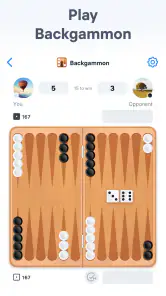



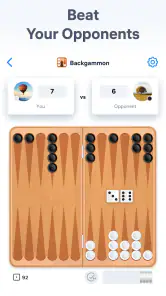


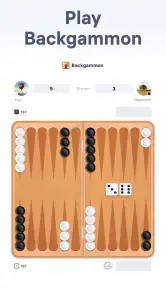
 Analysis by Frivlyz
I find Backgammon - Board Game most useful when I want a familiar strategy game that can fit into a short break. A match still asks me to think about risk, timing, and where each checker should go, but the digital format removes the effort of setting up a physical board. That makes it easy to try a few turns while waiting for a ride or to settle in for a longer game when I have time. It is a straightforward idea, and the appeal comes from the decisions rather than a long list of systems to learn.
Small goals that make the first games useful
Backgammon gives new players a natural first objective: learn how movement works, then try to bring every checker home and bear them off efficiently. I like that this goal is concrete. Even before I understand deeper strategy, I can see whether a move leaves a checker exposed or helps me build a safer route. The game’s familiar board makes each turn readable, so I can focus on why a choice matters instead of learning a complicated interface.
For a newcomer, I would treat the opening matches as practice rather than a test of skill. Try to notice what happens after a checker is left alone, how blocking points changes the opponent’s route, and when moving quickly is worth the risk. Those observations are more useful than trying to memorize tactics all at once. A digital opponent can make it convenient to repeat the basic decision-making, while playing another person gives those same choices a less predictable feel.
What progress looks like in a game built around skill
This is a board game, so progress is less about collecting things and more about becoming better at reading the position. A good sign is when I stop choosing a move simply because it is available and start weighing what it leaves behind. Can I protect a vulnerable checker? Am I making a point that limits the other player? Is a bold move sensible, or am I relying on luck? Thinking through questions like these gives each match a small learning goal even when there is no larger campaign to follow.
That style of progression suits players who enjoy gradual improvement. I can finish a game, remember one decision that went badly, and try a different approach next time. It is a quieter reward than unlocking a new character or reaching a story chapter, but it is also the reason backgammon remains interesting after the rules become familiar. If you need a steady stream of visible prizes to stay engaged, this may feel sparse; if sharpening your judgement is rewarding on its own, the board gives you plenty to examine.
Challenge, pace, and the point where luck enters
Backgammon balances planning with dice, and that mix is part of its appeal and its frustration. I can choose a sensible move, but the roll still shapes what is possible on the next turn. Good play is about making strong decisions across many situations, not expecting every individual game to go my way. When I keep that in mind, a surprising roll feels like part of the game rather than proof that a strategy has failed.
The challenge also changes with the person on the other side of the board. Playing against a computer can be useful when I want an immediate opponent and a chance to concentrate on positions. Human play is better when I want the uncertainty of another person’s choices. Neither kind of match replaces the other: practice against a predictable style can help me learn, while a human opponent can expose habits I did not notice. I would choose based on whether I want a calmer learning session or a more variable contest.
Gaming Stories You May Enjoy

Dancing Road Turns Short Breaks Into a Test of Rhythm and Timing

Super Stylist Makes Every Outfit a Test of Taste and Patience

Dominoes on Your Terms: Who Should Play and Who Should Pass

Pokémon GO Makes the Familiar World Feel New

Chess.com Turns Rematches Into Rivalries, but Community Has Its Costs

Archery Battle 3D Review: Sharp Aiming, Unclear Feedback
One practical habit helps me get more out of short sessions: before moving, I pause to check whether a checker will be left alone and whether the move creates a useful block. It takes only a moment, but it turns a quick roll into a deliberate decision. I also try not to judge improvement by a single win or loss. Looking back at one avoidable risk is a better measure of learning than expecting luck to behave consistently.
Rolling the Dice: First Impressions
The first thing that caught my eye when I downloaded Backgammon - Board Game was its sleek and intuitive interface. The developers have done a stellar job of replicating the tactile feel of a physical backgammon board. As soon as you launch the app, you're greeted with a clean, user-friendly design that's easy to navigate. No need to fumble around; everything you need is right at your fingertips.
Gameplay that Keeps You Hooked
Now, onto the most crucial part: the gameplay. The app offers a variety of modes, from single-player against AI to online multiplayer where you can test your skills against other players worldwide. The AI is surprisingly smart, offering a challenge that's both fair and engaging. I found myself constantly trying to outsmart the AI, and believe me, it wasn't a walk in the park!
For those who prefer human interaction, the multiplayer mode is a real treat. You can either invite friends or match up with random players, which means there's always someone ready to roll the dice with you. The matchmaking is quick, and I rarely had to wait more than a few seconds to get into a game.
Features That Stand Out
One of the standout features has to be the tutorial mode. If you're new to backgammon, this is a lifesaver. It walks you through the rules and strategies, making it easy for anyone to pick up and play. Not only does it cover the basics, but it also delves into advanced strategies, which I found incredibly useful as I honed my skills.
The app also offers customization options, allowing you to personalize your board and pieces. It's a small touch, but it adds that extra layer of enjoyment as you play. Plus, the graphics are crisp, and the animations run smoothly, making for an overall pleasant experience.
Matches, money, and who should choose another game
As a board game from Easybrain, it stays close to the appeal of physical backgammon: a compact board, dice-driven turns, and decisions that become more interesting as the position develops. Compared with a puzzle game, it gives me an opponent who can disrupt a plan; compared with a casual dice game, it asks me to manage risk rather than simply wait for a lucky result. If I want a deep, scripted campaign or a stream of unrelated mini-games, I would look elsewhere. This is best for someone who actually enjoys backgammon’s familiar loop.
It is also worth thinking about the setting in which I play. A quick match can suit a quiet break, but I would not start one if I have only a few seconds before needing to put my phone away. A turn-based board game still asks for attention: I need to look at the whole layout, consider what the roll permits, and avoid tapping through a move without checking its consequences. For a commute with interruptions, I prefer a moment when I can focus rather than trying to play while rushing between tasks.
If I am introducing a friend to the game, I would explain the basic aim first and then let the tutorial do the heavier lifting. The useful trick is to treat each lesson as a prompt to inspect the board, not as a script to follow blindly. A suggested move can demonstrate a principle, but the position may change, and backgammon rewards adapting to what is actually in front of you. That makes the learning process more practical than memorizing a sequence that may not appear again.
A useful routine for learning without overplaying
One way I would keep sessions purposeful is to pick a single thing to watch for before starting: protecting isolated checkers, building blocking points, or avoiding a risky move when a safer route is available. After the match, I can ask whether I followed that intention. This keeps improvement manageable and helps separate a decision I controlled from a dice result I did not. It is a small routine, but it makes repeated games feel less like rolling for its own sake.
Customization has a different role. Changing the board or pieces can make the experience feel more personal, but it does not alter the strategic task, so I see it as a pleasant visual extra rather than a reason to keep playing. Players who mainly want fresh objectives may not find that kind of personalization enough. Those who already like the backgammon board are more likely to appreciate a familiar game that feels comfortable to return to.
What to expect from access and ongoing play
The game is free to download, with in-app purchases listed at $9.99 per item. I would approach any optional purchase as a personal choice, not as a requirement for learning the rules or enjoying a match. Its age rating is Everyone, and it has a 4.3 average from around 125,000 ratings, with more than five million installs. Those figures suggest a widely played option, but they cannot tell me whether its style suits a particular player; the central question remains whether I enjoy backgammon itself.
The current version is 1.19.2, and the listed minimum operating system is version 7.0. I would check that my device meets that requirement before planning to play, especially if I am setting it up for someone using an older phone. The basic format makes it approachable, but it is still a game that depends on attention and willingness to think through turns. Someone who wants passive entertainment may be happier with a simpler game that does not ask them to weigh risk on every roll.
How the challenge holds up over time
The pacing is strongest when I give myself a reason to notice more than the final result. Early on, understanding the rules provides enough direction; later, I can focus on positioning, defensive choices, and how much uncertainty I am willing to accept. There is no need to race through that learning curve. In my view, a useful match is one where I can identify a decision to reconsider, even if the dice made the ending feel abrupt.
That also explains the main retention trade-off. Backgammon can invite another round because a new roll creates a new problem, but the game does not need a constant ladder of rewards to justify itself. For some people, that is refreshing. For others, especially players who want clear unlock targets or a campaign that steadily expands, the repeated board may feel limited. I would choose it for the satisfaction of reading positions and improving, not for a promise of ever-changing content.
Features That Stand Out
One of the standout features has to be the tutorial mode. If you're new to backgammon, this is a lifesaver. It walks you through the rules and strategies, making it easy for anyone to pick up and play. Not only does it cover the basics, but it also delves into advanced strategies, which I found incredibly useful as I honed my skills.
The app also offers customization options, allowing you to personalize your board and pieces. It's a small touch, but it adds that extra layer of enjoyment as you play. Plus, the graphics are crisp, and the animations run smoothly, making for an overall pleasant experience.
Progression verdict: a classic that rewards attention
For me, the strongest reason to keep playing is that each match gives me a fresh position to interpret, while the underlying rules stay easy to recognize. The tutorial helps lower the barrier, and the choice between computer play and human opponents offers different kinds of practice. The trade-off is that its long-term pull depends more on enjoying the board game than on chasing new goals. I would recommend it to a friend who wants a convenient way to play backgammon and is happy to learn through repeated decisions.
If I wanted a more varied strategy experience, a board game with changing objectives would be a better fit; if I wanted a social match, this app’s online play gives me a direct route to one. For players who like patient tactical choices, it is an easy game to return to. It is less convincing for anyone who expects every session to bring a new mode or a strong sense of unlock-driven progression.
So, if you're a fan of strategy games or just looking for something new to try, give this app a shot. You might just find yourself hooked, just like I did!
Backgammon - Board Game Pros and Cons
Pros
- Engaging multiplayer mode for global competition.
- User-friendly interface with intuitive controls.
- Customizable boards and pieces enhance experience.
- Offline mode available for practice and fun.
- Regular updates with new features and improvements.
Cons
- Occasional connectivity issues in online mode.
- Some features locked behind a paywall.
- Ads can be intrusive during gameplay.
- Limited tutorial for beginners.
- Requires stable internet for best experience.
Frequently Asked Questions
What is Backgammon - Board Game and how is it played?
Backgammon - Board Game is a classic strategy game where two players move their pieces around 24 triangles based on the roll of two dice. The objective is to move all your pieces into your home board and then bear them off before your opponent does. The game involves both luck and strategic decision-making, making it a timeless favorite among board game enthusiasts.
Can I play Backgammon - Board Game offline?
Yes, Backgammon - Board Game offers offline play. This feature allows you to enjoy the game against AI or a friend on the same device without needing an internet connection. It's perfect for long trips or situations where Wi-Fi is not available, ensuring you can always enjoy a game of backgammon.
Does Backgammon - Board Game support online multiplayer?
Absolutely! Backgammon - Board Game supports online multiplayer, allowing you to compete against players from around the world. This feature adds a competitive edge to the game, enabling you to test your skills against a diverse range of opponents. Online leaderboards and rankings are often available to track your progress.
Are there any in-app purchases in Backgammon - Board Game?
Yes, the game may include in-app purchases. These can enhance your gaming experience by offering additional features such as board designs, dice styles, or removing ads. However, these purchases are optional, and you can enjoy the full game without spending any money, though some features might be restricted.
How user-friendly is the interface of Backgammon - Board Game?
The interface of Backgammon - Board Game is designed to be user-friendly, catering to both new players and seasoned veterans. It features intuitive controls, clear graphics, and helpful tutorials for beginners. The straightforward design ensures an enjoyable experience, allowing players to focus on strategy rather than navigating complex menus.


