

Associations - Colorwood Game
- Reviews
- 4.6
- Version
- 1.12.17471
- Installs
- 1,000,000+

Screenshots
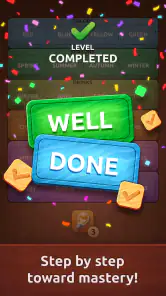
 Analysis by Frivlyz
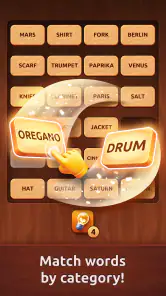
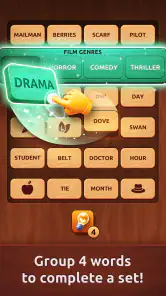
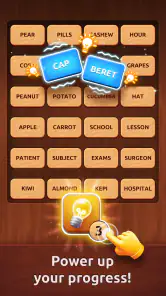
I tend to enjoy word games most when they give me one clear thing to do and let me settle into it without a long tutorial or a lot of setup. Associations - Colorwood aims for that kind of quick, focused puzzle: I look for words that belong together, make a group, and see whether my reasoning fits. It is an easy idea to understand, but the interesting part is deciding what a word means in context and which connection the puzzle expects.
That makes the game a natural fit for short breaks, though it can also hold my attention when I want to work through a puzzle more deliberately. It is a free word game from Burny Games, with a 4.6 average from around 98,000 ratings and over 1 million installs. Those figures suggest it has found a sizeable audience, but the more useful question is whether its particular kind of association puzzle suits the way you like to play.
The first move is about finding a rule
When I begin a board, I do not try to force every word into a group immediately. I scan the options and look for the clearest shared idea first: perhaps a subject, a familiar phrase, or a category that connects several words. Once one plausible cluster emerges, the remaining words become easier to consider because I can compare them against that first interpretation.
This is where the game’s central appeal sits. The task is not simply to recognize individual words; it is to choose a useful way of sorting them. A word can suggest more than one connection, so I have to weigh the surrounding choices rather than trust my first association. If I get stuck, I find it more productive to pause and reconsider the whole set than to keep tapping at the same tempting combination.
The game is listed in the word category, and that feels right: language and interpretation matter more than quick reflexes. Its short description is “Associations,” but in practice I would describe the activity as a sequence of small classification decisions. That distinction helps set expectations. Someone looking for a spelling challenge or a crossword-style clue hunt may find the focus different from what they want, while anyone who likes spotting shared themes should understand the basic draw straight away.
How the feedback shapes a session
The satisfying rhythm comes from making a choice, checking whether the group works, and then using that result to refine my thinking. Correct decisions provide a small sense of progress; a mistaken grouping is a prompt to look again at the words I treated as related. I like this kind of feedback because it keeps the puzzle moving without making the activity feel like a race.
There is a trade-off, though. Association puzzles depend on interpretation, and a set that feels obvious to one person may be less clear to someone who reads a word differently or does not share the same reference. When my first guess fails, I try to identify the assumption behind it: did I focus on a broad topic when the connection was more specific, or did I overlook a phrase that changes how the word should be read? That little diagnostic habit is more useful than guessing randomly.
Gaming Stories You May Enjoy

Dancing Road Turns Short Breaks Into a Test of Rhythm and Timing

Super Stylist Makes Every Outfit a Test of Taste and Patience

Dominoes on Your Terms: Who Should Play and Who Should Pass

Pokémon GO Makes the Familiar World Feel New

Chess.com Turns Rematches Into Rivalries, but Community Has Its Costs

Archery Battle 3D Review: Sharp Aiming, Unclear Feedback
The format also makes it easy to stop at a natural point. I can give a board a few minutes, put the phone down, and return when I feel like thinking again. That is a better fit for a commute break or a quiet moment at home than a game that demands constant attention. For a realistic everyday use, I would open it while waiting for an appointment, solve a board if I have enough time, and leave the next one for later rather than turn a short pause into a long session.
A calm kind of challenge, with a few caveats
I can see this working especially well for players who enjoy language puzzles but do not want the formal clues and grid-filling of a crossword. It also suits casual players who want a simple activity they can learn quickly. If you prefer fast rounds, competitive pressure, word searches, or puzzles with a single unambiguous clue, this may not be your first choice. The pleasure here comes from interpreting relationships, not from racing a clock or building a vocabulary list.
That makes the game a different proposition from familiar word-game alternatives. A word search asks me to locate letters already arranged on a board; a crossword points me toward answers through clues and crossings. Associations asks me to decide how words belong together, so the challenge is more about categorization and flexible thinking. If I am in the mood to practice spelling or solve a precise clue, I would choose another format. If I want a gentler puzzle that lets me test an idea and revise it, this is the more appealing option.
One practical tip is to read every word before committing to the first neat-looking group. A tempting cluster can be misleading if it leaves awkward words behind, and checking the whole board helps me notice a stronger organizing idea. I also try changing the level of abstraction: instead of asking only “what subject is this?”, I ask whether the words share a use, setting, expression, or role. This is not a special feature; it is a way of getting more out of the game’s core task.
Another useful approach is to treat a wrong answer as information rather than a failure. I mentally set aside the connection I just tested, then look at the remaining words with fresh eyes. That prevents me from repeating the same guess in slightly different forms. It is particularly helpful when two possible categories overlap, since eliminating one interpretation can make the intended grouping easier to see.
The game is free to download, with in-app purchases ranging from $2.99 to $99.99 per item. That is worth keeping in mind if you prefer games with no purchase options at all; the presence of in-app purchases does not by itself tell me how often a player will encounter them, so I would decide based on my own comfort with optional spending. The content rating is Everyone, making the stated age classification broad, and the current version is 1.12.17471. It requires Android 7.0 or later on Android devices.
For another kind of everyday test, I would use it when I want a mental change of pace after reading messages or finishing a task. Rather than opening a social feed and scrolling without a clear endpoint, I can focus on one set of words and finish with a definite result. The benefit is modest but real: the activity gives a short break some shape. It is less suitable when I am tired enough that interpreting ambiguous connections feels like work, or when I need a game that can be played without giving the words any attention.
Getting Started with Colorwood
First things first, downloading Associations - Colorwood is a breeze. Available on both Android and iOS, you can easily find it on the app store. Once you’ve got it installed, you’re welcomed by a bright and inviting interface that instantly sets the tone for the adventure ahead.
The game’s premise is simple yet intriguing. You’re tasked with connecting elements of the same color to form associations. These associations help you progress through a series of levels, each more challenging than the last. The beauty of Colorwood is in its simplicity combined with strategic depth.
Gameplay and Mechanics
So, how does it all work? The game is divided into colorful boards filled with different elements. Your job is to connect these elements by drawing lines between them. But here’s the catch: the lines can’t cross each other. This adds a layer of complexity that keeps the gameplay fresh and engaging.
As you advance, new elements and colors are introduced, keeping you on your toes. The game does an excellent job of gradually increasing difficulty, ensuring you’re always challenged but never overwhelmed. It’s like a colorful dance of strategy and intuition.
Visuals and Sound
Visually, Associations - Colorwood is a feast for the eyes. The colors are vibrant and well-chosen, creating a visually pleasing experience that’s relaxing yet stimulating. The graphics are smooth, and the animations are seamless, adding to the overall enjoyment of the game.
And let’s not forget about the sound design. The soothing background music complements the gameplay perfectly, creating an immersive environment. It’s the kind of game you can lose yourself in for hours, thanks to its captivating audio-visual harmony.
Why You’ll Love It
Now, why should you give Colorwood a shot? For starters, it’s a fantastic way to unwind. The game’s relaxing nature makes it perfect for winding down after a long day. But don’t be fooled by its calm demeanor; it’s also a great workout for your brain, keeping you sharp and focused.
Another highlight is its accessibility. Whether you’re a casual gamer or a puzzle enthusiast, Colorwood has something to offer. The intuitive controls and straightforward mechanics make it easy for anyone to pick up and play.
Final Thoughts
To wrap it up, Associations - Colorwood is a delightful addition to your gaming collection. It blends simplicity with strategy, offering a unique experience that’s both relaxing and challenging. The stunning visuals, combined with captivating gameplay, make it a standout choice in the world of mobile gaming.
If you’re on the hunt for a game that’s as entertaining as it is beautiful, look no further than Colorwood. Trust me, once you dive into this colorful world, you won’t want to leave!
Happy gaming, and may your associations be ever colorful!
One detail to keep in mind before installing is the release timing: the game arrived on August 22, 2025. That makes the current version number useful context if you are checking compatibility or comparing notes with another player, but I would not treat a version label as a promise that every device will feel identical. On Android, the stated minimum is version 7.0; on iOS, I would check the current store page for device requirements before downloading.
The reward in this kind of puzzle is less about collecting elaborate prizes and more about the clean click of seeing a hidden relationship. I enjoy the moment when a grouping that initially looked arbitrary suddenly makes sense because I notice a shared use or expression. That small recognition is enough to make another round appealing, especially when I have a few spare minutes and want a task with a clear finish.
My main reservation is that a calm presentation does not mean every board will feel effortless. A puzzle can slow down when several words seem to fit the same broad theme, and that can make the solution feel more like decoding the intended categorization than discovering an indisputable answer. If that ambiguity irritates you, a clue-driven crossword or a word search may be more satisfying. If you enjoy testing interpretations, the uncertainty is part of the point.
I also would not choose it as my only word game if variety is the priority. Its identity depends on sorting and connecting, so players who want changing mechanics, story progression, head-to-head play, or a timed challenge should look elsewhere. But for a low-pressure routine, the focused loop is a strength: start with the words in front of you, test a relationship, learn from the result, and decide whether you want one more board or a break.
Who will get the most from it
I would recommend it to someone who likes spotting patterns in language and wants a puzzle that can be approached without memorizing rules. It can also be a nice shared activity: two people can look at the same words and explain why they see different groupings, turning a quiet solo puzzle into a brief conversation. The value there comes from comparing reasoning, not from needing a competitive mode.
On the other hand, I would skip it if I mainly want a game that rewards speed, a rigorous vocabulary lesson, or a guaranteed single interpretation for every clue. It is also not ideal when I want something completely passive. Even a short session asks me to focus on the words and their relationships, so it works best when I have enough attention to spare.
How I decide whether to play another
For me, the session reset is simple: once I finish a board, I ask whether I still feel curious about the next set or whether I have had enough mental effort for now. That makes it easy to keep the game in the “small break” category rather than letting it take over an evening. If a puzzle has been frustrating, I stop instead of pressing on just to prove I can solve it; returning with a fresh perspective is often a better use of time.
Overall, I see Associations - Colorwood as a focused option for people who enjoy the act of making connections more than the usual crossword or word-search routine. Its best quality is that it gives a small puzzle a satisfying beginning and endpoint, while its main limitation is that the intended relationship may not always be the one I first notice. If that trade-off sounds enjoyable rather than annoying, it is worth trying as a free, casual word game; if precision, speed, or a wider mix of puzzle types matters more to you, another format will probably fit better.
Associations - Colorwood Game Pros and Cons
Pros
- Engaging and colorful graphics
- Easy to learn gameplay mechanics
- Suitable for all age groups
- Enhances cognitive skills
- Regular updates with new levels
Cons
- Ads can be intrusive at times
- Limited offline functionality
- In-app purchases can get pricey
- Occasional glitches in older devices
- Requires stable internet for best performance
This Game in Other Languages
Frequently Asked Questions
What is the main objective of Associations - Colorwood Game?
Associations - Colorwood Game is a puzzle game that challenges players to make logical connections between colors and objects. The main objective is to solve levels by correctly associating items based on color patterns and themes. It’s designed to stimulate your brain and enhance your problem-solving skills.
Is Associations - Colorwood Game suitable for all age groups?
Yes, Associations - Colorwood Game is designed to be family-friendly, making it suitable for players of all ages. The intuitive design and gradual increase in difficulty levels ensure that both children and adults can enjoy the game while honing their cognitive abilities.
Does Associations - Colorwood Game require an internet connection to play?
No, Associations - Colorwood Game can be played offline. This makes it a great option for players who want to enjoy the game on the go without worrying about internet connectivity. However, certain features like updates or leaderboards may require an internet connection.
Are there in-app purchases in Associations - Colorwood Game?
Yes, while the game is free to download, it offers in-app purchases. These can include additional levels, hints, or customization options. Players can enjoy the basic game without spending money, but optional purchases can enhance the gaming experience.
How can I contact customer support for Associations - Colorwood Game?
Customer support for Associations - Colorwood Game can be reached through the app’s settings menu, where you’ll find a ‘Contact Us’ option. This typically allows you to send an email or access a help center for troubleshooting and feedback.


