

СASHFLOW
- Reviews
- 3.7
- Version
- 2.0.27
- Installs
- 100,000+

Screenshots






 Analysis by Frivlyz
When I choose a financial learning game, I look for more than familiar money terms on a screen. I want decisions to feel connected: a choice about spending or investing should help me see how one part of a personal financial picture affects another. CASHFLOW is built around that kind of practice. It turns financial ideas into a game, which can make them easier to approach than a textbook or a spreadsheet—but it is still a simulation, not a substitute for advice about my real money.
A useful choice for learning by doing
This is an educational game from Torn Screen Entertainment, Inc., aimed at players who would rather test decisions than only read about them. Its central appeal is the chance to work through income, expenses, and investments in a simulated setting. I find that format most useful when I already have a basic question in mind, such as why passive income matters or how recurring expenses can constrain choices. The game gives those ideas a context to think about, rather than asking me to memorize definitions in isolation.
That makes it a good fit for a short learning session with a friend, a curious student, or an adult who wants a low-pressure introduction to financial concepts. It can also work as a conversation starter: after a session, you can compare which decisions seemed sensible and why. The value is not that a game can tell you what to do with your own budget; it is that trying a choice in a simulated setting gives you a reason to ask better questions before making real decisions.
What the decisions can teach—and what they cannot
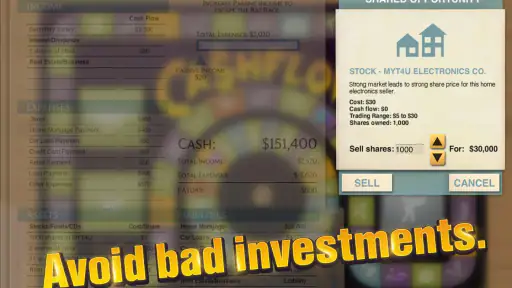
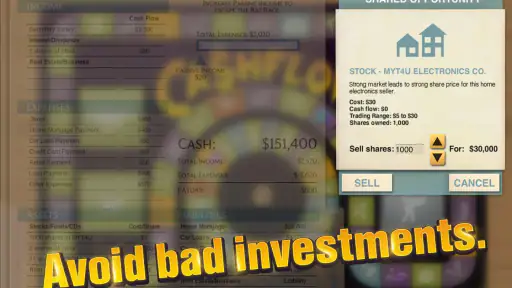
The financial statement is one of the more useful elements because it gives the decisions a record to refer back to. Rather than judging a move only by whether it seemed exciting at the time, I can look at how it fits into the broader picture of income, expenses, and investments. A practical way to use that feature is to pause after a few choices and explain the result in plain language: what changed, what cost something, and what would need to happen next for the position to improve. That turns play into a small exercise in financial reasoning.
Still, I would not treat a simulated outcome as a personal plan. Real finances include individual obligations, uncertainty, and details a game cannot know about me. The useful takeaway is the habit of looking at relationships between money choices, not a promise that a strategy will work outside the game. If you are looking for current investment recommendations, help with taxes, or a tool to track your actual household budget, a dedicated service or a qualified professional is a better match.
Where it sits among other learning options
Compared with a personal-finance article or video, a game gives me a more active role: I have to make choices and follow their effects instead of simply consuming an explanation. That can help a newcomer stay engaged, especially if financial terminology feels intimidating. The trade-off is that games necessarily simplify. A book, course, or carefully chosen explainer may be better when I want a structured account of a topic or a deeper treatment of how it works in real life.
Compared with a budgeting app, this is a different kind of tool. A budget app is for organizing real income and spending; this game is for exploring financial ideas through play. I would not choose one as a replacement for the other. If my immediate goal is to understand where my paycheck goes, I would start with a real budget. If I want a more approachable way to think about income, expenses, and investment choices, the game is the more relevant option.
Gaming Stories You May Enjoy

Dancing Road Turns Short Breaks Into a Test of Rhythm and Timing

Super Stylist Makes Every Outfit a Test of Taste and Patience

Dominoes on Your Terms: Who Should Play and Who Should Pass

Pokémon GO Makes the Familiar World Feel New

Chess.com Turns Rematches Into Rivalries, but Community Has Its Costs

Archery Battle 3D Review: Sharp Aiming, Unclear Feedback
Practical details before you begin
The game costs $1.99, so I would treat the purchase as paying for an educational game rather than expecting a free utility or a complete finance course. It is rated for Everyone and needs Android 6.0 or later. Its current version is 2.0.27; the game was released on December 20, 2018. Those details are useful when checking whether it suits your device and household, particularly if a younger player will be involved. The age rating does not change the fact that an adult may need to explain financial terms and help separate game choices from real-world advice.
Its average rating is 3.7 from around three thousand ratings, and it has passed one hundred thousand installs. I take that as a sign of an established, modestly received game rather than a guarantee that every player will enjoy its pace or approach. I would go in expecting an educational simulation, not a polished replacement for a finance app. A useful first session is to focus on understanding the financial statement and the consequences of choices instead of trying to win quickly; that makes it easier to notice what the game is teaching.
Getting Started with CASHFLOW
First off, downloading and installing CASHFLOW is a breeze. Available on both Android and iOS, just head to your app store, and you’ll have it ready to go in no time. Once installed, you’re greeted with a sleek, user-friendly interface that’s both inviting and easy to navigate. It’s like stepping into a virtual classroom where learning about finance is actually enjoyable. Who would’ve thought?
Gameplay and Features
The app is designed to simulate real-life financial scenarios through gameplay. You start off by choosing a character with a specific profession, and your journey begins with managing monthly expenses, income, and investments. The goal? To increase your passive income and ultimately exit the rat race. It’s a bit like Monopoly but with a modern twist and real-life financial principles.
One of the coolest features is the interactive financial statement. This tool helps you track your progress and make informed decisions about your spending and investments. It’s a fantastic way to learn the ropes of financial management while having fun. The app also includes educational videos and tips, which are an absolute gem for those new to personal finance.
Why I Love CASHFLOW
What sets CASHFLOW apart is its ability to make a typically mundane subject exciting. It’s not just an app for number crunchers or financial gurus. It’s for anyone who wants to gain financial literacy without the boredom. The game-like approach makes it engaging, and before you know it, you’re learning complex financial concepts without even realizing it.
The community aspect is another plus. You can play with friends or join global games, which adds a social element and a bit of competitive spirit. It’s always fun to see who can escape the rat race first!
Final Thoughts
In a world where financial literacy is more important than ever, CASHFLOW provides a valuable resource for anyone looking to improve their financial acumen. Whether you’re a college student, a young professional, or someone planning for retirement, there’s something to gain from this app. Its educational yet entertaining approach makes it a must-have on your smartphone.
So, if you’re ready to take control of your financial future, give CASHFLOW a try. It might just be the fun and interactive tool you need to turn those financial dreams into reality!
Who will get the most from it
I would recommend it most to people who learn by making choices and talking through consequences. For example, a parent and teenager could use a session to discuss why income alone does not describe someone’s financial position. A student could play with a friend, then compare how their different decisions affected the picture shown in the financial statement. These conversations are where a simplified game can be surprisingly useful: it gives people a shared example without requiring anyone to disclose personal finances.
On the other hand, I would skip it if you want a quiet, practical tool for recording bills, building a real budget, or tracking investments you already own. It is also a weaker fit if you dislike games or want a thorough, linear course that explains each concept before asking you to apply it. The best expectation is modest but worthwhile: it can make financial topics more approachable and give you material to discuss, while leaving real-world planning to tools designed for that purpose.
A realistic way to use a session
Imagine you have a spare half-hour after dinner and want to learn something useful without turning the evening into homework. You could start a game with a friend, pay attention to the choices around income and expenses, and use the financial statement as a checkpoint rather than rushing through. When a result surprises you, stop and ask what caused it. Was the choice itself costly, or did it make sense only in combination with other decisions? That simple review is more valuable than treating the final outcome as a score to chase.
For a group, I would agree beforehand that the point is to compare reasoning, not to prove that one person has a better real-life financial approach. The game’s competitive element can make people eager to win; a quick discussion after each meaningful decision helps keep the focus on learning. If playing alone, I would jot down one question to look up afterward. That way the session becomes a starting point for learning, not an assumption that every simulated situation maps neatly onto ordinary finances.
How to judge the purchase and the fit
At $1.99, the decision is less about replacing a free budgeting tool and more about whether an interactive learning experience is worth paying for. The game has a 3.7 average across roughly three thousand ratings, with around one hundred ninety reviews, so I would read the general reception as mixed rather than universally enthusiastic. If you are unsure, consider what you want from it: a game you can use to explore financial ideas is a reasonable reason to buy it; access to personalized guidance or a reliable record of your own spending is not.
The Android minimum is version 6.0, and the age rating is Everyone. Those points make it easier to check basic suitability, but they do not answer whether the game’s style will suit a particular player. I would give it a first session focused on understanding the choices and the statement before deciding whether its approach clicks. If you find yourself interested in discussing why an outcome changed, it is doing its job for you. If you mainly want to skip the game and get a direct explanation, a book, course, or focused finance guide will probably be a better use of your time.
A balanced recommendation
My recommendation is to see this as a small, paid learning game with a specific purpose, not as a shortcut to financial independence. Its strongest case is for curious beginners and social learners who want to think about cash flow, expenses, and investments in a more active way. Its weakest case is for anyone who needs accurate, personalized financial management or expects the simulation to settle what they should do with real money.
The game’s premise gives a familiar subject a useful structure, and the financial statement offers a reason to reflect instead of simply clicking through. The limitations matter too: a simplified simulation cannot cover every circumstance, and its game format may not hold the attention of someone who prefers direct instruction. If those trade-offs suit what you are looking for, I think it is worth considering as an approachable way to start a conversation about money. If they do not, choose a budgeting or learning resource aimed squarely at your immediate goal.
СASHFLOW Pros and Cons
Pros
- User-friendly interface
- easy navigation.
- Comprehensive financial tracking tools.
- Real-time financial updates.
- Customizable budget categories.
- Secure data encryption.
Cons
- Limited free version features.
- Requires internet connection.
- Occasional app crashes.
- Complex initial setup for beginners.
- No offline mode available.
This Game in Other Languages
Frequently Asked Questions
What is the main purpose of the CASHFLOW app?
The CASHFLOW app is designed to help users manage their finances more effectively by simulating real-life financial scenarios. It aims to educate users about financial management, investment strategies, and wealth-building through interactive gameplay. By engaging with this app, users can learn how to make informed financial decisions and improve their financial literacy.
Is the CASHFLOW app suitable for beginners in finance?
Yes, the CASHFLOW app is suitable for beginners. It provides a user-friendly interface and educational content tailored for those new to financial concepts. The app simplifies complex financial theories and practices into easy-to-understand gameplay, making it an excellent starting point for anyone looking to enhance their financial knowledge and skills.
Does the CASHFLOW app offer real financial advice?
While the CASHFLOW app provides educational insights into financial management and investment strategies, it does not offer personalized financial advice. The app is primarily a learning tool designed to simulate financial scenarios. Users should seek professional financial advice for specific personal finance concerns or decisions.
Can I use the CASHFLOW app offline?
The CASHFLOW app requires an internet connection for initial download and updates, but some features may be accessible offline. However, for the best experience, including accessing the latest content and community features, a stable internet connection is recommended. Users should check the app's specifications for detailed offline capabilities.
Is there a cost associated with using the CASHFLOW app?
The CASHFLOW app may offer a free version with basic features, but premium features might require a subscription or one-time purchase. Users should review the pricing details within the app to understand what is included in the free version and what additional features are available through paid options. This ensures they can make an informed decision based on their budget and needs.


