Gin Rummy: Classic Card Games
- Reviews
- 4.7
- Version
- 1.07.00
- Installs
- 1,000,000+

Screenshots
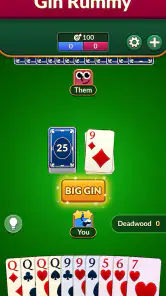
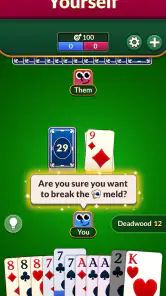
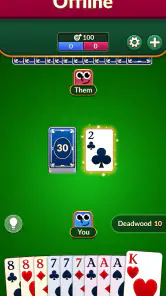

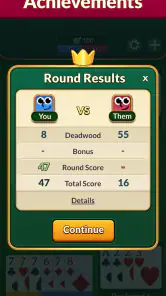
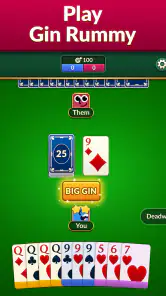
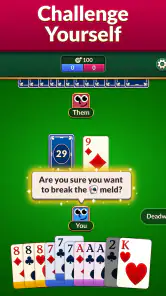
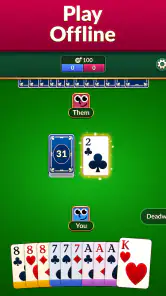
 Gin Rummy: Classic Card Games Analyzed by the Frivlyz team
I enjoy card games most when they are easy to start but still reward careful thinking, and Gin Rummy: Classic Card Games fits that description well. It is a free card game from Tripledot Studios Limited that focuses on Gin Rummy rather than trying to become a huge collection of unrelated modes. That narrow focus is part of its appeal: I can open it when I have a few spare minutes, understand the objective immediately, and concentrate on arranging my hand, reading the discards, and deciding when to knock.
My overall impression is of a straightforward mobile version aimed at people who already know Gin Rummy or want a gentle way to learn it. The game is listed for Everyone and runs on Android devices using version 6.0 or later, which makes it approachable for many older phones and tablets. It was released on January 23, 2025, and the current version is 1.07.00. Those details matter less than how the game feels in ordinary use, but they give a useful picture of a relatively recent, accessible card title rather than an old app kept alive only for a small audience.
The store page presents it as a classic card game to play with friends, and that idea is important when deciding whether it suits you. I would recommend it to someone looking for focused Gin Rummy sessions, especially if they prefer a clean card-table experience to a busy game packed with events and distractions. I would not choose it for a player who needs a deep competitive ladder, a large collection of card variants, or action-heavy entertainment. Its strength is concentration, not spectacle.
How Gin Rummy feels in everyday play
Quick sessions without a heavy start-up routine
The most noticeable advantage is the low mental and practical barrier to a round. A game of Gin Rummy has a familiar rhythm: draw, improve the hand, discard, and watch for opportunities to finish with useful combinations. That makes it a good choice for a short break, a quiet evening, or a few rounds while waiting for an appointment. I do not need to learn a complicated control scheme, and the card format naturally works on a touchscreen.
Speed in this kind of game is not only about how quickly a screen opens. It is also about how quickly I can understand what deserves attention. The hand is always the center of the experience, so I spend my time considering sequences, sets, deadwood, and the information revealed by discarded cards. That focused design feels faster than a more elaborate card app that surrounds a simple match with several layers of menus.
There is a useful distinction between a fast game and a shallow game. Gin Rummy can be played quickly, but good decisions still require patience. I may draw a card that looks helpful while holding on to a combination that is unlikely to improve. The temptation to knock early is another source of tension. A short session can therefore feel meaningful rather than disposable, provided I enjoy making small decisions instead of waiting for dramatic action.
For a realistic everyday example, I could play a round during a coffee break, stop after that hand, and return later without needing to remember a complicated campaign. It also works well as a relaxed two-player activity with a friend who already understands the rules. The trade-off is that people who want a game to fill a long commute with constant novelty may find the repeated structure too restrained.
Learning the rhythm instead of memorizing a large system
New players should expect the first few hands to be more about recognizing patterns than making perfect choices. The basic goal is familiar, but the difficult part is judging which cards to keep when several possibilities are open. A pair can become part of a set, while a neighboring card may help build a run. Holding both possibilities too long can leave the hand crowded with unhelpful cards.
My practical advice is to avoid treating every attractive card as valuable. A card is useful because it fits a realistic plan, not simply because it is close to another card in rank or suits. I also pay attention to what the other player discards. Picking up a visible card can reveal the direction of my hand, so sometimes the less exciting draw is strategically safer. That kind of observation gives the game more depth than its simple presentation suggests.
Another helpful habit is to decide what information I am willing to give away. Discarding a card that completes an obvious sequence for the opponent can be costly, even when it lowers my own deadwood. I do not need to calculate every possibility, but I do need to balance immediate improvement against the message my discard sends. This is one of the reasons I think the game suits thoughtful casual players better than people who play only by instinct.
What happens when the game is used repeatedly
During a single short session, the focused format is comfortable. The heavier test comes when I play several hands in succession. Gin Rummy does not have the natural variety of a broad card collection because the central rules remain the same. The enjoyment then depends on changing opponents, changing hands, and my own willingness to refine decisions. If I am chasing constant rewards or dramatic unlocks, repetition may become noticeable sooner.
On the other hand, repeated play is exactly where the strategic side becomes clearer. I begin to notice that a hand can be improved by reducing risk rather than chasing the highest possible combination. I also become more aware of timing: knocking immediately can protect a lead, while waiting can create a stronger finish but expose me to a sudden loss. This makes the game suitable for short practice sessions where the goal is to become more consistent, not simply to pass time.
For heavy use, I would treat it as a compact strategy game rather than an all-day destination. A few rounds can be satisfying, but long sessions may feel less varied than a multiplayer card platform with several games or a more feature-rich rummy app. That is not a flaw in the rules themselves; it is a limitation of choosing one classic format and keeping the experience focused.
Stability and the practical meaning of a recent version
The listed current version, 1.07.00, suggests that the app is being presented as an actively maintained release rather than a forgotten installation package. I still judge reliability by whether a game feels dependable when I open it, move through a hand, and return to it later. For a card game, stability matters because interruptions are especially annoying when they happen after several careful decisions.
I value a design that does not make a simple match feel fragile. A card game should let me concentrate on the hand instead of worrying about complicated setup. In ordinary use, the main expectation is a responsive turn-by-turn experience with clear interaction, not a demanding visual showcase. If a player is choosing this title for casual Gin Rummy, the important question is whether the basic loop remains comfortable over many visits.
Recovery is also worth considering in practical terms. A short hand is easier to resume mentally than a long story mission, but losing the context of a match can still be frustrating. I therefore prefer to begin a session when I have enough uninterrupted time to finish a hand, particularly when playing with another person. The compact nature of Gin Rummy reduces the cost of an interruption, but it does not remove it entirely.
I would avoid making the game part of an important competitive routine until I had used it enough to understand how it behaves on my particular device and connection. That is sensible for any online-oriented card experience, and especially so when playing with friends. For relaxed play, the stakes are lower: an interrupted round is inconvenient, but it is not a major loss.
Older phones, storage, and battery expectations
The minimum operating system requirement of Android 6.0 is a positive sign for people using older compatible hardware. It does not guarantee identical performance on every phone, because processor age, available memory, screen size, and background activity still matter. A newer device should have an easier time handling a simple card table, while an older phone may show its limitations when many other apps are open.
From a resource perspective, this is the kind of game I would expect to be less demanding than a modern three-dimensional title. The play area is based on cards and turn-based interaction rather than constant animation or a large world to render. That makes it a reasonable candidate for a modest Android device, especially for someone who wants a game that does not feel like a major gaming commitment. I would still close unnecessary background apps if the phone is already struggling.
Battery use should also be easier to manage than with an action game that keeps the processor and display busy at high intensity. However, a bright screen, weak battery, or unstable connection can affect any mobile session. I would not install it solely because I expect zero resource use. The better conclusion is that its card-focused design should make it a comparatively sensible choice for casual play on a broad range of Android hardware.
The Everyone content rating makes it suitable for a general audience, including families looking for a simple card game. That does not mean every family will prefer it: younger players may need help understanding Gin Rummy strategy, while older players who already know the physical game may care more about the quality of the digital interactions. The rating tells me the subject matter is broadly accessible, not that every player will find the learning curve identical.
Playing with friends versus choosing a different card app
The strongest reason to choose this game is its direct connection to Gin Rummy. If I want that particular game and would like to play with friends, a focused app is more convenient than a general card collection where Gin Rummy is buried among solitaire, poker, or other formats. The narrow purpose also makes it easier to recommend to a friend: we both know what kind of session we are starting.
A general rummy app may be better for someone who wants several regional rule sets or a larger social environment. A traditional physical deck remains better when the group is sitting together and wants conversation to be part of the experience. A solitaire app is a better alternative for solo play without another participant, while a more competitive card platform may suit players who want rankings and a stronger sense of progression.
What I like here is the reduction of clutter. What I miss, compared with broader alternatives, is variety. A focused Gin Rummy title has to make the core decisions satisfying because it cannot rely on many unrelated modes to keep attention. That is a fair trade if I already enjoy the rules. It is a poor trade if I am still searching for a card app that offers something different every few minutes.
Who will get the most from it
I think this game is best for three kinds of players. First, it suits people who already know Gin Rummy and want a convenient digital table. Second, it works for beginners who are willing to learn through repeated hands rather than expecting an elaborate tutorial journey. Third, it fits friends who want a light competitive activity that can be played in short sessions without the commitment of a larger multiplayer game.
I would be more cautious recommending it to someone who dislikes turn-based games. The pace depends on waiting, observing, and making a choice, so there is no way to replace that deliberate rhythm with rapid tapping. I would also steer away players who need a large catalogue of cards, constant visual rewards, or an expansive progression system. The game’s identity is its simplicity, and that simplicity will feel either refreshing or limited depending on what you want from mobile entertainment.
The free price makes trying it relatively easy for anyone who meets the device requirement. The audience reach is already substantial, with over a million installs, and its average rating is 4.7 from around 7.1 thousand ratings. Those figures suggest that the basic concept is connecting with many players, although popularity should not replace personal testing. A player who loves Gin Rummy will probably understand the appeal quickly; someone indifferent to the rules may not be persuaded by the audience size.
My performance verdict
After looking at the game as a practical mobile experience, I see it as a focused and approachable way to play Gin Rummy rather than a technically ambitious card platform. Its likely strengths are the light structure, the modest demands of a turn-based card format, and the fact that a session can fit naturally into everyday gaps. The most important limitation is also clear: the same focus can become repetitive for players who need frequent new modes or a larger competitive ecosystem.
I would install it if I wanted Gin Rummy specifically, especially for occasional games with friends or for practicing the small decisions that separate a lucky hand from a well-managed one. I would approach every round by watching discards, avoiding unnecessary commitment to weak combinations, and deciding whether speed or a stronger hand matters more in that moment. Those habits make the experience more rewarding than simply drawing cards and hoping for a lucky finish.
My recommendation is positive, with a clear condition: choose it for focused Gin Rummy, not for endless card-game variety. Tripledot Studios Limited has placed the classic rules at the center, and that is enough for a satisfying casual game when the format matches your taste. If you want a compact, free card game for an Everyone-rated audience and your Android device supports version 6.0 or later, this is an easy option to try. If you need broad variety, deep progression, or the atmosphere of a real table, another kind of card experience will serve you better.
In the end, I appreciate that the game does not need to pretend to be something larger than it is. It gives Gin Rummy room to work: draw carefully, read the opponent, manage deadwood, and decide when to finish. For me, that makes it a useful companion for short sessions and a pleasant way to keep the classic format close at hand. Gin Rummy: Classic Card Games is at its best when I want a calm, readable match with just enough strategy to make every discard matter.
Gin Rummy: Classic Card Games Pros and Cons
Pros
- Simple rules make it easy for beginners to start playing.
- Classic gameplay works well for short
- casual sessions.
- Offline play is useful when you have no internet connection.
- Clean card layouts make melds and discards easy to follow.
- Adjustable difficulty offers a challenge as your skills improve.
Cons
- Computer opponents may feel predictable after extended play.
- Ads can interrupt the experience
- especially in the free version.
- Limited game variety may reduce long-term replay value.
- Some features may require in-app purchases to unlock fully.
- Small screens can make card selection awkward on some phones.
Frequently Asked Questions
What is Gin Rummy: Classic Card Games?
Gin Rummy: Classic Card Games is a mobile version of the traditional two-player card game, designed for quick matches against computer opponents or, depending on the available mode, other players. The main objective is to organize your hand into sets and runs while minimizing unmatched cards. It is suitable for beginners, although understanding melding, knocking, and scoring makes the experience much easier.
How do you play Gin Rummy: Classic Card Games?
At the beginning of each round, you receive a hand of cards and draw one card before discarding another. You try to form sets, such as three cards of the same rank, and runs, such as consecutive cards in the same suit. When your unmatched cards have a low enough value, you may knock, or you can aim for gin by arranging your entire hand into valid combinations. The winner is determined by the final score.
Can I play Gin Rummy: Classic Card Games offline?
The game is generally well suited to offline play when you want a quick match without relying on a constant internet connection, particularly when playing against built-in opponents. However, online features, advertisements, cloud synchronization, leaderboards, or competitive events may require connectivity. Before traveling or disabling mobile data, it is worth checking which modes remain available offline on your specific Android or iOS version.
Is Gin Rummy: Classic Card Games free to download?
Gin Rummy: Classic Card Games is typically available as a free download, allowing players to try the basic gameplay without paying upfront. Like many free card games, it may include advertising, optional in-app purchases, premium features, or items that improve convenience rather than changing the core rules. Always review the store listing and purchase settings before downloading, especially if children use the device.
Is Gin Rummy: Classic Card Games suitable for beginners?
Yes, the game can be a good starting point for players who are unfamiliar with gin rummy because digital opponents, automatic card handling, and clearly presented turns make the rules easier to follow than with a physical deck. New players should still spend time learning how scoring, deadwood, undercutting, and the difference between knocking and going gin work before entering more competitive matches.