Boost Rider: Car Racing Games
- Reviews
- 4.5
- Version
- 1.0.16
- Installs
- 1,000,000+

Screenshots



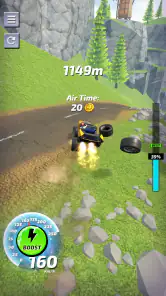



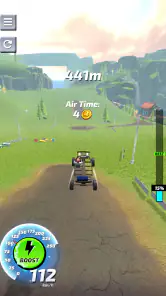
 Boost Rider: Car Racing Games Analyzed by the Frivlyz team
I went into Boost Rider: Car Racing Games expecting a quick racing distraction, but its central idea gives it a different rhythm from a conventional track racer. Instead of simply steering around a circuit, I build a car, choose when to launch it from a slingshot, and try to turn each attempt into a controlled burst of speed. That makes the game feel closer to a series of short experiments than a traditional race from start to finish.
That distinction matters if you are deciding whether to install it. This is a free racing game from Estoty, rated for Everyone, and it suits players who like immediate action, simple goals, and the satisfaction of improving a launch. It is less suitable if you want realistic driving, deep simulation, or long competitive races where careful cornering is the main skill.
The game has already reached over a million installs and holds a 4.5 average from around sixteen thousand ratings. Those figures suggest that its quick, accessible format has found an audience, but they do not tell you whether the unusual launch mechanic will fit your taste. After spending time with it, I would describe it as an easy game to start and a surprisingly fussy one to master.
What the first session really feels like
The opening minutes are deliberately approachable. You are not asked to learn a complicated control scheme before seeing any action. The basic appeal is visible almost immediately: prepare a custom ride, release it with momentum, and watch how well your choices translate into movement. That quick loop is the strongest reason to try it during a short break.
I also like that the concept gives each attempt a clear question. Should I focus on a stronger launch, improve the car, or change the way I approach the next run? Even when an attempt is not successful, the result usually points toward one of those decisions. That is more engaging than a racer where failure simply means repeating the same lap.
At the same time, the game should not be mistaken for a full driving simulator. The emphasis is on timing, momentum, and upgrading or shaping a ride rather than reproducing the weight and handling of a real vehicle. If your favorite mobile racers are built around realistic braking points and detailed circuits, this will feel intentionally playful instead of authentic.
My first useful tip is to resist treating every launch as a race that must be won immediately. Early attempts are better used as tests. Watch what happens after the initial release, notice whether the car loses momentum quickly, and then change one thing at a time. If you alter everything between attempts, it becomes difficult to understand which choice actually helped.
Getting ready without overthinking the install
The current release is version 1.0.16 and requires Android 12 or later. That requirement is worth checking before you plan a download, especially if you are using an older phone that still handles other racing games comfortably. On a compatible device, the free entry point makes it easy to try the core loop without committing money first.
There are in-app purchases ranging from $1.99 to $59.99 per item. I would keep that in mind before getting attached to rapid progression. A sensible first session is one where you learn the controls and decide whether the launch-and-build structure is enjoyable on its own. Buying something early may make progress feel quicker, but it can also hide whether your decisions are improving or whether you are simply moving forward through spending.
The age rating of Everyone makes the game approachable for a broad audience. In practical terms, that means it can work as a casual game for a younger player, a family member who does not normally play racers, or an adult looking for something that does not demand a long uninterrupted session. I would still supervise purchase settings on a shared device, particularly because the available items cover a wide price range.
Estoty presents the game as a racing title, but I would set expectations around its unusual structure before handing it to someone who wants a familiar car game. The most helpful explanation is simple: you are not mainly navigating a conventional course; you are trying to make a launch and build a better result from it. That one sentence prevents much of the initial confusion.
Finding the first meaningful success
For a first-time player, the first meaningful success is not necessarily the biggest distance or the fastest result. It is the moment when you deliberately adjust your approach and see a better outcome. I recommend making a baseline attempt first, without worrying about optimizing it. Then, on the next attempt, change only the launch timing or the car choice available to you and compare the result.
This method turns the game into a small learning exercise. You begin to separate a poor launch from a weak vehicle setup, rather than blaming the whole game when a run falls short. That is one of the less obvious strengths of the design: the short attempts make experimentation cheap. You can test an idea, see the consequence, and try again without losing a large amount of time.
When I play this kind of loop, I find it tempting to tap quickly and restart whenever the opening feels imperfect. That is usually a mistake. Let a mediocre attempt continue long enough to see how the car behaves after the launch. Sometimes the useful information is not at the start but in the way momentum fades. Learning that pattern helps you make better choices than simply chasing a perfect opening.
Another practical habit is to keep your upgrades or adjustments purposeful. If the game presents several ways to improve the ride, choose the one that addresses the problem you actually observed. A car that launches well but loses energy quickly needs a different response from one that never gets a clean start. This sounds obvious, yet the fast pace encourages random choices, and random choices make progress feel less predictable.
That is where I think the game is strongest for beginners. It gives immediate feedback without demanding that you understand every possibility at once. You can play for a few minutes, identify one weakness, and return later with a specific goal. The experience becomes more satisfying when you treat each run as a small piece of information rather than a verdict on your skill.
Where new players can get confused
The slingshot launch is the main source of both fun and friction. Players coming from standard racers may instinctively look for steering as the dominant action, then wonder why the opening decision has such a large effect on the result. The launch is not just a dramatic animation before the real game begins; it is the foundation of the attempt.
I would also avoid assuming that a more powerful-looking ride automatically solves every problem. A vehicle can feel better in one part of the run and still produce disappointing results if the launch is poorly judged. The useful question is not “Which car looks strongest?” but “Which choice helps with the weakness I keep seeing?” That change in thinking made my sessions more consistent.
Progress can feel uneven if you expect every attempt to improve. Some runs will be worse even after a sensible adjustment, because timing and setup work together. I found it more helpful to judge progress over several attempts instead of reacting to one result. This is especially important for younger or less experienced players, who may interpret a single failed run as evidence that they are doing everything wrong.
The free-to-play structure can create another point of hesitation. Since purchases are available, a player may wonder whether the game is asking for payment to remain enjoyable. My advice is to play long enough to understand the basic loop before considering any purchase. If the launch mechanic itself does not feel satisfying, spending will not fix that fundamental mismatch. If it does feel satisfying, you can make a calmer decision about whether convenience is worth paying for.
I would skip this game if you need precise lap racing, a serious car collection, or a strong simulation feel. It is also not the best choice for someone who dislikes repeating short attempts to refine timing. A conventional arcade racer may be better when you want clear steering, recognizable tracks, and a more traditional sense of competition.
How it fits into an ordinary day
Its best everyday use case is a short waiting period. Imagine having a few minutes before an appointment or while taking a break from work. You can make a handful of attempts, focus on one improvement, and stop without feeling that you have abandoned a long race. The game’s structure respects brief sessions better than racers that require several minutes of uninterrupted concentration for one complete event.
It can also work as a low-pressure introduction to racing games. Someone who finds conventional steering difficult can begin by concentrating on the launch and the relationship between the car and its momentum. That does not make the game effortless, but it removes some of the intimidation associated with managing a full circuit, braking, and turning at the same time.
On the other hand, the same short-loop design may become repetitive for players who need constant environmental variety or a strong sense of head-to-head competition. The appeal depends on whether you enjoy polishing a result through small decisions. If you need every session to introduce a new track or a different opponent, the central loop may feel narrow.
I would also be cautious about recommending it as a background game while distracted. The controls may be simple, but launch timing still matters. Playing while watching something else can turn the experience into random tapping, which removes the part that makes the game interesting. It is casual, but it is not completely mindless.
Making the next step worthwhile
Once the first successful run is behind you, set a concrete target for the next few attempts. You might aim to improve the opening, understand why momentum drops, or test whether a different ride handles your preferred approach better. A narrow target keeps the progression understandable and prevents the customization from becoming a menu of unexplained choices.
I recommend keeping a mental note of what changed between a good run and a poor one. You do not need a written spreadsheet; simply remember whether the difference came from timing, the selected car, or an adjustment made before launch. This small habit is valuable because the game’s quick pace can otherwise make every result blur into the next.
There is also a trade-off between experimentation and efficiency. Trying unusual combinations may produce a slower short-term result, but it teaches you more about how the game responds. Repeating the safest setup may improve your score more quickly, yet it can leave you unprepared when that setup stops being effective. I prefer alternating the two: use a reliable approach when I want progress, then spend a few attempts testing something different.
Players who enjoy customization should give themselves time to understand the effect of each change rather than judging it by appearance. The phrase “custom ride” sounds broad, but the useful value comes from connecting a change to an observed behavior. That is the difference between meaningful tuning and simply selecting whatever looks most impressive.
For families, I would introduce the game by playing alongside a child and asking what they think caused a result. That turns the repeated attempts into a simple lesson in cause and effect. It is more rewarding than taking over the controls, and it helps the player understand that a failed launch is useful feedback rather than a reason to quit.
My recommendation after learning its rhythm
After getting used to its structure, I see Boost Rider: Car Racing Games as a focused casual racer with a clear identity. Its best qualities are the fast restart cycle, the unusual launch mechanic, and the way small adjustments can make each attempt feel like a test. It does not need a complicated presentation to create a reason for one more try.
The limitations are just as clear. It will not replace a traditional track racer for players who want steering precision, realistic handling, or lengthy events. The repetition can also wear thin if you do not enjoy refining the same basic action. In-app purchases deserve a measured approach, particularly for anyone who prefers to progress without spending or who shares a device with children.
Still, I think it is worth trying if you want a free racing game that works in short sessions and gives you something specific to learn. Install it when you are in the mood for quick experiments, not when you are searching for a complete motorsport simulation. Start with one baseline launch, change one factor, and let the result teach you what to do next.
That is the path I would recommend to a friend: begin slowly, do not rush toward purchases, and judge the game by whether improving a launch feels satisfying. If that small cycle of preparation, release, observation, and adjustment clicks with you, Estoty’s game can become an enjoyable pocket challenge. If you want the road itself to be the main event, a more conventional racing alternative will probably serve you better.
For its intended audience, the current version offers a straightforward entry into a distinctive kind of mobile racing. The key is to play it as a momentum-and-decision game, not as a standard steering racer. Once that expectation is in place, the first session becomes clearer, the early mistakes feel less frustrating, and the next improvement is usually easier to find.
Boost Rider: Car Racing Games Pros and Cons
Pros
- Fast-paced races are easy to start and enjoyable in short sessions.
- Simple controls make the game accessible for casual players.
- Vehicle upgrades add a satisfying sense of progression.
- Bright visuals and energetic effects give races a lively feel.
- Multiple cars encourage experimentation with different play styles.
Cons
- Gameplay can become repetitive after extended play sessions.
- Some upgrades may require considerable grinding to unlock.
- Frequent ads can interrupt the racing experience.
- Touch controls may feel imprecise during sharper turns.
- Limited depth may disappoint players seeking realistic racing physics.
Frequently Asked Questions
What is Boost Rider: Car Racing Games?
Boost Rider: Car Racing Games is an arcade-style mobile racing game focused on fast driving, short races, and action-packed challenges. Players can control cars through different tracks, avoid obstacles, collect useful items, and use boosts to improve their performance. It is designed for casual play, making it suitable for users who want quick racing sessions rather than a highly realistic driving simulator.
How do you play Boost Rider: Car Racing Games?
The gameplay is generally based on controlling your vehicle while maintaining speed, steering around obstacles, and collecting rewards along the track. Depending on the mode, you may need to finish first, travel as far as possible, or complete specific objectives. Boosts are especially important because using them at the right moment can help you overtake rivals, escape hazards, and achieve better scores.
Is Boost Rider: Car Racing Games free to download and play?
Boost Rider: Car Racing Games can typically be downloaded without an upfront purchase, allowing players to try the main racing experience for free. However, availability of advertisements, optional purchases, extra vehicles, upgrades, or other in-game items may vary according to the version and platform. Before downloading, check the official store listing for current pricing, supported purchases, and any additional requirements.
Does Boost Rider: Car Racing Games require an internet connection?
The internet requirements may depend on the features included in the installed version. Basic races may work offline, which is convenient for playing while traveling or when mobile data is unavailable, but advertisements, online rankings, updates, or certain reward systems may require a connection. It is best to launch the game once while connected and test which modes remain accessible offline.
Is Boost Rider: Car Racing Games suitable for children and casual players?
The game is generally approachable for casual players because its racing mechanics are easier to understand than those of a realistic simulator. Children may enjoy the colorful presentation and quick races, but parents should review the age rating, advertising, privacy information, and possible in-app purchases before installation. If the game includes competitive features or frequent ads, supervision may be useful for younger players.