7 Little Words and More
- Reviews
- 4.7
- Version
- 8.15.2
- Installs
- 1,000,000+

Screenshots
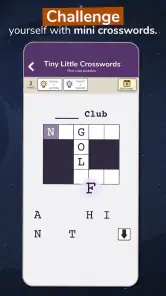
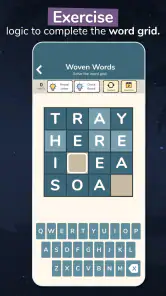
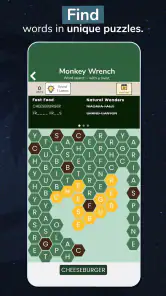
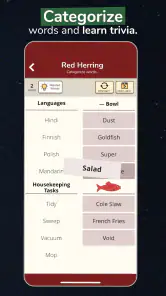
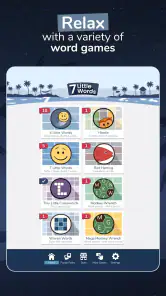
 7 Little Words and More Analyzed by the Frivlyz team
I enjoy word games that give me something to think about without demanding a long, uninterrupted session, and 7 Little Words fits that mood unusually well. It is a free word game from Blue Ox Family Games, Inc. built around short daily puzzles, but it does not feel like a simple anagram exercise. Each puzzle asks me to connect clues with groups of letter chunks, so the challenge comes from vocabulary, deduction, and recognizing how words are assembled.
That combination makes it easy to recommend to someone who likes crosswords but wants a more compact format. I can open it while waiting for coffee, solve a few clues, and put it away without losing the thread of a large board. At the same time, it is not effortless entertainment. Some clues require patience, and the game can become surprisingly stubborn when I know the meaning of an answer but cannot see which pieces create it.
How the current game feels to play
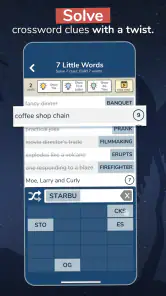
The central idea is simple: solve seven clues by combining small groups of letters. The clues are usually brief, while the available chunks act as a second layer of information. I am not merely searching for synonyms; I am checking whether a possible answer can be built from the pieces on screen. That extra restriction is what gives the game its identity.
In practice, I usually begin with the clues that have the clearest meaning. A familiar answer can reveal several letter groups and reduce the number of possibilities for the harder clues. When I get stuck, I switch from thinking about definitions to examining the chunks themselves. A distinctive ending or a common word root can point toward an answer that did not immediately come to mind.
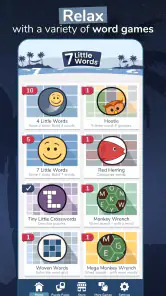
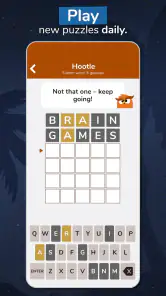
The daily format is a strong part of the experience. It creates a natural stopping point instead of encouraging endless scrolling through a large collection of similar boards. I like that rhythm because it turns the game into a small routine rather than another app that competes for all of my free time. The store summary describes a variety of daily word games, and that variety is important: the appeal is not just solving one isolated puzzle, but returning to see what the next challenge feels like.
It is also suitable for casual shared play. I have found that a clue can become easier when another person approaches it from a different angle. One player may focus on the definition while another notices a useful letter combination. That makes it a pleasant choice for a quiet conversation, although people who prefer completely private, uninterrupted solving may find discussion distracting.
A better way to approach difficult clues
My most useful habit is to avoid spending too long on the clue that feels most obvious. A clue can appear familiar while still allowing several answers, and forcing that answer too early may waste the chunks needed elsewhere. I now look for the most constrained answer first: a long word, an unusual ending, or a clue with a very specific meaning. Solving that one often makes the rest of the puzzle much more manageable.
Another practical technique is to treat the letter groups as evidence rather than leftovers. If a chunk looks like a common prefix, suffix, or short connecting sound, I test words that use it naturally. This is especially helpful when the clue is broad. Instead of asking only, “What word means this?” I ask, “Which word with this meaning can actually be built from these pieces?” That small change prevents a lot of unproductive guessing.
I also recommend taking a short break before using help. A few minutes away from the screen can make a familiar word suddenly visible, while repeatedly staring at the same arrangement tends to narrow my thinking. For players who want a relaxed vocabulary workout, that pause-and-return pattern is part of the fun. For players who expect every puzzle to yield instantly, it may feel like unnecessary friction.
Who will get the most from it
This is a good match for people who enjoy wordplay but do not necessarily want a full crossword grid. The compact structure makes it approachable for occasional players, while the combination of clues and letter groups gives experienced word-game fans enough resistance to stay interested. It can also work well for anyone trying to build a small daily mental habit around vocabulary and deduction.
I would be more cautious recommending it to someone who dislikes ambiguity. Some clues can be interpreted in more than one reasonable way, and the intended answer may not be the first word a player associates with the definition. That is not a flaw in the concept, but it does mean the game rewards flexibility more than strict, literal clue reading.
It is also not the best choice for someone seeking a competitive multiplayer experience, a story-driven adventure, or a visually elaborate game. The attraction here is the puzzle itself. Players who need constant novelty, action, or social progression may find the daily word format too restrained.
What the developer’s ongoing version means for players
Blue Ox Family Games, Inc. has kept the game available as an established word-play option since its release on August 9, 2011. The current version is 8.15.2, which suggests a product that has continued to be maintained rather than left as a one-time experiment. I see that longevity as reassuring for anyone who values a familiar daily routine, although a long-running app can also feel less radical than newer puzzle games that frequently redesign their format.
The most important effect of ongoing maintenance is continuity. Existing players can return to the same basic style of solving without having to relearn an entirely different game. That matters with a puzzle app because the appeal often comes from the ritual: open it, understand the board quickly, and get straight to the clues. A stable structure is a benefit when the goal is a dependable daily challenge.
At the same time, version numbers alone should not be treated as proof of a dramatic transformation. What I notice most is the continued focus on the established word-game formula rather than a complete reinvention. That is good news for fans of the original idea, but it may disappoint players hoping for a radically different mode or a large change in how puzzles are solved.
The game is free to install and carries an Everyone age rating, so it is easy to try without committing money up front. In-app purchases range from $0.99 to $39.99 per item. That makes it important to approach the app with a clear personal limit, especially if I am tempted to use assistance repeatedly on difficult puzzles. The free entry point is generous for testing the experience, but the optional spending can change how comfortable the game feels for people who prefer a completely unrestricted free experience.
Its reach is substantial: the game has passed one million installs, with an average rating of 4.7 from around 140 thousand ratings and roughly 44 thousand written reviews. Those figures do not replace personal testing, but they do indicate that the format has found a durable audience. I would interpret that as evidence of broad appeal, not as a guarantee that every player will enjoy the clue style.
How it fits into an everyday routine
A realistic use case is a short break during a busy day. I might have ten minutes before an appointment, open the game, solve the easiest clues first, and leave the remaining ones for later. Because the puzzle is divided into recognizable clue-sized tasks, I do not need to reserve an entire evening for it. That makes it more practical than many traditional crossword apps when I want a quick mental reset.
There is also a useful difference between playing alone and playing with someone else. Alone, I can work methodically and enjoy the satisfaction of finding a word without interruption. With a friend or family member, the clues become conversation starters. One person may know the vocabulary while another is better at spotting combinations of letter groups. The game naturally supports that kind of informal cooperation without requiring a formal multiplayer system.
For parents considering it for a child, the Everyone rating makes it a more comfortable candidate than many games built around mature themes. Still, the practical suitability depends on reading ability and vocabulary. A younger player may understand a clue but lack the word knowledge needed to solve it, while an older child may enjoy the challenge as a shared activity. I would treat it as a game to play together when necessary, not automatically as a puzzle every child will handle independently.
Where it differs from familiar alternatives
Compared with a standard crossword, this game removes the large grid and the need to manage intersecting answers. That makes the presentation cleaner and the sessions shorter. The trade-off is that crossing letters in a crossword can provide a powerful safety net. Here, I have to rely more heavily on the clue and the available chunks, so a single uncertain answer can remain uncertain for longer.
Compared with a basic anagram game, it offers more direction. I am not simply rearranging a random collection of letters into any word I can find. The clue gives me a target, while the pieces confirm whether my idea is viable. This creates a more deliberate solving process, though players who love free-form word hunting may prefer the looser rules of an anagram board.
Compared with a daily guessing game built around one word, the seven-clue structure gives me more room to recover from a bad start. If one clue is difficult, I can work on the others and return later. That is one of its quiet strengths. The challenge is spread across a small set of answers rather than concentrated entirely in a single guess, so a disappointing first attempt does not necessarily end the session.
On the other hand, players who want a huge archive of puzzles, a detailed progression map, or a strongly competitive score chase may prefer a different word-game style. This title’s appeal is its focused daily rhythm and its distinctive use of letter groups. It is better at creating a thoughtful pause than at delivering a long-term achievement system that constantly pushes me forward.
The friction points I would consider first
The biggest limitation is that the game can become dependent on vocabulary familiarity. When I do not know a word, clever deduction may not be enough. The letter groups can narrow the field, but they cannot always teach me the answer in a satisfying way. That can make a difficult puzzle feel educational for one player and arbitrary for another.
Clue interpretation is another source of tension. A short clue has to carry a lot of weight, and a player may imagine a perfectly valid answer that is not the intended one. The game becomes more enjoyable when I accept that clues may require lateral thinking, but that learning curve is real. Someone who expects dictionary-style precision may become frustrated before appreciating the broader wordplay.
The purchase structure deserves attention as well. The game is free, but optional items can cost from $0.99 up to $39.99 each. I would avoid treating hints as the default response to every obstacle. Solving the puzzle is the main reward, and frequent assistance can weaken that reward while also making the overall experience feel less predictable financially.
Device compatibility is straightforward for current users: the listed minimum operating system is version 10. Before installing on an older device, I would check that it meets that requirement. For most people using a relatively recent Android or iOS device, this should not be a major concern, but it is still a practical detail worth checking rather than assuming every phone can run it.
What I would watch as the game continues
For existing players, the key question is whether future maintenance continues to preserve the quick, readable solving experience. A word game benefits from consistency, but it also needs enough freshness to keep the daily habit from becoming mechanical. I would pay attention to how well new content, puzzle variety, and any interface adjustments support that balance.
I would also watch how the game handles the relationship between challenge and assistance. Hints can make a puzzle accessible when I am genuinely stuck, but too much dependence on them can change the tone from satisfying deduction to guided completion. The best experience is one where help remains a safety net rather than the central route through every board.
For new users, my advice is to try it during a calm moment rather than judging it from one rushed session. The game reveals its strengths after I learn to combine clue meaning with the letter groups. Give the easier answers priority, leave stubborn clues alone temporarily, and return with fresh eyes. That workflow makes the design feel much more coherent than simply guessing at every possible synonym.
My recommendation after spending time with it
I consider 7 Little Words a strong choice for anyone who wants a compact, thoughtful word game with a dependable daily structure. Its best idea is the interaction between short clues and constrained letter pieces: neither element is especially complicated alone, but together they create puzzles that are easy to start and capable of slowing me down.
The game is not ideal for players who want action, deep social features, or a completely free experience without optional purchases. It can also test patience when a clue feels broad or a required word is outside my vocabulary. Those limitations are worth accepting only if I enjoy the process of reasoning through language rather than needing constant, effortless success.
For me, the long-running release history, current version 8.15.2, free starting point, and established audience make it an easy app to try. I would approach the purchase options carefully, use hints sparingly, and treat the daily puzzles as a small routine instead of a game to rush through. If that sounds appealing, this is one of the more distinctive ways to spend a few quiet minutes with words.
7 Little Words and More Pros and Cons
Pros
- Short daily puzzles fit easily into a coffee break.
- Clues encourage flexible thinking instead of simple word recall.
- Multiple puzzle packs provide plenty of variety.
- Hints are available when a clue becomes especially difficult.
- Clean design makes the game comfortable to play on phones.
Cons
- Some puzzle packs may require an additional purchase.
- Difficulty can vary noticeably from one puzzle to the next.
- Players may encounter repeated word patterns over time.
- The game can feel slow if you prefer fast-paced challenges.
- Progress may be limited when offline features are unavailable.
Frequently Asked Questions
What is 7 Little Words and More?
7 Little Words and More is a word-puzzle game built around short, clue-based challenges. Each puzzle usually presents a set of definitions and a collection of letter groups that must be combined to form the correct answers. The format is easy to understand but can become surprisingly challenging, making it suitable for quick sessions as well as longer play periods for people who enjoy vocabulary games.
How does the gameplay work?
In each puzzle, you read the clues and select letter tiles to create the requested words. A correct combination disappears or is marked as solved, while the remaining tiles help you work through the unsolved clues. There is no strict need to rush, so you can experiment with different combinations, use your vocabulary knowledge, and rely on the available hints when a clue proves especially difficult.
Can I play 7 Little Words and More without an internet connection?
Many puzzle features may be available offline, which is useful when traveling, commuting, or playing in places with a weak connection. However, online access can still be required for downloading new puzzle packs, synchronizing progress, displaying advertisements, or using certain optional features. Availability may vary by version and device, so it is best to open the game online at least once after installation.
Is 7 Little Words and More free to download and play?
The game can generally be downloaded without an upfront purchase, but free access may include advertisements, limited puzzle content, or optional in-app purchases. Depending on the version, players may be able to buy additional puzzles, remove advertising, or obtain hints. Before confirming a purchase, check the store listing and the in-game payment details, particularly if children also use the device.
Who would enjoy 7 Little Words and More?
7 Little Words and More is a good choice for players who enjoy crosswords, anagrams, trivia-style clues, and vocabulary challenges without complicated controls. It works well for short daily sessions because individual puzzles can often be completed quickly, while the growing difficulty provides longer-term interest. Players who dislike wordplay or prefer fast action games may find its thoughtful, slower pace less appealing.