

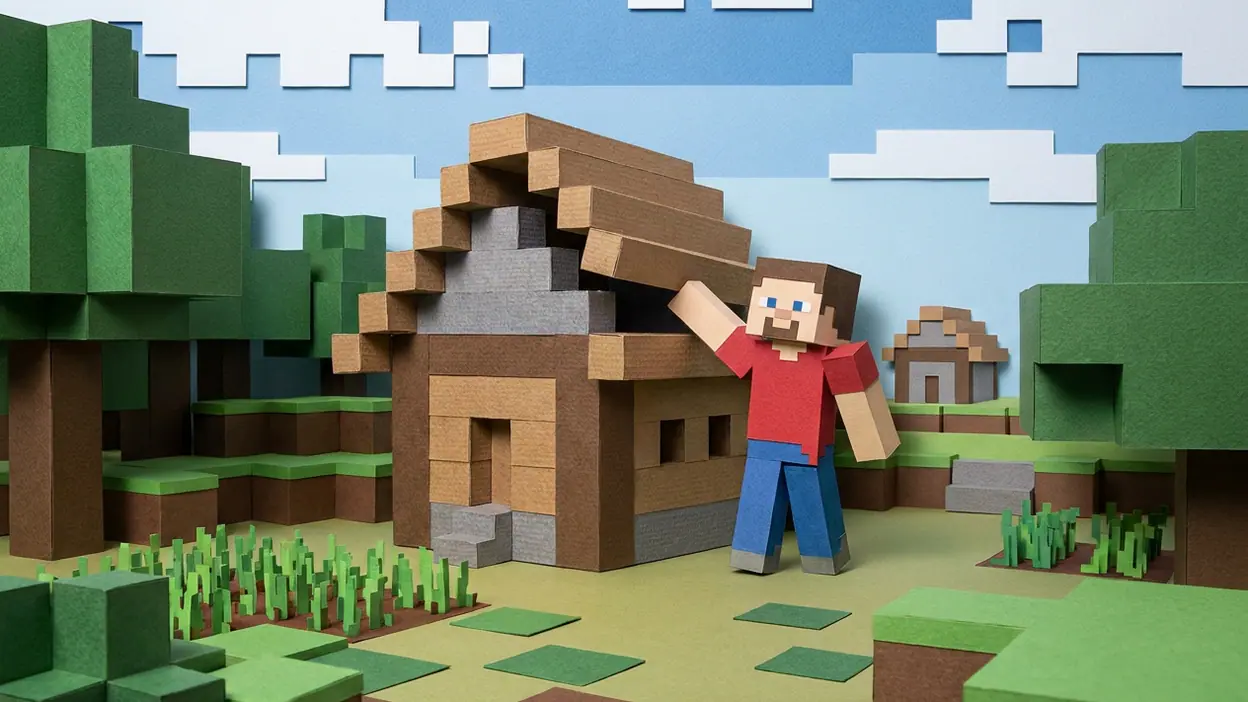
 Article about Craftsman: Building Craft
Craftsman: Building Craft Makes Community a Question of What Players Share
A block-built house is easy to admire on a screenshot. The more revealing question is whether anyone else can enter it, improve it, or remember who made it. Craftsman: Building Craft makes that question central to its appeal: its familiar construction-and-survival format invites players to create a world, but the strength of its community depends on what happens around that world rather than on building alone. That distinction matters, because the game’s social promise is easier to imagine than to verify.
A world built for participation, with limits
The basic rhythm is tactile and open-ended. Gather materials, place blocks, shape a shelter, and keep extending the landscape until a rough plan becomes a home, farm, tower, or improvised fortress. The pleasure comes from visible progress: a few materials turn into walls; walls acquire a roof; the empty patch of terrain starts to feel claimed. Unlike a quiz or a competitive round in UNO!™, a construction project does not naturally end when the match does. It can become a personal routine, and, if shared play is available in the version a player uses, a reason to return with someone else.
That “if” is important. Craftsman is commonly presented as a Minecraft-style building game, and its block-based language makes collaborative play easy to picture. But features, connection options, and player populations can vary by release and platform. I would not treat a particular multiplayer setup, public server scene, or sharing system as guaranteed without checking the current version. The safest description is that the game supplies the raw materials for community: a flexible building space, recognizable goals, and creations that are naturally easy to discuss. It does not automatically supply a durable social network.
The participation model starts with making rather than talking. A player can contribute by building something useful, making a structure look distinctive, or finding a clever way to use limited resources. That is a welcoming threshold: newcomers do not need a high score, a rare collection, or an expert grasp of competitive rules before they can leave a mark. The world itself becomes the record of effort. A well-placed path or a shared shelter can communicate more than a profile badge.
It also makes participation uneven by design. One player may spend an evening gathering and building; another may prefer to roam, test survival, or simply borrow ideas from what they see. In a group, that can create a satisfying division of labor. It can also make a less experienced player feel like a helper in someone else’s project. Craftsman gives players room to invent roles, but it does not appear to formalize them with team jobs, contribution tracking, or community milestones. Cooperation has to be negotiated socially.
For newcomers, the entry point is refreshingly legible. Blocks behave as building pieces, and the first useful goal can be modest: find resources, make a place to shelter, and add one feature that feels personal. There is no need to understand a deep social etiquette before starting. The challenge is that an open canvas can be intimidating once the beginner’s shelter is complete. A game with a strong community often solves that next-step problem through public examples, guided challenges, or an easy route to other players’ work. Craftsman’s core loop can inspire those habits, but the available information does not establish how consistently its current edition supports discovery or showcasing.
That gap shapes the game’s recurring rituals. The most natural ones are self-made: returning to finish a roof, expanding a farm, rebuilding after a mishap, or showing a friend the latest addition. Those small acts create a pleasing cadence, especially for players who like progress they can see at a glance. By contrast, there is less reason to assume the game has a dependable calendar of community events, creator contests, or seasonal traditions. Without verified, recurring shared occasions, the ritual belongs first to the player’s own world.
There is still room for a creator culture to grow around that loop. Compact builds, before-and-after transformations, resource-efficient designs, and playful experiments all make good material for a screenshot or short clip. The block aesthetic is readable even to someone who has never opened the game, so a build can travel beyond its original session as an image or video. That is a real kind of contribution, though it is not the same as an in-game gallery or a searchable library. Whether players can publish creations directly, browse them, or reliably visit one another’s worlds should be checked in the current release rather than assumed.
That distinction also separates Craftsman from games whose social layer is built around a clearly defined repeatable contest. Plants vs. Zombies™ gives players a shared strategic vocabulary through its lanes and defenses; Tiles Hop Music & Ball Game turns performance into an immediately legible score. Craftsman’s equivalent is harder to measure. A build can be impressive because it is beautiful, useful, funny, or simply ambitious, and the game does not need to declare a winner for that work to matter. The upside is creative freedom. The downside is that recognition may depend on outside sharing or on a group already motivated to look.
Social friction follows from that openness. If players share a space, disagreements can arise over who owns a plot, whether a structure should be changed, or how much risk is acceptable during survival play. Even friendly groups need a basic understanding of permissions and expectations. In a public setting, griefing, unwanted destruction, or simply incompatible play styles can undermine the pleasure of a carefully built world. These are familiar problems in sandbox games, not evidence that they are happening in every Craftsman session. They are reasons to be cautious about treating shared access as automatically safe or harmonious.
Moderation is therefore a key unknown, not a detail to wave away. Players and parents should check the current app listing and in-game settings for the version they install: whether multiplayer is present, how access is controlled, whether communication is available, and what blocking or reporting tools exist. I cannot verify a consistent moderation system or a reliable public-community framework across editions, so I would not promise those protections. For younger players in particular, private play or a trusted group is a more prudent default than assuming any open connection is supervised.
The network value of Craftsman appears most clearly at a smaller scale. A friend’s practical design can save time; a shared project can turn resource gathering into teamwork; a build shown outside the game can give another player an idea to adapt. In each case, another person adds context to an activity that can otherwise be solitary. The value is not a huge audience or a formal ranking ladder. It is the little exchange between “I made this” and “let’s add something.” If the current version makes visiting or co-building straightforward, that exchange can be a powerful reason to return.
Whether that ecosystem lasts depends on more than creative freedom. It needs convenient ways to find people and their work, reliable access to shared spaces, clear boundaries, and enough fresh reasons to build after the first ambitious project is finished. A player-made tradition can thrive without official events, but it is harder to sustain when creations are difficult to discover or when every group has to invent its own safety rules. The game’s simple visual language and low barrier to construction are good foundations; they are not substitutes for tools that connect players over time.
My verdict is that Craftsman: Building Craft is best understood as a social canvas, not a proven social platform. Its strongest community potential grows from the act of making: a shelter becomes a project, a project becomes a shared memory, and a finished build can travel as inspiration. But the evidence for public discovery, stable multiplayer rituals, creator infrastructure, and moderation is too uncertain to treat that potential as a guaranteed feature. If you enjoy building at your own pace, or can bring trusted friends into the experience where your version allows it, the game has room for meaningful cooperation. If you want a lively, well-organized community waiting inside the app, check the current edition carefully before expecting one. The blocks invite people in; the lasting community still has to be built.


