

 Article about Tic Tac Toe - 2 Player XO
Tic Tac Toe - 2 Player XO Turns Spare Moments Into Brief Encounters
A round of tic-tac-toe can end in less time than it takes to agree who goes first. That speed is the real social design of Tic Tac Toe - 2 Player XO: it turns a spare moment into a tiny contest between two people, without asking either to build a profile, learn a world, or join a persistent club. Its community is therefore less like a bustling online game and more like a chain of brief encounters. That is both its appeal and its ceiling.
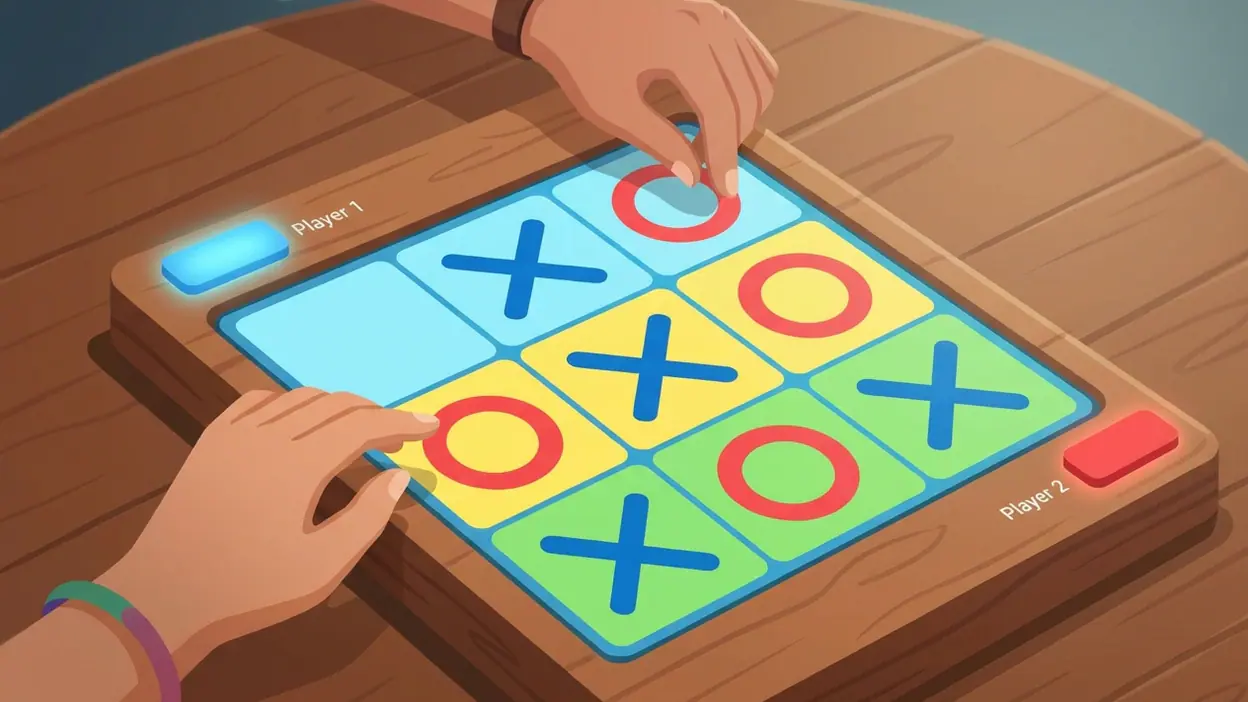
The game’s familiar three-by-three grid makes the invitation almost frictionless. One person places an X, the other an O, and each move changes the possibilities for both. A win is satisfying because it is immediate; a draw still carries the quiet accusation that someone missed a threat. The basic loop is old, but the social rhythm remains sharp: challenge, read the other player, block or risk, then reset. The question is not whether the game can generate conversation. It can. The question is how much of that conversation belongs to the game rather than to the people already there.
A community built from the next move
The participation model is unusually direct. In a two-player format, the main contribution is playing a turn. There is no need to master a long tutorial or prove competence before joining in. A newcomer can understand the board at a glance, while a returning player can begin a rematch without recovering a complicated strategy. That makes the game especially suited to passing a device between friends, siblings, classmates, or anyone sharing a short wait.
This is a different kind of togetherness from the asynchronous crowds around Trivia Crack: Brain Quiz Games or the shared match culture of UNO!™. Those games can give players more material to discuss, compare, and revisit beyond one hand or question. Here, the board itself is the whole meeting place. Its small scale can make a face-to-face exchange feel unusually focused, but it gives strangers little to hold on to once the match ends.
Newcomers enter through recognition rather than discovery. Most people already know the rules, even if they have not played in years, and the grid explains the rest. There is no social identity to assemble before taking part and no large collection of mechanics to absorb. That accessibility is a genuine strength: a less experienced player can compete immediately, and the first few turns usually reveal how cautious or aggressive the opponent is.
But easy entry should not be mistaken for a guided community welcome. Without a substantial onboarding path, a newcomer may learn how to place marks but not what the game provides beyond a quick match. If the app’s available play options or online features vary by version, region, or update, those details need to be checked in the installed build rather than assumed. The dependable point is simpler: the core game asks very little of a new player, and that is enough to get a casual round going.
The recurring ritual is the rematch. Someone wins, someone claims the other was lucky, and the grid resets before the complaint has fully landed. Playing a best-of-three series gives the encounter a shape that a single round lacks. Players can trade first moves, test whether the same opening still works, or simply keep going until one of them has to leave. These rituals are not elaborate, but they create a small sense of continuity: the next game is a reply to the last one.
There is also a natural ritual of teaching. A stronger player can point out that taking the center changes the board, or show how two threats can force a win. Yet tic-tac-toe has a low strategic ceiling. Once both players know the basic defensive patterns, perfect or near-perfect play tends toward a draw. That creates a curious social bargain: the game is easy enough to teach in a minute, but it may stop surprising experienced opponents soon after. The fun then depends less on discovering new strategy and more on joking, speeding up, or making the rematch personal.
Player contribution is correspondingly modest. In games with levels, user-made content, or elaborate customization, creators can extend the experience by giving the community new things to explore. This game’s central object is a fixed board and a fixed set of rules. Players contribute through their play style, informal house rules, and the stories attached to a rivalry, rather than by reshaping the game itself. It would be misleading to claim a visible creator scene or a robust sharing culture without evidence of those features in the version being reviewed.
Still, small contributions matter in a two-person game. A player might insist on alternating who starts, agree to a speed round, or keep score across several matches. Those choices turn a disposable puzzle into a shared activity. They also travel easily: the rules can be explained aloud, and a memorable match can be retold without a clip, screenshot, or account link. The community’s creative work is mostly social improvisation, not publishing.
That simplicity also leaves room for friction. The most obvious dispute is the familiar one: who won, whether a move was made, or whether someone touched the board before the other person was ready. In a shared-device setting, these are minor and usually easy to settle. In remote play, if available, connection delays or unclear turn states can make a tiny game feel more contentious than it deserves. There is no deep team structure to absorb disagreement; each player is directly responsible for the next move, and each mistake is visible.
Competition can become stale, too. A tactical game that reaches a draw repeatedly may stop feeling like a contest and start feeling like a test of patience. Players can invent informal stakes, but the app cannot guarantee that both people want the same kind of match. One may be practising; the other may only want to fill a minute. That mismatch is not a design failure so much as a limit of the format, though it makes the game better as a flexible social tool than as a serious competitive destination.
Moderation and safety are harder to assess from the board alone. A game centered on brief two-player rounds has fewer obvious channels for public discussion than a large multiplayer hub, but that does not prove that every version lacks chat, invitations, accounts, or other social features. Their presence and safeguards should be verified in the current app rather than inferred from the title. Parents and players should check the actual permissions and interaction options on their device, especially before enabling online contact. A tiny game can have a small social surface, but small is not the same as automatically safe.
Network value appears most clearly in proximity. If two people share a room, the app gives them a common activity with almost no setup. It can bridge a lull in conversation, occupy a short queue, or let a child challenge an adult on equal terms. The device is merely the board; the relationship supplies the stakes. That is a meaningful form of network value, even if it does not produce a large public community or a lasting trail of player activity.
Compared with Plants vs. Zombies™, which gives players a broader world to revisit, or Tiles Hop Music & Ball Game, where rhythm and personal performance shape the loop, Tic Tac Toe - 2 Player XO has little to sustain solo engagement over long sessions. Its strongest use case is another person’s presence. Remove that person, and the familiar puzzle remains, but the game loses much of its social charge. The distinction matters: this is not a community platform that happens to include a game; it is a simple game that becomes social when someone accepts the invitation.
Can that ecosystem last? It can last as a recurring habit between particular people, because the barrier to returning is almost zero. A quick rematch does not demand a schedule, a seasonal update, or a shared investment in progression. But the broader ecosystem is unlikely to deepen on the strength of the grid alone. The rules do not generate much new content, and once players know the strongest responses, novelty depends on the company and the circumstances.
The best way to judge Tic Tac Toe - 2 Player XO is not by asking whether it can gather a crowd. Its value lies in making participation immediate and mutual: one person moves, the other answers, and both know exactly when the round is over. That is a clean, useful social loop, not a sprawling community. For quick face-to-face competition and low-pressure rematches, the game earns its place. For persistent friendships, creator activity, or deep competitive play, it asks the board to do more than a board can. Its community verdict is modest but positive: a reliable excuse to play together, provided together is already within reach.


