

 Article about Block Blast!
Block Blast! Turns Three Pieces Into a Test of Foresight
The most important decision in Block Blast! happens before a block touches the board: you have to decide what not to place yet. Three shapes sit in the tray, each waiting for a home on the 8-by-8 grid. Fill a row or column and it disappears; run out of room for the pieces in hand and the round ends. That small queue is the game’s real engine. It turns a familiar block puzzle into a chain of short-term commitments, where the clever move is often the one that preserves options.
This is why the game can feel calm and tense at the same time. There is no clock pushing your thumb, no opponent to blame, and no complicated rulebook to learn. Yet a square left open in the wrong corner can become a problem several turns later. Block Blast! is at its best when the board looks manageable but the next three shapes demand three different kinds of space.
Three pieces, one board, a growing set of consequences
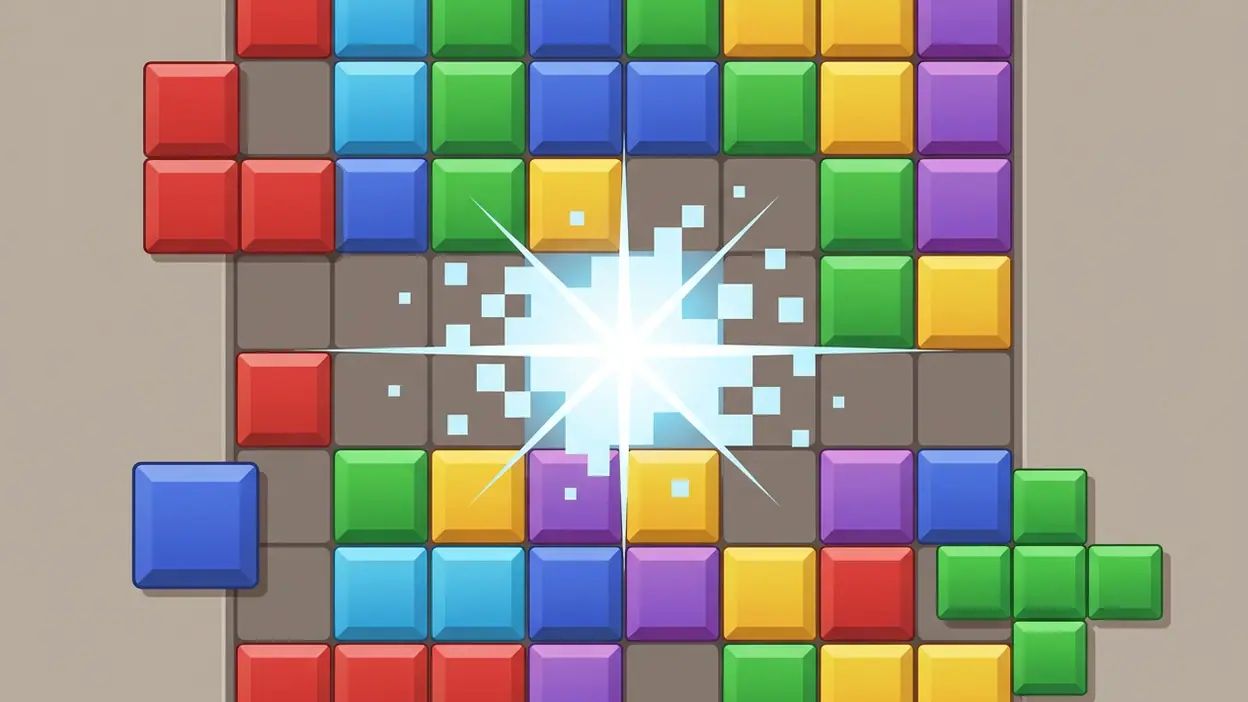
The core routine is straightforward. The game gives you a set of three shapes, usually built from chunky squares, and you drag them onto the grid. Complete a full horizontal or vertical line to clear it and make room. You generally need to place all three pieces before the next set arrives, and the round continues until the board can no longer accommodate the available shapes.
That final condition is what gives the queue its bite. A piece that cannot fit right now is not automatically a problem if the other shapes can open space. But the game does not let you discard an awkward shape and try another. You have to work with the hand you have, deciding which piece belongs first and which spaces must stay usable for the rest.
The shapes are familiar enough to read instantly: compact squares, long bars, L-shaped pieces and larger clusters. Their simplicity keeps the puzzle legible even on a small screen. The board is the whole stage, so your attention goes to gaps, edges and the increasingly irregular outline of the empty cells. There is no map to study or collection of abilities to manage; the puzzle is contained in the relationship between the pieces and the space left behind.
Clearing a line is both a reward and a planning tool. A row disappearing can create a broad landing strip, but it can also tempt you to chase a quick clear when a more useful placement would keep a corner open. Because the next shapes are visible together, you have enough information to plan a few moves ahead, but not enough to calculate the entire round. The result is a puzzle with a clear horizon and an uncertain future.
Why the queue matters more than its size suggests
Three pieces might sound like a modest amount of information. In practice, it is just enough to make every turn feel like a small scheduling problem. You are not simply asking, “Where does this shape fit?” You are asking, “Where does it fit without making the other two impossible, and what kind of space will I need after they are gone?”
That change in question is the difference between casual placement and actual planning. A neat move can be bad if it seals off the only space for a long bar. A placement that looks awkward can be smart if it completes a line and clears the exact cells needed for the next piece. The game rewards keeping the board flexible, not just making it look tidy.
It also gives mistakes a useful shape. When the board becomes crowded, you can often trace the trouble back to a decision several turns earlier: a hole left under a block, an edge filled too soon, or a line clear pursued without considering the remaining tray. That hindsight makes failure sting, but it also makes another round tempting. You can usually name the moment you would handle differently.
The best place for a quick round
The game’s strongest real-world fit is a short break in which you have enough attention to think but not enough time to enter a larger game. A commute, a wait for food, or a quiet few minutes between tasks suits it better than a long session that demands uninterrupted focus. A round starts immediately, and the board communicates its state without a tutorial or a narrative setup.
In that setting, the three-piece queue is especially effective. It gives each turn a natural stopping point: place the current shapes, assess the new set, and decide whether you have time for another stretch. The pace is self-directed. You can move quickly when the board is open, then pause when a difficult combination arrives. The game never insists that you react within a countdown.
That freedom also makes the puzzle easy to return to. The rules remain in your hands even if you have not played for a day, and the challenge comes from the board in front of you rather than from remembering a story or a complicated build. Its replay value is less about discovering new content than about testing whether you can keep a crowded grid alive for longer this time.
How it changes the way you play
After a few rounds, the obvious habit is to stop treating empty cells as interchangeable. A large open patch is useful, but so are narrow corridors and clean corners. You begin to notice which shapes are most restrictive and protect the spaces they need. A long bar can be awkward if the board is chopped into little islands; a compact piece can often be tucked into a gap that would otherwise become dead space.
The queue also encourages a more patient kind of play. Completing a line feels satisfying, and the animation makes the cleared space easy to read, but the best move is not always the one that clears immediately. Sometimes you place a piece to preserve a future landing spot, accepting a messier board now in exchange for room to maneuver later. That quiet restraint is the game’s most interesting skill test.
There is a limit to how far ahead you can plan. New shapes arrive after the current set is used, and you cannot know exactly what the next hand will demand. So the goal is not to solve the board several rounds in advance. It is to avoid creating a position that only one very specific piece can rescue. In other words, good play is less about predicting the future than leaving yourself more than one future.
Where the design gets the small things right
Block Blast! communicates through touch and shape with little fuss. Pieces are large enough to distinguish at a glance, the square grid makes placement easy to judge, and line clears provide immediate feedback. When a piece fits, the board confirms the choice; when a row or column disappears, the payoff is visually direct. That clarity matters in a game built around tiny spatial judgments.
The absence of a timer is more than a comfort feature. It gives the queue room to do its work. If the game rushed every placement, the challenge would shift from planning to speed, and the careful balancing of the three shapes would matter less. Here, you can inspect the board, reconsider a position and drag a piece deliberately. The pressure comes from limited space, not from a countdown.
The sound and visual effects add a pleasant sense of completion to clears without obscuring the puzzle. Still, the core loop is intentionally narrow. There is no elaborate progression system needed to make the next round appealing; the board itself supplies a fresh arrangement. That restraint is part of the appeal, although it means players looking for new mechanics or a strong sense of campaign advancement may find the game samey over time.
Where the formula still falls short
The same randomness that keeps rounds fresh can make some losses feel less like a clean test of judgment. A cramped board paired with an inconvenient set of shapes may leave little room to recover, even if you have played carefully. You can reduce the odds of that happening by protecting flexible space, but you cannot control the next draw. The game sometimes asks you to live with a bad hand rather than offering a clever escape.
Its simple rules also put a ceiling on discovery. The first sessions teach you to protect corners, avoid isolated holes and consider the whole tray. Those lessons are satisfying, but the game does not keep adding layers at the same pace. If you want a puzzle that introduces new systems as you progress, the steady focus on block placement may eventually feel repetitive. The loop is sticky, but it is not especially deep in variety.
There is also a tension between playing for a personal best and playing casually. Chasing a longer run can encourage cautious, deliberate placement, which is rewarding, but it can turn a breezy break into a prolonged argument with every square. The no-timer design lets you set your own tempo; it does not automatically make every session relaxing.
What other mobile games do differently
Other games in the broader mobile mix illustrate what this design chooses not to do. Hill Climb Racing builds momentum through driving, terrain and near-misses; its tension is physical and continuous. Free Fire: 9th Anniversary centers on competition and survival, while Hair Dye leans on quick visual transformations. These games can fill a short session, but their hooks rely on action, spectacle or a visible before-and-after result.
Word puzzles such as Crossword Crush ask players to search for language patterns rather than manage a shrinking field of space. That contrast helps explain the appeal of Block Blast!: it makes the board itself the resource. There is no rival to outplay and no answer to uncover. You are managing your own future room, one placement at a time.
That focus is also its trade-off. A game with missions, characters or changing modes can refresh its rhythm by changing the task. Block Blast! largely asks the same question again, with new shapes and a new arrangement. For players who enjoy refining a repeatable skill, that consistency is a strength. For players who need novelty to stay engaged, the alternatives may have more to offer.
Who will get the most from it
The ideal player enjoys spatial organization and does not mind a little uncertainty. You do not need puzzle-game expertise, but you should like weighing a tidy immediate move against a flexible position later. It also suits anyone who wants a game that can be understood at a glance, paused between moves and resumed without rebuilding context.
It is less compelling for someone who wants a strong narrative, a changing roster of mechanics or a competitive reason to keep playing. The challenge is personal and self-contained. A long run feels good because you kept the board under control, not because you unlocked a new world or defeated another player. That gives the game a clean identity, but it asks you to enjoy repetition on its own terms.
The three-piece queue is the feature that earns Block Blast! its staying power. It gives a simple grid enough uncertainty to demand judgment, while keeping the rules light enough for a spare few minutes. The game is not endlessly varied, and an awkward draw can end a promising round, but its best decisions are genuinely satisfying: preserve space, think across the whole hand, and resist the urge to clear a line just because you can.
Block Blast! works because every turn makes the next one matter. It turns empty cells into options, careless placements into consequences and a handful of shapes into a small, readable strategy problem. If that is the kind of challenge you want from a mobile puzzle, it is easy to see why one quick round so often becomes another.


